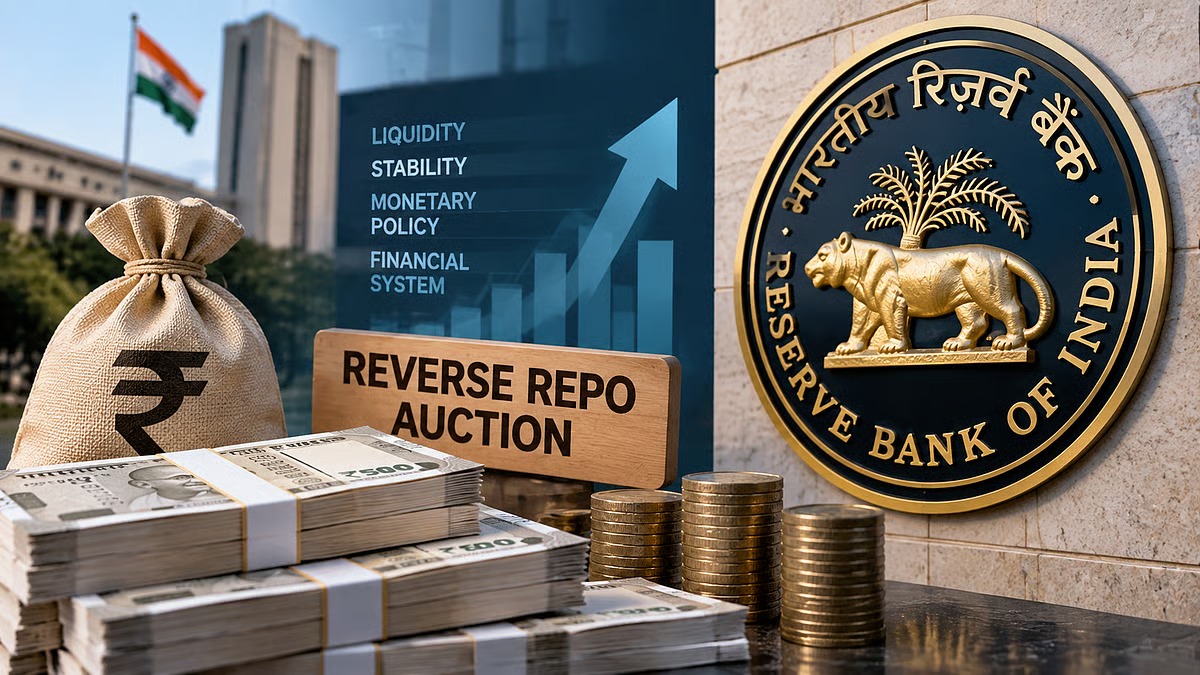
The Reserve Bank of India scheduled an overnight variable rate reverse repo auction to absorb 5 trillion rupees from the banking system on September 9, 2026. The liquidity management operation aims to neutralize surplus cash and maintain short-term money market rates in line with the central bank's monetary policy framework.
The Reserve Bank of India scheduled an overnight variable rate reverse repo auction to absorb 5 trillion rupees from the banking system.
The Reserve Bank of India (RBI) announced that it will conduct an overnight variable rate reverse repo (VRRR) auction to absorb up to 5 trillion rupees from the domestic banking system on September 9, 2026. Disclosed through official central bank notifications, the liquidity-absorption operation comes in response to significant surplus cash conditions driven by recent foreign-currency inflows. The central bank's intervention is designed to align short-term money market rates closely with the established policy repo rate and maintain monetary stability across the financial sector.
Managing Banking System Liquidity and Short-Term Rates
According to official releases from the Reserve Bank of India, the overnight VRRR auction will be executed under the Liquidity Adjustment Facility (LAF), with funds reversal scheduled for the following business day. Recent market data indicates that the banking system has experienced robust surplus liquidity, which has occasionally pushed short-term rates below the central bank's policy benchmark.
Financial analysts and market observers note that large-scale VRRR operations allow the apex bank to temporarily remove excess short-term liquidity without altering fundamental policy rates. By utilizing variable rate reverse repo auctions, the RBI ensures that weighted average call-money rates remain anchored near official policy targets, preventing undue downward pressure on short-term borrowing costs.
Implications for Money Markets and Financial Institutions
For commercial banks, corporate treasuries, and institutional investors, the regular deployment of liquidity-absorption tools shapes short-term asset-liability management strategies. While surplus liquidity typically eases funding pressures, excessive cash can distort money market signaling. The central bank's proactive intervention provides a secure, interest-yielding avenue for banks to park excess funds overnight, ensuring orderly conditions across the domestic money market.
Official Sources Section
Details concerning the liquidity operations and auction parameters are based on official press releases, circulars, and notifications issued by the Reserve Bank of India (RBI) under the Liquidity Adjustment Facility framework.
Quote Section
According to officials, the overnight variable rate reverse repo auction is being conducted after a careful assessment of current and evolving liquidity conditions to manage short-term cash flows effectively.
Why It Matters
Absorbing excess short-term liquidity helps the central bank maintain precise control over monetary policy transmission. For financial institutions, predictable liquidity management ensures stable money market rates and balanced credit growth.
Key Facts at a Glance
The Reserve Bank of India scheduled an overnight VRRR auction for 5 trillion rupees on September 9, 2026.
The operation is conducted under the Liquidity Adjustment Facility (LAF) with a one-day tenor.
The initiative aims to mop up excess banking system liquidity driven by recent foreign-currency inflows.
Reversal of the absorbed funds is scheduled to take place on the following business day.
FAQ Section
What is the objective of the RBI's overnight VRRR auction?
The auction aims to temporarily absorb excess liquidity from the banking system and align short-term money market rates with the policy repo rate.
What is the notified amount for the September 9, 2026 auction?
The Reserve Bank of India notified an aggregate amount of 5 trillion rupees for the overnight operation.
Where can financial institutions access official auction results and notifications?
Official auction timings, cut-off rates, and results are published directly on the official website of the Reserve Bank of India.
Source: Reserve Bank of India, National Stock Exchange of India, BSE India