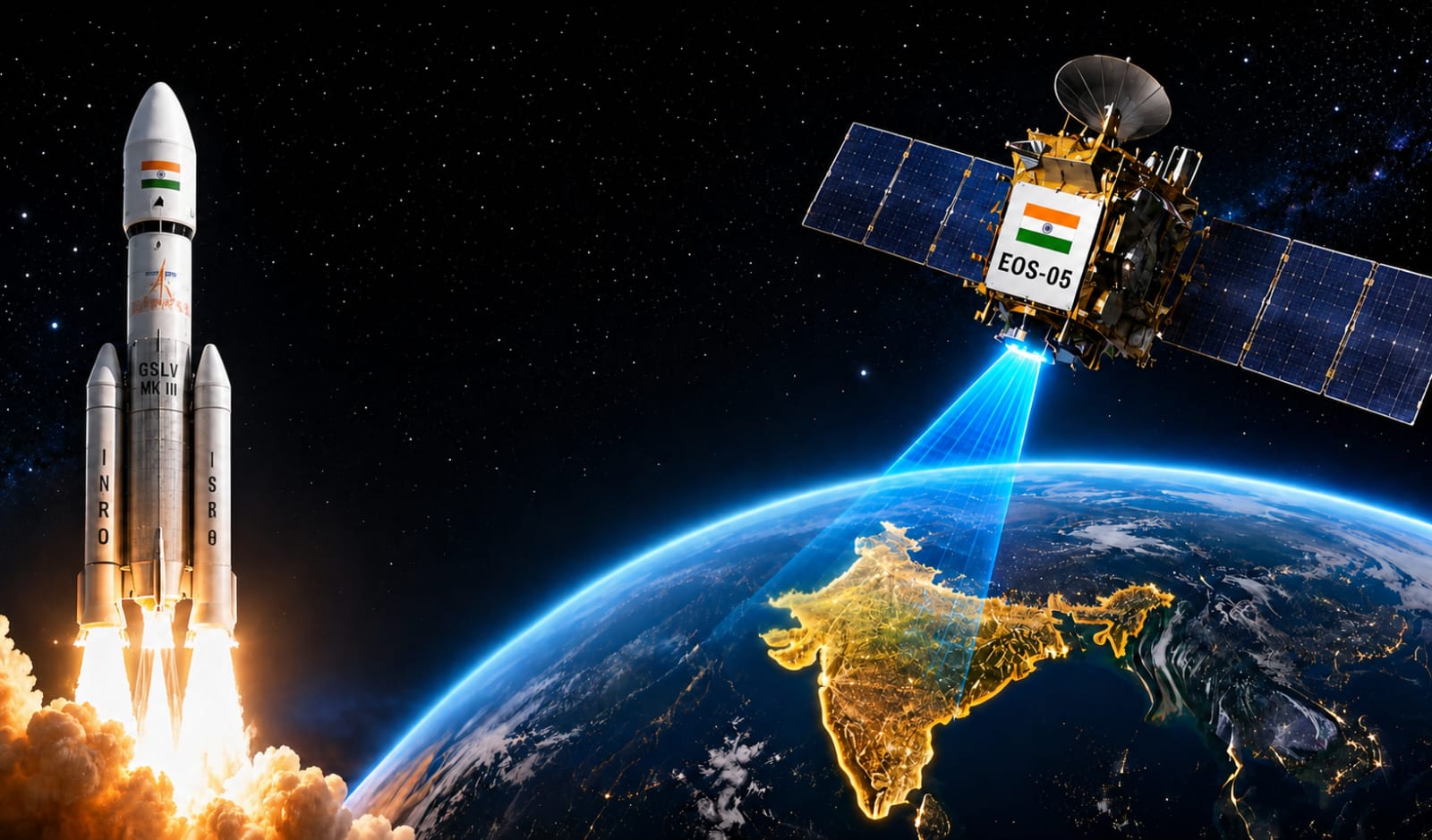
ISRO successfully launched the 2,367-kg EOS-05 Earth observation satellite using the GSLV-F17 rocket from Sriharikota. Dubbed the "eye in the sky," India's first geo-orbit imaging satellite provides continuous monitoring for agriculture and disaster management, restoring vital momentum to the national space program.
SRIHARIKOTA, India — The Indian Space Research Organisation (ISRO) successfully launched the advanced Earth Observation Satellite-05 (EOS-05) aboard the GSLV-F17 rocket from the Satish Dhawan Space Centre in Sriharikota on Friday. Liftoff occurred at 2:55 a.m. local time, and the 2,367-kg spacecraft was precisely injected into its intended sub-geosynchronous transfer orbit 18 minutes later. The milestone achievement marks ISRO's first successful mission of 2026, providing a crucial psychological and operational boost following a challenging streak of launch vehicle setbacks over the preceding eight months.
Technical Architecture and Geo-Orbit Capabilities
According to mission announcements from ISRO, EOS-05 is India's first dedicated imaging satellite placed in a high-altitude geosynchronous orbit, operating approximately 36,000 kilometres above the Earth. Unlike low-earth-orbit satellites that pass rapidly overhead, a geo-orbit platform matches the Earth's rotational speed, allowing continuous monitoring and scanning of the Indian landmass and surrounding regions.
Equipped with a 700mm Ritchey-Chrétien telescope and advanced multi-spectral and hyperspectral detectors across visible, near-infrared, and shortwave-infrared bands, the spacecraft can capture high-resolution imagery every few minutes. This configuration enables near real-time tracking of rapidly evolving weather patterns, natural disasters, and environmental changes.
Restoring Faith in India's Launch Vehicle Reliability
The flawless execution of the GSLV-F17 flight serves as a redemption arc for the Geosynchronous Satellite Launch Vehicle program, which suffered a high-profile failure during the GSLV-F10/EOS-03 mission in August 2021. Furthermore, following consecutive setbacks in polar launch vehicles throughout 2025 and January 2026, the space agency adopted an intensely cautious review process.
By successfully lofting the heaviest payload ever carried by a GSLV into a sub-geosynchronous transfer orbit, ISRO validated structural optimizations, enhanced cryogenic stage reliability, and strengthened manufacturing synergy with domestic industrial partners.
Impact on National Security, Agriculture, and Disaster Response
The operationalization of EOS-05 directly impacts multiple domestic sectors by providing uninterrupted strategic data streams. For disaster management authorities, the satellite offers vital tracking tools for sudden weather phenomena such as cyclones, cloudbursts, floods, and forest fires.
For the agricultural sector, regular multispectral imaging delivers essential metrics for crop health assessment, soil moisture mapping, and forestry management. Additionally, the constant monitoring capability provides security agencies with enhanced situational awareness across national borders.
Official Sources Section
Information regarding launch parameters, mission timelines, and payload specifications is based on official statements and technical press releases issued by the Indian Space Research Organisation (ISRO), updates provided by the Department of Space, and formal remarks from mission directors at the Satish Dhawan Space Centre.
Quote Section
"I am very happy to announce that the GSLV-F17 vehicle has successfully and precisely injected the advanced Earth observation satellite EOS-05 in the intended and required orbit," stated ISRO Chairman Dr. V. Narayanan during the post-launch briefing.
Why It Matters
The success of the EOS-05 mission revitalizes India's civilian and strategic Earth observation roadmap. By establishing a permanent, high-altitude surveillance and meteorological watchtower, ISRO minimizes blind spots in disaster prediction and reinforces national self-reliance in advanced space-based infrastructure.
Key Facts at a Glance
Launch Date: Friday, September 4, 2026.
Rocket & Site: GSLV-F17 launched from the Second Launch Pad at Satish Dhawan Space Centre, Sriharikota.
Payload Weight: 2,367 kg, marking the heaviest satellite ever lifted by a GSLV.
Orbital Target: Geosynchronous orbit at an altitude of approximately 36,000 km.
FAQ Section
What is the primary function of the EOS-05 satellite?
EOS-05 is a high-altitude geo-imaging satellite designed to provide near real-time, continuous monitoring of India for weather forecasting, disaster warning, and agricultural assessment.
Why is this mission considered a major turning point for ISRO?
The successful launch breaks an eight-month mission hiatus and overcomes previous technical setbacks, restoring confidence in India's heavy-lift GSLV program.
How does a geosynchronous earth observation satellite differ from standard ones?
Operating at 36,000 km, the satellite synchronizes with Earth's rotation, allowing it to maintain a constant eye over a specific regional target rather than making brief, transient passes.
What was the rocket used for the EOS-05 deployment?
The satellite was carried by the Geosynchronous Satellite Launch Vehicle (GSLV-F17) on its 19th flight.
Source: Indian Space Research Organisation (ISRO), The Hindu, LiveMint, ANI News