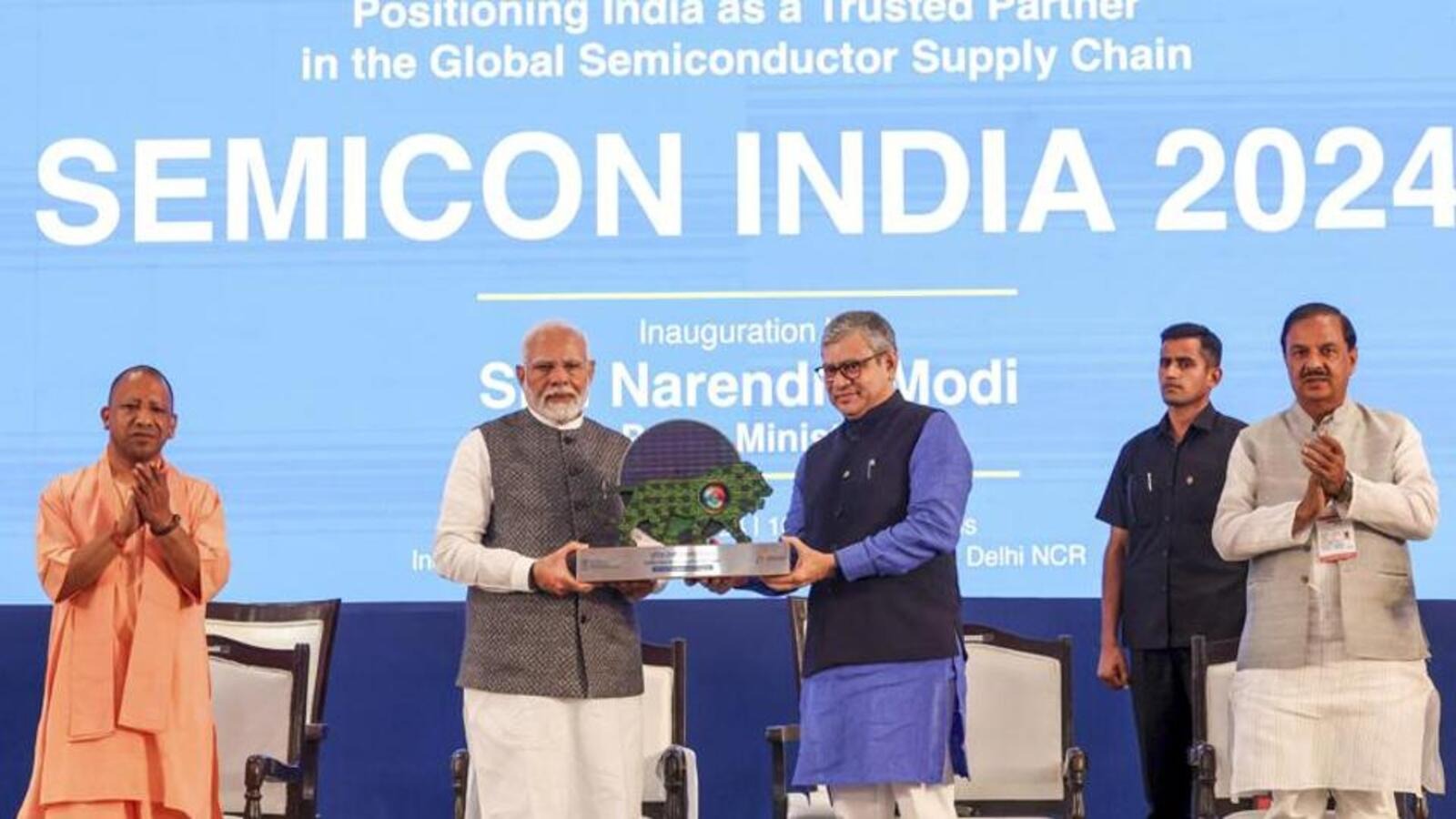
Union Minister for Electronics and Information Technology Ashwini Vaishnaw stated that India's chip manufacturing strategy has transitioned from policy blueprints to execution, with 12 semiconductor units representing around USD 20 billion in investments. Three facilities have already commenced commercial production, he emphasized that the newly approved Semicon 2.0 framework will drive domestic chip design, advanced packaging, and supply chain self-reliance.
Union Minister Ashwini Vaishnaw announced that India's semiconductor manufacturing ecosystem has reached 12 approved units with USD 20 billion in investments, positioning the nation for its next growth phase under Semicon 2.0.
Growth of India's Semiconductor Manufacturing Ecosystem
The national semiconductor landscape has expanded significantly since the rollout of the initial Semicon India initiative in 2022. According to updates shared by Union Minister Ashwini Vaishnaw, structured policy implementation and robust execution have successfully attracted 12 dedicated semiconductor units across the country, securing approximately USD 20 billion in cumulative investments.
Out of these approved projects, three facilities have already commenced active chip manufacturing. This milestone marks a critical structural shift from initial government approvals to physical assembly, testing, and fabrication. The overarching initiative aims to insulate India's domestic supply chains from international vulnerabilities, ensuring steady components access for automobiles, telecommunications, consumer electronics, and strategic defense systems.
Transitioning to Semicon 2.0 and Comprehensive Ecosystem Support
Building upon the foundations of the first phase, the Union Cabinet approved the rollout of Semicon 2.0 with a substantial financial outlay to broaden the domestic value chain. The second phase focuses heavily on six core pillars: indigenous chip design, specialized manufacturing equipment, raw materials, fabrication plants, advanced packaging (ATMP-OSAT), and rigorous research and development.
Government policy frameworks are designed to foster indigenous intellectual property, allowing critical system-level chips to be conceptualized and designed entirely within India. Furthermore, international partnerships established with global economies—including the United States, Japan, the European Union, the Netherlands, Singapore, and Germany—are projected to catalyze further capital inflows under the expanded phase.
Official Statements and Ministerial Attribution
According to official announcements and statements released by Union Minister Ashwini Vaishnaw, the administration evaluated historical roadblocks from past decades to construct a predictable, execution-focused policy environment.
"Organizers stated that under the Semicon 2.0 programme, the focus extends beyond building traditional fabrication facilities to encompass comprehensive supply chain resilience, material sourcing, and domestic design leadership."
Government regulatory filings confirm that the strategy relies on seamless collaboration between central authorities, global technology developers, and private sector consortiums to establish long-term economic viability.
Practical Implications for Businesses, Investors, and Consumers
The acceleration of India's semiconductor sector carries broad structural consequences across multiple economic sectors:
Automotive & Electronics Industries: Localized chip production mitigates vulnerability to overseas supply chain disruptions, ensuring steady production lines for vehicles and smart devices.
Global Investors: The structured financial incentives and multi-pillared support framework under Semicon 2.0 provide long-term regulatory clarity for capital allocation.
Technology Professionals & Students: Expanded research and design hubs create specialized engineering roles, fostering domestic talent in high-end semiconductor design.
Key Facts at a Glance
Total Approved Units: 12 semiconductor manufacturing and packaging units.
Capital Inflow: Approximately USD 20 billion in cumulative investments.
Operational Milestone: 3 semiconductor units have already commenced active chip production.
Next-Phase Policy: Approval of Semicon 2.0 to scale design capabilities, advanced packaging, and material ecosystems.
Frequently Asked Questions (FAQ)
How many semiconductor units are currently established in India?
India currently has 12 approved semiconductor units involving an investment of around USD 20 billion.
How many of these semiconductor units have started production?
According to official disclosures, three of the approved semiconductor units have already begun manufacturing chips.
What is the objective of Semicon 2.0?
Semicon 2.0 aims to expand India's capabilities beyond basic manufacturing by focusing on indigenous chip design, advanced packaging, fabrication equipment, research and development, and raw material supply chains.
Which industries benefit most from domestic semiconductor production?
Automobiles, smartphones, telecommunications infrastructure, consumer electronics, and defense systems rely heavily on locally fabricated semiconductor chips.
Source: