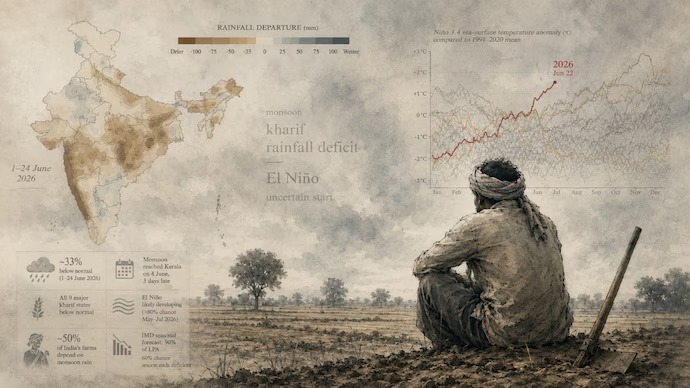
India’s 2026 southwest monsoon is experiencing a critical rainfall deficit of 38% by mid-June, driven by El Niño and unfavorable wind patterns. With central and northwest India facing the worst impact, experts warn that delayed sowing in 315 vulnerable districts poses a significant threat to national food security and farmer incomes.
India’s critical southwest monsoon is facing a severe test in 2026, with the India Meteorological Department (IMD) reporting a countrywide rainfall deficit of 38% for the period between June 1 and June 17. The sluggish progress of the season, which accounts for nearly 75% of the country’s annual rainfall, has triggered widespread alarm among meteorologists, policymakers, and the millions of farmers whose livelihoods depend on the timely arrival and distribution of rains.
The monsoon, which recorded a delayed onset over Kerala on June 4, hit a significant pause shortly thereafter. By mid-June, while coastal and northeast regions saw some relief, the core agricultural heartland—central and northwest India—remained largely parched, creating a "drought-like" atmosphere that has disrupted the sowing of critical Kharif crops such as rice, soybeans, and cotton.
A Perfect Storm of Weather Factors
Meteorologists attribute this stalling pattern to a rare convergence of five rain-suppressing climate factors. The India Meteorological Department (IMD) and climate researchers point to developing El Niño conditions, weak Madden-Julian Oscillation (MJO) activity, dry westerly winds, a weak Somali Jet, and a neutral Indian Ocean Dipole (IOD) as the primary culprits.
"The core monsoon zone is not receiving the necessary convergence of moisture-laden winds from the Arabian Sea or the Bay of Bengal," noted an expert tracking the seasonal progress. The continued presence of the subtropical westerly jet stream over northwest India has further suppressed the monsoon's advance, leaving vast stretches of farmland waiting for moisture.
Impact on Kharif Sowing and Rural Economy
With nearly half of India’s farmland lacking assured irrigation, the stakes for the 2026 Kharif season are exceptionally high. The Ministry of Agriculture has already identified 315 vulnerable districts across states including Maharashtra, Madhya Pradesh, Karnataka, and Bihar, classifying 111 of these as "high-priority" areas with less than 25% irrigation coverage.
For farmers, the delay is not merely a logistical challenge; it is a financial one. As the optimal sowing window narrows, many are forced to delay planting or pivot to lower-yielding, drought-resistant crops. Agriculture specialists warn that if the deficit persists, it could lead to reduced national output, elevated food prices, and a strain on rural wages.
Official Outlook and Mitigation Strategies
In response, the central government has initiated a comprehensive contingency strategy. According to official government releases, states have been instructed to prioritize water conservation, repair farm ponds, and promote climate-resilient farming practices such as the use of short-duration crop varieties and micro-irrigation systems.
"According to officials, the government is closely monitoring the situation in the 111 high-risk districts and is working to ensure that farmers receive timely weather advisories and resources, including drought-tolerant seed kits, to mitigate the impact of the ongoing dry spell."
Why It Matters
A prolonged weak monsoon has repercussions that ripple far beyond rural fields. It affects reservoir levels—which are essential for both drinking water and hydropower generation—and significantly influences India’s inflation trajectory. Given India’s role as a major global producer of staples like rice and sugar, a poor monsoon could also prompt the government to implement export restrictions to protect domestic supply, impacting global markets.
Key Facts at a Glance
Rainfall Deficit: India recorded a 38% countrywide rainfall deficit between June 1 and June 17, 2026.
Regional Impact: Central India has been hit hardest, facing a 62% deficit compared to the long-period average.
Vulnerability: 111 districts have been labeled "high-priority" due to low irrigation coverage (under 25%).
Primary Drivers: A combination of strong El Niño conditions, weak Somali Jet, and neutral Indian Ocean Dipole.
IMD Forecast: The monsoon seasonal rainfall for the country as a whole is likely to be 90% of the Long Period Average (LPA).
Frequently Asked Questions (FAQ)
1. Why is the 2026 monsoon considered "weak"?
The monsoon is labeled weak because of a significant delay in its onset and a lack of consistent, widespread rainfall across the core agricultural regions, resulting in a rainfall deficit that has reached nearly 40% in June.
2. How does El Niño affect India’s rainfall?
El Niño involves the warming of the Pacific Ocean, which historically disrupts global wind patterns and shifts rain-producing zones away from South Asia, typically leading to drier, warmer monsoon seasons in India.
3. What crops are most at risk?
The Kharif crops sown between June and October—specifically rice, soybeans, pulses, cotton, and groundnuts—are the most dependent on monsoon rains and face the highest risks from delayed sowing.
4. What steps can farmers take in rainfed areas?
Farmers are being advised to utilize drought-tolerant crop varieties, practice soil-moisture conservation like mulching, and shift toward water-efficient crops such as millets, pulses, and oilseeds where sowing is delayed.
Source: India Meteorological Department (IMD), Press Information Bureau (PIB), Down To Earth, BigHaat Agriculture Research