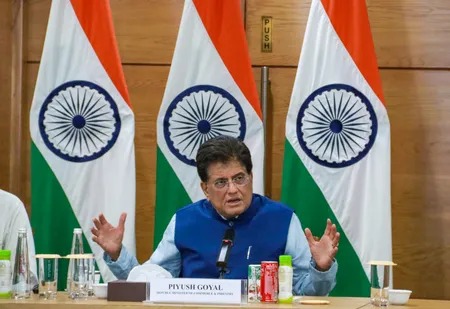
Minister Piyush Goyal has called on Indian entrepreneurs to treat "Made in India" as a symbol of national pride and quality. By focusing on indigenous design and manufacturing excellence, India aims to strengthen its global economic position, reduce import dependence, and achieve ambitious export targets while supporting domestic industry growth.
Union Commerce and Industry Minister Piyush Goyal emphasizes that quality control is a vital pillar of the nation's global economic ambitions.
Goyal Calls for Quality Over Labeling in Global Trade
Union Commerce and Industry Minister Piyush Goyal has urged Indian entrepreneurs to view the "Made in India" label as a profound national responsibility rather than a mere commercial tag. Speaking on June 27, 2026, the Minister emphasized that every product manufactured within the country serves as a reflection of India’s global reputation and national pride.
In a statement addressing the domestic manufacturing sector, Goyal highlighted that quality control must transcend corporate metrics. He noted that as India strengthens its global trade corridors—including critical ongoing discussions for Free Trade Agreements (FTAs) and bilateral partnerships—the "Made in India" stamp must become synonymous with trust, excellence, and consistency on the international stage.
Elevating the "Brand India" Standard
The Minister’s remarks come at a time when India is aggressively pursuing a target of $2 trillion in exports over the next five years. To achieve this, the government has consistently advocated for moving beyond "assembled in India" toward products that are fully designed, engineered, and manufactured domestically.
Goyal highlighted the success stories of Indian entrepreneurs who are already setting global benchmarks. Citing the example of Florence Shoe Company, he lauded how high-quality Indian manufacturing has successfully integrated into the supply chains of iconic global luxury brands. He noted that such achievements not only bolster India’s export competitiveness but also drive large-scale rural employment and sustainable industrial practices, such as zero liquid discharge technologies.
Strategic Shift: Import Substitution and Innovation
Beyond quality, the Ministry is pushing for a strategic shift in how Indian businesses interact with the global market. Minister Goyal has frequently urged industry leaders to:
Monitor Import Trends: Use the Commerce Ministry’s trade portals to identify products currently imported into India, presenting opportunities for domestic import substitution.
Strengthen Swadeshi: Promote domestic production to reduce dependence on foreign capital goods and components, particularly in industrial clusters like Rajkot, Pune, and Ludhiana.
Adopt Global Standards: Focus on "zero defect and zero effect" manufacturing to ensure that indigenous products can compete effectively with foreign goods without the need for protective barriers.
Impact on Global Economic Partnerships
The Minister’s call for quality resonates with India’s current diplomatic efforts. Whether through the India-France "Year of Innovation" or trade negotiations with the United States, the focus remains on leveraging India’s talent advantage in emerging sectors like artificial intelligence (AI), quantum computing, and sustainable energy.
As India negotiates the final frameworks for bilateral trade pacts, the government maintains that competitive advantage is non-negotiable. Goyal has clarified that India will only finalize such agreements when it can secure a clear tariff advantage over competing nations, ensuring that Indian exports receive favorable market access.
Key Facts at a Glance
National Mission: India is aiming for a $1 trillion export target this year and a $2 trillion target within five years.
Strategic Focus: The government is prioritizing import substitution and the "Swadeshi" spirit to build a resilient domestic manufacturing ecosystem.
Quality Standard: Entrepreneurs are being urged to adopt "zero defect, zero effect" manufacturing to enhance India's global competitiveness.
Policy Stance: India's ongoing trade negotiations, including those with the US, are contingent on securing a clear comparative tariff advantage.
FAQ
1. Why does Piyush Goyal emphasize "national responsibility" for entrepreneurs?
The Minister believes that every product labeled "Made in India" represents the country. High-quality standards protect the nation’s reputation, build global trust, and ultimately support the country's broader economic goals.
2. How are Indian companies being supported in this mission?
The Central Government is providing support through infrastructure investments, the promotion of Free Trade Agreements (FTAs), and the digitization of trade portals to help businesses identify import substitution opportunities.
3. What does "zero defect, zero effect" manufacturing mean?
This refers to a dual commitment: ensuring products have zero defects (high quality) and zero effect on the environment (sustainable and eco-friendly manufacturing).
4. How does this strategy impact small and medium enterprises (MSMEs)?
By encouraging large firms to source from domestic suppliers and identifying gaps in current import trends, the government aims to create growth opportunities for India’s 8.7 crore MSMEs.
Official Sources