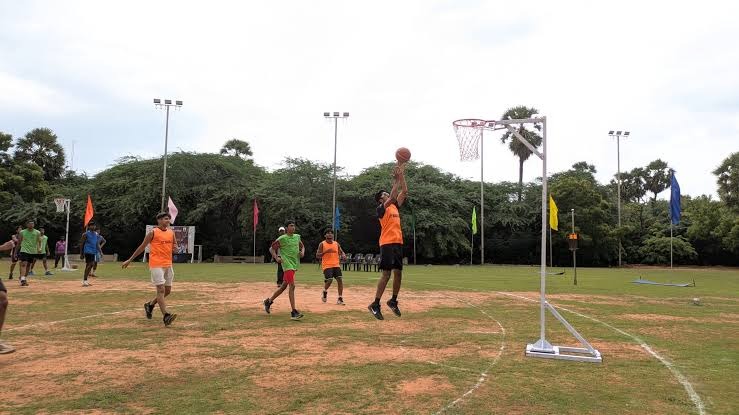
IIT Madras has launched 'Phiball', an innovative three-team circular sport modeled after basketball to provide a low-cost, highly strategic alternative for rural and government schools. Played on a compact circular court, the game demands rapid spatial adaptation, multi-directional teamwork, and enhanced tactical decision-making.
IIT Madras launched 'Phiball', an innovative three-team circular sport inspired by basketball, designed to democratize court games across rural and government schools.
CHENNAI — Ahead of National Sports Day, the Indian Institute of Technology (IIT) Madras officially unveiled a brand-new competitive sport named 'Phiball' on its campus. Developed as an accessible alternative to conventional two-team invasion games, the sport reimagines basketball dynamics within a circular court layout. Aimed at overcoming infrastructural constraints that typically limit basketball to urban concrete or synthetic courts, Phiball requires minimal setup costs and a compact 29-meter diameter space. The global launch event featured student teams from multiple regional institutions, including VIT Chennai, Sathyabama University, and Presidency College.
Mechanics and Multi-Team Dynamics
Phiball introduces a novel structural format featuring three teams competing simultaneously on a circular court divided into three equal 120-degree sectors. Each team comprises seven registered players—four active players on the field and three substitutes. Unlike standard basketball where teams contest a single opponent, Phiball players must simultaneously attack two opposing baskets while defending their own. The court features dedicated boundaries including a 4-metre Centre Free Zone and a No-Offense Zone beneath each basket, demanding rapid tactical adaptation, constant spatial awareness, and intensive multi-directional passing.
Promoting Grassroots Inclusivity and Accessibility
According to institutional leadership, the initiative addresses a major gap in physical education across rural and government schools where high-cost flooring infrastructure restricts traditional basketball. By utilizing open soil or standard grounds and simple modular basket frames costing a fraction of standard setups, schools can integrate the sport seamlessly. The gameplay rules mandate a clockwise defensive-basket rotation after each 8-minute quarter, ensuring balanced exposure to diverse offensive and defensive scenarios while keeping physical fatigue manageable.
Official Sources Section
According to official announcements and launch statements released by IIT Madras administration, the sport was conceptualized to foster teamwork, spatial mathematics, and rapid decision-making under pressure.
"Organizers stated that Phiball has been developed around the core values of teamwork, speed, communication, tactical decision-making, fairness and safety to provide a fresh competitive experience."
Institute Director Professor V. Kamakoti and Dean of Students Professor Sathyanarayana N Gummadi highlighted that the sport successfully merges mathematical field dimensions with physical agility.
Why It Matters
The introduction of Phiball carries practical implications for sports development, physical education, and grassroots infrastructure in India. For schools with limited budgets or spatial constraints, the low-cost circular format provides a viable entry point for competitive team sports. For students and athletes, the multi-directional engagement sharpens cognitive processing and spatial strategy far beyond standard two-team dynamics.
Key Facts at a Glance
Format: Three-team simultaneous invasion sport played on a 26-metre-diameter circular court.
Team Structure: Seven players per squad (four active, three substitutes).
Match Structure: Three 8-minute quarters with a rotating defensive-basket rule.
Accessibility: Designed to be set up on normal grounds at a minimal cost for rural and government schools.
Frequently Asked Questions
What is Phiball? Phiball is a newly invented three-team circular sport developed by IIT Madras that draws structural inspiration from basketball.
How many teams play on the court at once? Three teams compete simultaneously, with each team defending one basket while attacking two opposing baskets.
Why was Phiball created? It was designed to overcome the high infrastructure and space costs of traditional basketball, making competitive court sports accessible to rural and government schools.
How are points scored in Phiball? Scoring awards 1 point for a free throw, 2 points for a field goal inside the 6.75-metre arc, and 3 points for a field goal from beyond the arc.
Source: IIT Madras Official Portal, Press Information Bureau India, ANI News Reports