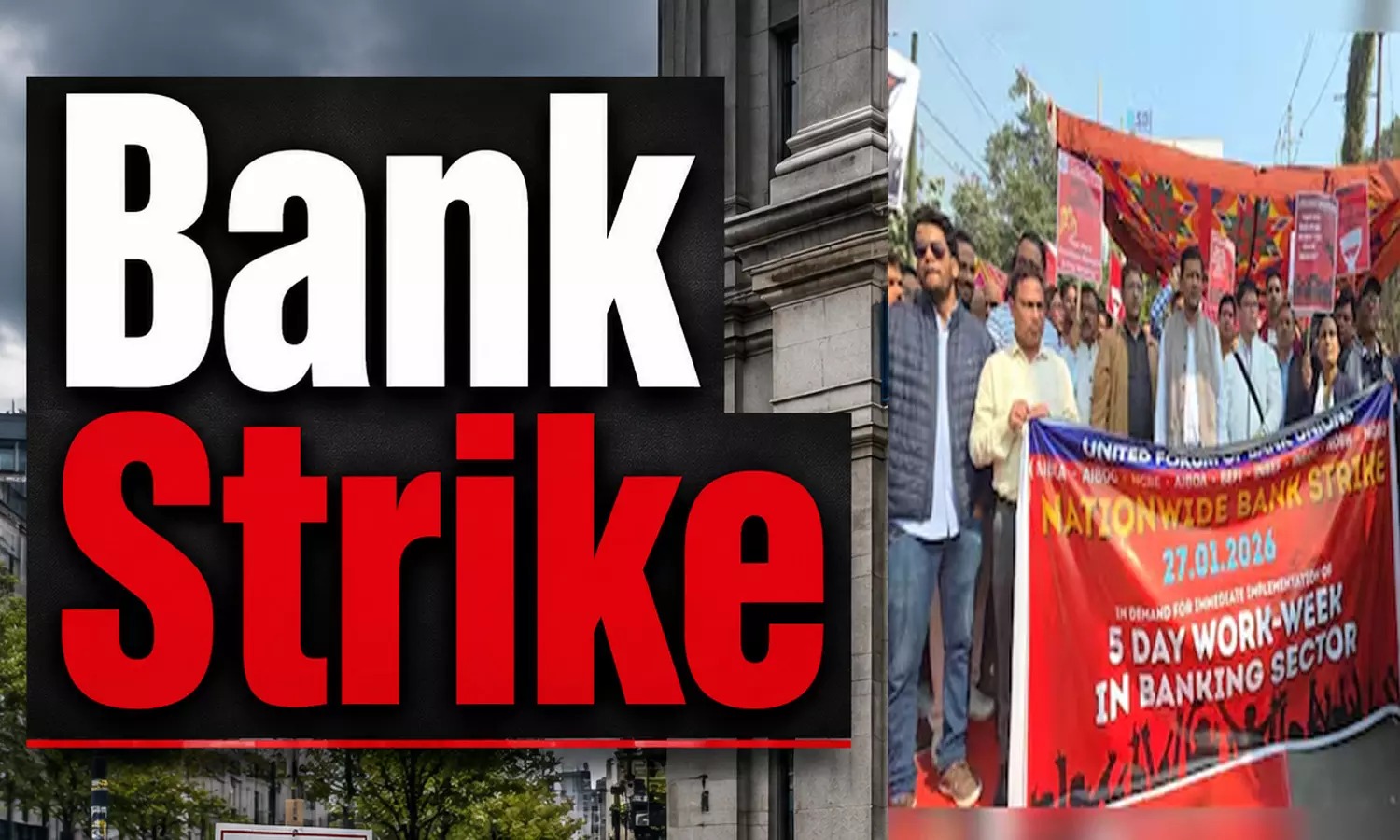
Bank unions across India have announced phased nationwide strikes to pressure authorities into approving a long-delayed five-day workweek and resolving disputes over the government's revised performance-linked incentive scheme.
Bank unions are intensifying nationwide agitations to secure a five-day workweek and resolve performance-linked incentive disputes following years of administrative delays.
NEW DELHI — The United Forum of Bank Unions (UFBU), an umbrella body representing nearly 8 lakh employees and officers across public and private sector institutions, has announced a series of nationwide strikes starting September 11, 2026. The industrial action targets the prolonged delay in implementing a five-day workweek across India's banking sector, alongside grievances concerning a revised Performance-Linked Incentive (PLI) framework. As banking operations face potential disruptions heading into the autumn financial cycle, the core dispute centers on unfulfilled commitments made during previous bipartite wage settlements.
The Background of the Five-Day Banking Push
The demand for a five-day workweek is not a newly minted proposal; it stems from a formal understanding reached between the Indian Banks' Association (IBA) and employee unions in December 2023, which was subsequently recorded in the 12th Bipartite Settlement signed on March 8, 2024. Under the agreed framework, all Saturdays would be declared official holidays for the banking industry, offset by increasing daily working hours from Monday to Friday by approximately 40 minutes. This adjustment ensures that total operational and customer-facing hours remain unchanged. However, despite the IBA forwarding the recommendation to the central government, mandatory regulatory clearances have remained stalled for over two years, prompting renewed labor friction.
Core Grievances and the PLI Scheme Dispute
In addition to the stalled five-day workweek, labor organizations have strongly opposed a revised Performance-Linked Incentive framework introduced by the Department of Financial Services (DFS). Unions argue that the revised structure disproportionately rewards senior executives (Scale IV and above) with payouts reaching up to 365 days of basic pay based on individual metrics, while restricting workmen and lower-scale officers to a maximum cap of 15 days. The UFBU maintains that this unilateral alteration violates original bilateral terms which tied incentives uniformly to overall institutional performance. Residual pension adjustments and demands to switch from the National Pension System (NPS) to the Old Pension Scheme (OPS) further compound the current labor unrest.
Official Sources and Statements
According to formal notices and circulars issued by the United Forum of Bank Unions (UFBU), ongoing conciliation proceedings before the Chief Labour Commissioner and active litigation in the Delhi High Court have failed to yield an interim resolution.
"Organizers stated that the IBA agreed in the 12th Bipartite Settlement to introduce 5 days banking by increasing daily working hours, yet the matter has been kept pending by the government for over two years," union representatives noted in their official release.
Industry coordinators confirmed that if bilateral discussions fail to bridge the gap, phased strikes scheduled for September and October 2026 will proceed as planned.
Why It Matters
The unresolved friction carries significant practical implications for retail customers, corporate borrowers, and institutional investors. Prolonged bank strikes disrupt clearing house operations, cash logistics, and credit processing cycles, causing operational bottlenecks for businesses. For bank employees, the push for a five-day workweek represents a critical step toward achieving work-life balance and aligning public sector banking standards with modern corporate environments.
Key Facts at a Glance
Pending Proposal: All Saturdays designated as holidays, balanced by adding 40 minutes to Monday-to-Friday work shifts.
Settlement Context: The transition was formally recommended under the 12th Bipartite Settlement signed in March 2024.
Strike Timeline: Union actions include a nationwide strike on September 11, a three-day shutdown from September 28 to 30, and an indefinite strike starting October 26, 2026.
Secondary Dispute: Opposition to the government's revised, scale-dependent Performance-Linked Incentive (PLI) structure.
Frequently Asked Questions
Why are bank unions pushing for Saturday holidays? Unions are demanding a five-day workweek to secure better work-life balance, backed by a formal agreement from the 2024 wage settlement that increases daily weekday hours to compensate for lost Saturday time.
What are the proposed working hours under the five-day system? Under the proposed framework, banks would remain closed on all Saturdays, while daily working hours from Monday to Friday would be extended by roughly 40 minutes.
Why hasn't the five-day workweek been implemented yet? Although the Indian Banks' Association recommended the proposal, it has awaited final administrative clearance and regulatory approval from the central government for over two years.
What other issues are driving the bank strikes? Beyond the five-day week, unions are protesting the revised Performance-Linked Incentive (PLI) scheme for senior executives and demanding resolution on pension-related reforms.
Source: United Forum of Bank Unions (UFBU) Circulars, Indian Banks' Association (IBA) Bipartite Settlements, Ministry of Finance / DFS Documentation