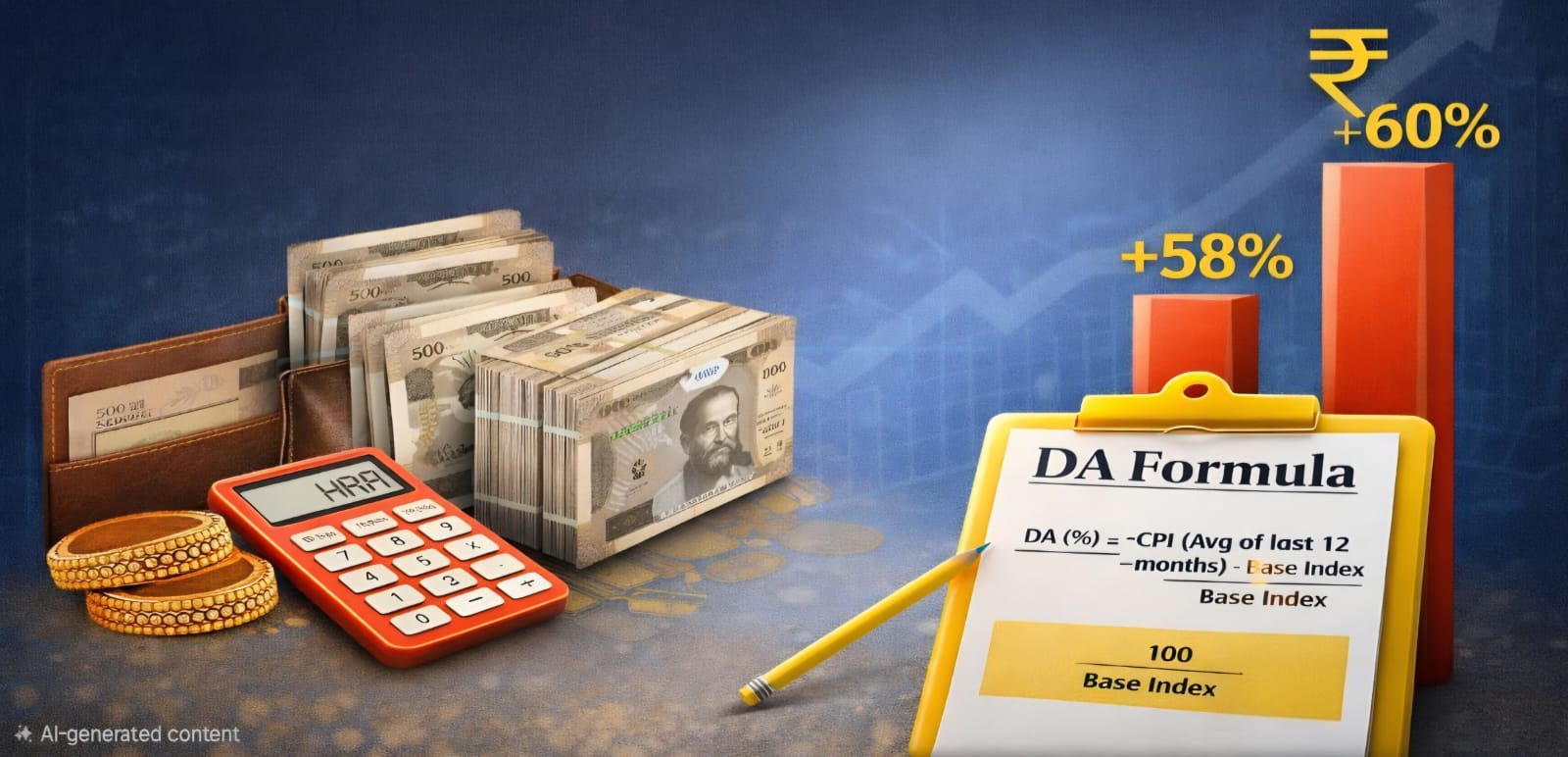
Central government employee unions are demanding a revised dearness allowance calculation formula to better reflect actual household inflation. Currently pegged at 60% using the AICPI-IW twelve-month average, stakeholders argue the metric underestimates modern living costs. Any formula overhaul would significantly impact national fiscal outlays and take-home pay structures.
The calculation and periodic revision of Dearness Allowance (DA) for central government employees and pensioners have resurfaced as a central policy discussion in September 2026. With the current DA rate established at 60% following a 2% hike effective January 1, 2026, employee unions and labor organizations are pressing the central government to overhaul the underlying mathematical model. Stakeholders argue that the prevailing formula fails to capture modern retail inflation realities, triggering persistent calls for structural reform ahead of upcoming pay commission considerations.
Mechanics of the Current Dearness Allowance Calculation
For central government employees, the calculation of dearness allowance relies on a twelve-month average of the All India Consumer Price Index for Industrial Workers (AICPI-IW) published by the Labour Bureau under the Ministry of Labour and Employment.
The established formula utilized under the framework is:
$$\text{DA percentage} = \left[ \frac{\text{12-Month Average AICPI (Base Year 2001 = 100)} - 261.42}{261.42} \right] \times 100$$
Revisions occur biannually—typically announced for January and July—to mitigate the erosion of real wages caused by escalating living costs. However, employee representatives point out that the fixed base year and weightings assigned to generic consumer goods do not accurately map against contemporary urban expenditures, such as healthcare, education, and housing rentals.
Background and the Demand for Formula Overhaul
The debate surrounding the dearness allowance calculation stems from a widening gap between official retail inflation metrics and out-of-pocket household expenses incurred by public sector personnel. Employee federations have repeatedly argued that the current weighting assignment in the AICPI-IW basket underrepresents services and essential commodities.
While historical revisions occurred smoothly—such as the transition when DA crossed 50% and triggered automatic merges under 7th Pay Commission guidelines—labor groups assert that incremental percentage adjustments fail to neutralize structural cost-of-living spikes. Consequently, demands have intensified for a more dynamic index mechanism or a completely overhauled computation methodology that mirrors real-time market inflation.
Impact on Employees, Pensioners, and Public Finances
Any modification to the dearness allowance calculation directly influences the disposable incomes of millions of central government employees and pensioners. A higher DA percentage expands monthly take-home pay, which in turn scales up fully taxable salary brackets.
For the exchequer, altering the formula carries substantial fiscal implications, governing budgetary allocations for government salaries and pension disbursements nationwide. Conversely, maintaining the status quo risks compounding dissatisfaction among workforce unions who view the current metrics as lagging indicators of economic reality.
Official Sources Section
Ministry of Labour and Employment (Labour Bureau): Monthly releases and compilation data regarding the All India Consumer Price Index for Industrial Workers (AICPI-IW).
Ministry of Finance (Department of Expenditure): Official notifications, policy memoranda, and cabinet resolutions concerning dearness allowance and dearness relief revisions.
Quote Section
"According to officials, the dearness allowance framework remains tied strictly to statutory indices compiled by the Labour Bureau, ensuring that any modifications to the underlying formula require comprehensive inter-ministerial evaluation and consensus."
Why It Matters
The methodology governing dearness allowance calculation dictates how effectively public sector compensation tracks inflation. If structural changes are adopted, millions of employees and pensioners could experience shifts in their regular payout structures, influencing broader consumer spending and fiscal planning across federal budgets.
Key Facts at a Glance
Current DA Rate: Established at 60% of basic pay following a 2% increase effective January 1, 2026.
Calculation Metric: Derived from the 12-month average of the AICPI-IW (Base Year 2001 = 100).
Revision Frequency: Updated biannually, typically covering January–June and July–December periods.
Core Demand: Employee unions seek a revised formula to accurately reflect modern retail and service sector inflation.
FAQ Section
What is the primary purpose of the dearness allowance?
Dearness allowance functions as a cost-of-living adjustment designed to offset inflation and protect the real purchasing power of government employees and pensioners.
How often is the dearness allowance revised?
The central government typically revises the DA rate twice a year, with changes taking effect prospectively from January and July.
Why are employee groups demanding changes to the formula?
Unions argue that the current 12-month AICPI-IW average fails to capture true out-of-pocket expenses for services like healthcare and education, lagging behind actual household inflation.
Is dearness allowance subject to taxation?
Yes, dearness allowance is fully taxable as part of an employee's salary income under the provisions of the Income Tax Act.
Source: Ministry of Labour and Employment, Ministry of Finance, Press Information Bureau