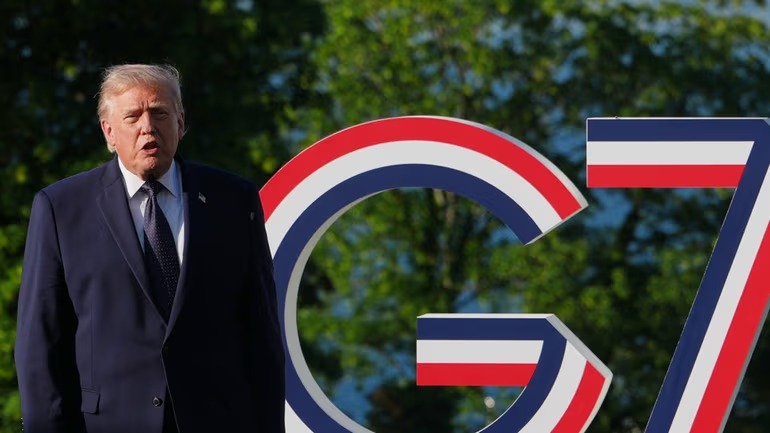
During the G7 summit in France, President Donald Trump rejected reports of a $300 billion U.S. payment to Iran, clarifying that any reconstruction funds would come from private investors. Trump is also scheduled to meet with Egypt’s President El-Sisi to discuss regional trade and the Grand Ethiopian Renaissance Dam dispute.
President Donald Trump sought to clarify his administration’s foreign policy on Monday during the G7 summit in France, forcefully rejecting claims that the United States is providing financial payouts to Iran as part of a recently announced peace deal. At the same time, the President turned his attention to regional stability, confirming that bilateral trade and the ongoing dispute over the Grand Ethiopian Renaissance Dam (GERD) would be central topics in his talks with Egyptian President Abdel Fattah El-Sisi.
Iran Reconstruction Fund Dismissed as "Fake News"
Addressing media reports that had circulated regarding a potential $300 billion reconstruction package for Iran, President Trump took to his social media platform, Truth Social, to label the figures "fake news." The President emphasized that the United States is not issuing direct government payments to Tehran.
The controversy stemmed from reports suggesting a massive investment package could be available to Iran if it adhered to strict nuclear compliance measures, including the elimination of its enriched uranium stockpile and submission to enhanced international inspections. Administration officials have since clarified that while discussions regarding economic mechanisms for Iranian reconstruction have occurred, any such funding would be derived from private investors and regional partners, rather than American taxpayers.
"Not a single dime of that money comes from the United States," Vice President JD Vance stated in a recent interview, noting that any economic benefits for Tehran would be strictly conditional upon the country’s adherence to its obligations under the peace framework.
Bilateral Focus: Egypt and Regional Stability
On the sidelines of the G7 summit, President Trump’s agenda includes a high-profile meeting with Egyptian President El-Sisi. The Egyptian presidency confirmed that the discussions would center on “resolving geopolitical crises” and their subsequent impacts on global trade, energy supply chains, and regional development.
A primary point of interest for the two leaders is the ongoing dispute regarding the construction of the Grand Ethiopian Renaissance Dam. The dam has long been a flashpoint for regional tensions between Ethiopia, Egypt, and Sudan, with concerns mounting over its impact on Nile water flow. President Trump has signaled a willingness to mediate the discussion, reflecting the U.S. government’s desire to prevent further instability in the Nile Basin.
Official Statements and Context
The French-hosted G7 summit, held from June 15 to June 17, has served as a platform for global leaders to navigate the fallout from the U.S.-Iran conflict and discuss the path forward for the Middle East. According to official statements from the Egyptian presidency, President El-Sisi’s participation underscores Egypt's role in advancing regional stability.
Regarding the Iran agreement, "According to officials, the economic package remains a secondary phase of the diplomatic process, contingent entirely upon the verification of Iran’s commitments to never pursue a nuclear weapon."
Why It Matters
The clarity provided by President Trump regarding the Iran fund is critical for both domestic and international audiences, as it seeks to quell concerns over U.S. spending in the wake of a sensitive peace agreement. Meanwhile, the focus on the Grand Ethiopian Renaissance Dam during the G7 sidelines highlights the administration's pivot toward active diplomatic mediation in Africa and the Middle East, as the U.S. attempts to leverage its influence to secure stable energy and trade corridors.
Key Facts at a Glance
Trump’s Stance: Labeled the $300 billion Iran fund report as "fake news," clarifying no U.S. tax dollars are involved.
G7 Agenda: Discussions include the aftermath of the U.S.-Iran peace deal, global economic imbalances, and critical mineral sourcing.
Egypt-U.S. Talks: President Trump and President El-Sisi are meeting to discuss regional trade and the Grand Ethiopian Renaissance Dam dispute.
Summit Location: Evian-les-Bains, France (June 15–17, 2026).
FAQ
What is the status of the $300 billion fund mentioned in media reports?
President Trump and Vice President Vance have clarified that there is no direct U.S. government payout. Any potential reconstruction capital would come from private entities and regional allies, contingent on Iran's performance.
Why is the Grand Ethiopian Renaissance Dam being discussed at the G7?
The dam is a critical regional issue impacting water security in Egypt and Sudan. Its status has direct implications for regional stability, making it a priority for bilateral discussions on the sidelines of the summit.
What has Iran agreed to in the new peace deal?
According to administration officials, Iran has pledged not to pursue nuclear weapons, has agreed to eliminate its stockpile of enriched uranium, and will allow international inspectors full access to its facilities.
Source: The Presidency of the Arab Republic of Egypt, Truth Social (Donald Trump), The Financial Times, The Media Line