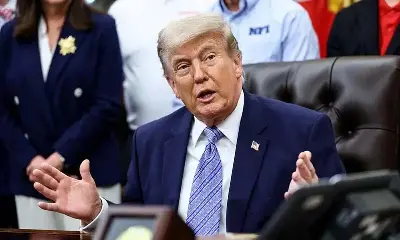
The US President, Donald Trump, has made peace with Iran conditional on the terms of the Abraham Accords framework, claims have come out of Islamabad, Pakistan. In this version, Washington is seeking Tehran to agree to a wider regional normalisation package that includes Israel, rather than establishing any such package first.This version suggests that Washington is hoping Tehran will agree to a broader regional normalisation package that includes Israel, as opposed to establishing such a package first. Pakistan is being used as a go-between to help with the US-Iran talks, which are meant to keep the lines open, and simultaneously cater to its own regional agenda.
Trump has linked Iran peace to the Abraham Accords Normalisation, says Pakistan, which is acting as a mediator.Trump has tied Iran peace to the Abraham Accords Normalisation, says Pakistan, which is playing the role of a mediator.
These statements have not been fully detailed or independently verified, and details of such conditional offers are still not clear. If true, the concept would signal a huge shift in Iran track in the broader Middle East peace process, however.
Abraham Accords As A New Precondition
The Abraham Accords were the first to sign an agreement between Israel and a number of Arab countries for normalisation. Such a framework would become part of a peace agreement with Iran, and effectively tilt the country toward a softer tone with Israel and regional cooperation, which could not have been more contrary to Tehran's policy than that. In Iran, this kind of connection is probably going to be a political poison, politically speaking, even if it's presented as a route to sanctions relief and economic opening.
The claim to be a mediator is Pakistan's hallmark.Claimed Mediation is Pakistan's hallmark.
This has seen Pakistan being seen as a mediator, which is a reflection of its efforts to keep all three capitals, Washington, Tehran and the major Gulf capitals, at the same time. Islamabad may be indicating its influence and limitations on both sides by floating details of Trump's supposed demands. It also highlights the growing importance of the role of the non-Arab regional actors in Middle East diplomacy in the absence of direct involvement in the Abraham Accords or Iran's main issues.
The ramifications of this for peace could be vast.
Iran’s assessment of the Abraham Accords linkage as a non-starter may exacerbate the deadlock narrative and make any progress more difficult. To the US and other regional allies, advancing these terms may be a way to maintain a long-term strategic balance, but at the expense of complicating negotiations. But, until the major capitals get on record with more clarity, it is just diplomatic signalling and not a policy shift.
Takeaways from the Middle East Peace Process
- It is reported that Trump has made conditions for Iran peace terms the same as for Abraham Accords style regional normalisation.
- This would necessitate a complete change of Iran's course with regard to Israel and the regional balance.
- Pakistan is acting as a mediator through whom Washington is trying to communicate with Tehran.
- If the linkage is genuine, it might make the already precarious talks more difficult.
- Before considering this as a peace condition, clarity from both the US and Iranian officials will be key.
Sources: Mainly from recent global and regional coverage on Trump linking an Iran deal to broader Abraham Accords participation and Pakistan’s emerging role as a mediator between Washington and Tehran.