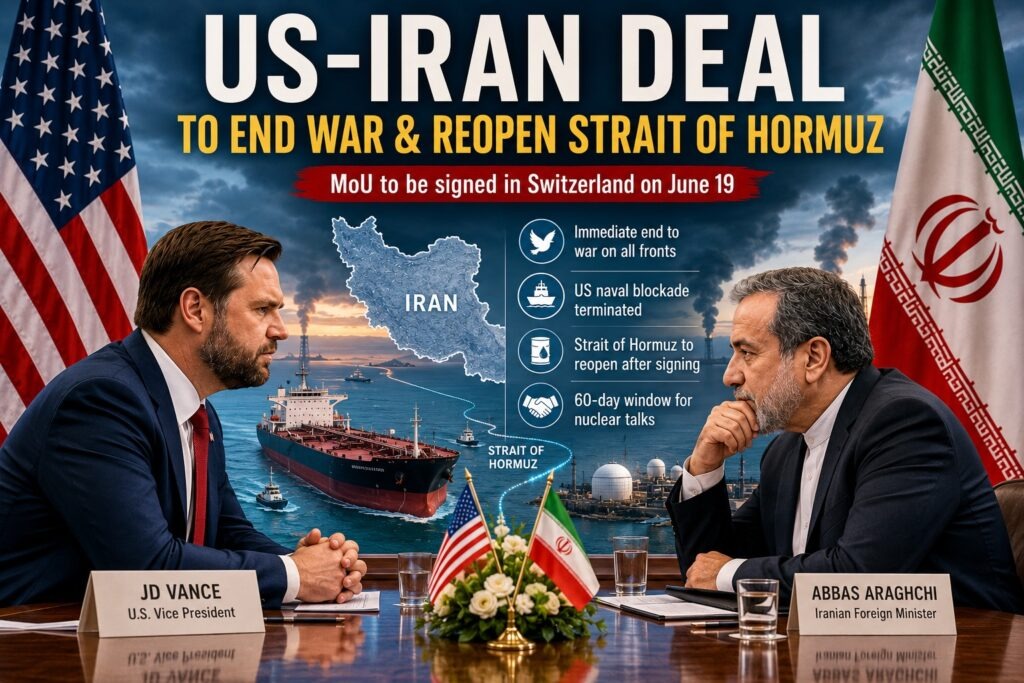
U.S. President Donald Trump, Vice President JD Vance, and Iranian Parliament Speaker Mohammad Bagher Ghalibaf have finalized the Islamabad MOU, effectively ending the 15-week West Asia maritime war. The historic agreement mandates an immediate end to military operations, lifts the U.S. naval blockade, and opens the strategic Strait of Hormuz ahead of a formal signing ceremony on June 19, 2026, in Geneva.
WASHINGTON — United States President Donald Trump, Vice President JD Vance, and senior Iranian leadership have formally finalized the Islamabad Memorandum of Understanding (MOU), marking an immediate termination of military operations across all active regional fronts. The breakthrough diplomatic accord, brokered following weeks of intensive negotiations mediated by Pakistan, directly brings a halt to the 15-week West Asia conflict that had heavily disrupted international shipping lanes.
Following the finalization of the framework on Monday, June 15, 2026, President Trump announced that he has fully authorized the toll-free reopening of the strategic Strait of Hormuz alongside the prompt withdrawal of the U.S. naval blockade surrounding Iran. The core provisions of the initial memorandum are structured to prevent further escalation in Lebanon, stabilize global energy networks, and establish a permanent verification protocol to ensure that Iran never acquires a nuclear weapon.
High-Level Signatories Unify Framework Parameters
The comprehensive agreement represents a coordinated effort involving the highest levels of both the American and Iranian political structures. U.S. Vice President JD Vance, acting as a key architect of the programmatic parameters, confirmed that the preliminary memorandum has been successfully cleared by all participating administrative branches. On the Iranian side, the text was moved through the sovereign approval system by Parliament Speaker Mohammad Bagher Ghalibaf and Foreign Minister Abbas Araghchi.
According to corporate and state logistics registries tracking the diplomatic timeline, the finalized MOU shifts the process toward a rigid execution schedule:
Naval Blockade Termination: The United States Armed Forces have initiated the physical rollback of strategic naval interceptors stationed across the Persian Gulf.
Pre-Implementation Technical Talks: Specialized teams from Washington and Tehran are launching immediate, 60-day technical reviews regarding specialized nuclear tracking safeguards.
Geneva Accord Summit: A formal public signing ceremony is locked in to take place on Friday, June 19, 2026, in Geneva, Switzerland, with Vice President Vance and senior Iranian executives in attendance.
Global Financial Corridors React to Reopening of Hormuz
The finalization of the Islamabad MOU has triggered immediate, sweeping shifts across international commodity trading floors. The Strait of Hormuz serves as the single most critical maritime chokepoint for global oil distribution, handling roughly 20% of the world's total crude consumption prior to the outbreak of hostilities. The immediate assurance of safe, toll-free commercial navigation has already caused global energy prices to drop significantly, unwinding a major inflationary risk factor for global industrial manufacturing.
However, the rapid execution of the bilateral deal has generated sharp policy friction with key regional allies. While global leaders across the G7 nations officially welcomed the stabilization of the world economy, the Israeli political cabinet has openly distanced itself from the American diplomatic initiative. Israeli government officials publicly declared on Monday that the terms of the U.S.-led memorandum do not bind Tel Aviv's independent defense postures, warning that any cross-border provocations from regional militias will continue to face direct military retaliation.
Official Sources Section
The baseline institutional data, security authorizations, and operational parameters cited regarding this international agreement were verified through official executive statements distributed via the White House press room and President Trump's official Truth Social communication logs. External diplomatic coordinates and timeline announcements correspond directly with official notifications published on social platforms by the Ministry of Foreign Affairs of Pakistan and the Ministry of Foreign Affairs of the Islamic Republic of Iran.
Quote Section
"According to officials presenting the executive briefs on Monday, the finalization of the Islamabad Memorandum of Understanding provides a critical window of opportunity to permanently normalize shipping security. Vice President JD Vance stated that if the Iranian authorities strictly comply with the structural benchmarks outlined in this text, it will fundamentally transform the stability and investment landscape of the Middle East for the next 50 years."
Why It Matters
The immediate finalization of the U.S.-Iran MOU carries massive practical implications for corporate supply chain managers, commercial maritime travelers, global energy investors, and retail consumers. Reopening the Strait of Hormuz eliminates the costly fuel surcharges and extended shipping detours that have penalized international container transport for nearly four months. For the public, this structural de-escalation prevents a severe wave of energy-driven retail inflation, allowing global central banks more breathing room to lower domestic borrowing costs and stimulate standard commercial growth.
Key Facts at a Glance
Blockade Removed: President Donald Trump has officially authorized the immediate removal of the U.S. naval blockade on Iran.
Hormuz Cleared: The Strait of Hormuz is designated for an immediate, toll-free reopening to standard global commercial vessels.
Geneva Summit Locked: The formal international signing ceremony is officially scheduled for June 19, 2026, in Switzerland.
Nuclear Guardrails Placed: The MOU incorporates explicit verification systems to ensure Iran cannot advance toward building nuclear weaponry.
Allied Friction: European G7 allies welcomed the economic stabilization, while Israeli leadership explicitly declared they are not a party to the text.
FAQ Section
What is the exact purpose of the Islamabad MOU finalized by the U.S. and Iran?
The Islamabad Memorandum of Understanding serves as a foundational diplomatic framework designed to immediately halt all active military hostilities between U.S. forces and Iran, reopen blocked global shipping corridors, and establish a 60-day window for specialized technical talks regarding regional security and nuclear non-proliferation.
Who are the core political figures signing this international accord?
The diplomatic framework was navigated and finalized by U.S. President Donald Trump and Vice President JD Vance alongside Iran's Parliament Speaker Mohammad Bagher Ghalibaf and Foreign Minister Abbas Araghchi. The final treaty documentation will be executed during a formal summit in Switzerland.
How does this peace agreement affect global crude oil prices and inflation?
Prior to the conflict, approximately 20% of the world's crude oil supply transited through the Strait of Hormuz. The lifting of the naval blockade and the restoration of toll-free shipping access allow energy shipments to flow normally again, which reduces global fuel expenses and helps lower general consumer inflation.
Source: White House Briefing Registry, Ministry of Foreign Affairs of Pakistan Official Press Statements, Ministry of Foreign Affairs of Iran Communiqués.