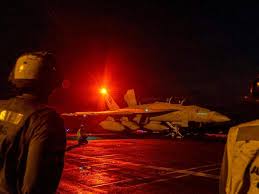
The U.S. launched fresh airstrikes on Iran following the death of two service members in a Jordanian air base attack. This marks the eighth consecutive day of U.S. strikes, aimed at degrading Iran's military capabilities and ability to disrupt shipping in the Strait of Hormuz amid escalating regional hostilities.
WASHINGTON — The United States military launched a renewed wave of airstrikes against Iran on Saturday, intensifying an eight-day air campaign following the deaths of two American service members. The soldiers were killed on Friday while defending against Iranian ballistic missile and drone strikes at the Muwaffaq Salti Air Base in Jordan, according to U.S. Central Command (CENTCOM).
The incident marks a significant escalation in the ongoing conflict between Washington and Tehran, which has intensified following the collapse of a tentative ceasefire agreement last month. In addition to the two fatalities, CENTCOM reported that one service member remains missing and four others sustained injuries requiring hospitalization, though those personnel have since been discharged.
Targeting Strategic Capabilities
The U.S. military’s retaliatory strikes are designed to degrade Iran’s capacity to threaten international shipping lanes in the Strait of Hormuz—a vital maritime chokepoint that historically handles roughly 20% of global oil supplies. According to CENTCOM, the latest operations have targeted surveillance sites, military logistics infrastructure, underground weapons storage, and maritime capabilities.
Recent U.S. strikes have also caused significant damage to Iranian civilian and industrial infrastructure, including bridges, tunnels, and water desalination plants in the Hormozgan province. These strikes have disrupted local services, with reports indicating that thousands of residents have been left without water, while critical transportation routes have been blocked.
Regional Escalation
The attack on the Jordanian base was part of a broader wave of Iranian strikes across the region that also hit targets in Kuwait and Bahrain. Kuwaiti authorities reported that ballistic missiles and drones damaged oil facilities, electricity grids, and water desalination plants, causing significant infrastructure damage and injuries to energy sector workers.
Tehran’s leadership has adopted an increasingly defiant stance. Iranian Supreme Leader Mojtaba Khamenei accused the U.S. of breaching the memorandum of understanding signed in June, declaring that President Donald Trump’s commitments are "utterly worthless." Iranian officials have warned that regional states hosting American forces should be prepared for a "corresponding response" should their territory be used for further strikes against the Islamic Republic.
Official Sources
U.S. Central Command (CENTCOM): Provided official confirmation of the troop casualties, the status of the injured personnel, and the objectives of the retaliatory airstrikes.
Department of Defense: Secretary of Defense Pete Hegseth reaffirmed the U.S. commitment to the mission, stating that the recent sacrifices have "stiffened" the nation's resolve.
Iranian State Media: Reported on the impacts of U.S. strikes within Iranian territory and relayed official statements from the Supreme Leader and the Islamic Revolutionary Guard Corps (IRGC).
Kuwaiti Ministry of Defense: Reported on the damage to national infrastructure following Iranian missile and drone strikes.
Why It Matters
The deepening conflict threatens to destabilize the Persian Gulf, with significant implications for global energy markets and regional security. The collapse of diplomatic efforts to maintain the ceasefire, coupled with the targeting of critical infrastructure, raises concerns about a sustained return to full-scale regional hostilities. For the international community, the disruption of shipping through the Strait of Hormuz remains a primary economic anxiety, while the risk to infrastructure poses long-term challenges for desert nations heavily dependent on desalinated water.
Key Facts at a Glance
Casualties: Two U.S. service members killed and one missing following an attack in Jordan; total U.S. military death toll in the conflict now stands at 16.
Retaliatory Scope: The U.S. has conducted eight consecutive days of airstrikes targeting Iranian military, surveillance, and logistics facilities.
Regional Impact: Iranian strikes have caused significant damage to energy and water infrastructure in Kuwait and Bahrain, alongside the fatal attack in Jordan.
Economic Tension: The battle for control over the Strait of Hormuz continues to drive global concerns regarding oil supply and maritime safety.
FAQ
Why did the U.S. launch new strikes on Iran?
The strikes were launched in direct response to an Iranian ballistic missile and drone attack on the Muwaffaq Salti Air Base in Jordan, which resulted in the deaths of two American service members.
What is the objective of the current U.S. air campaign?
The military aims to degrade Iran’s ability to threaten commercial shipping in the Strait of Hormuz and to punish the Islamic Revolutionary Guard Corps for attacks on U.S. personnel.
Has the conflict affected the global oil supply?
Yes, the ongoing battle for control of the Strait of Hormuz has created significant uncertainty, as the waterway is a critical artery for global crude oil transportation.
How has Iran responded to the U.S. strikes?
Iran has retaliated by targeting U.S. assets and allies across the Gulf, including critical infrastructure in Kuwait and Bahrain, and by suspending commitments to previous diplomatic agreements.
Source: U.S. Central Command, Financial Times, Washington Post, PBS NewsHour, Air & Space Forces Magazine, Times of India