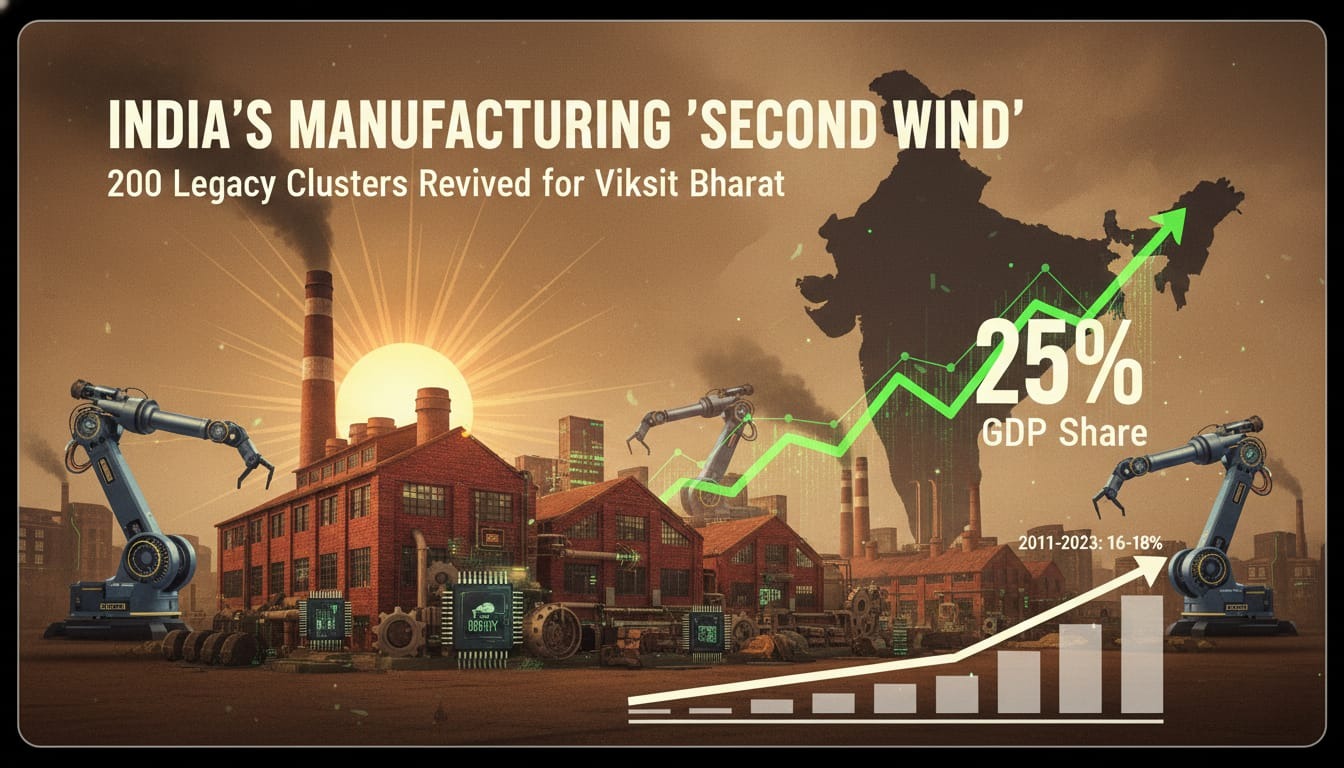
The Union Budget 2026-27 has launched a major initiative to revitalize 200 legacy industrial clusters across India. By providing targeted funding and infrastructure support, the government aims to modernize these older manufacturing hubs, boost regional employment, and integrate them into India's growing, globally competitive industrial economy.
The Union Budget 2026-27 signals a decisive shift in India’s industrial strategy, moving to modernize 200 legacy clusters that have long operated on the fringes of formal economic policy.
For decades, India’s industrial geography was defined by organic, often unplanned growth. While metropolises like Mumbai, Bengaluru, and Chennai became magnets for global investment, hundreds of older industrial hubs—ranging from leather workshops in Kanpur to iron foundries in Howrah—were left to languish with outdated infrastructure and fragmented regulation.
Recognizing this critical gap, the Union Budget 2026-27 has introduced a comprehensive scheme to revitalize 200 of these legacy industrial clusters. This initiative aims to transition these hubs from isolated, inefficient zones into modern centers of excellence, reinforcing India's broader ambition to raise manufacturing’s share of the national GDP to 25%.
The Challenge of "Missing" and Legacy Clusters
Legacy clusters often developed based on proximity to raw materials or inherited skills, rather than strategic policy design. Over time, these areas faced severe structural failures:
Infrastructure Deficit: Roads designed for local traffic struggled to handle heavy industrial logistics, while power supply inconsistencies forced units to rely on expensive diesel generators.
Environmental Strain: Many clusters were locked into dense layouts that made it difficult to upgrade waste management or effluent treatment, leading to pollution and health risks for surrounding residential areas.
Regulatory Fragility: Operating as collections of isolated small-to-medium enterprises (SMEs), these units lacked the capital to invest individually in modern pollution control or advanced technology.
Left outside the formal policy spotlight, these clusters faced "industrial sickness"—a cycle where outdated technology and mismanagement led to job losses and economic stagnation.
The 2026 Roadmap for Modernization
The government’s revival plan is not a "one-size-fits-all" model but a phased, region-specific approach designed to integrate these legacy sites into global value chains.
Strategic Infrastructure Upgrades
The first priority is repairing the physical foundation. This includes improving last-mile logistics, upgrading power grids, and installing common testing centers. By treating these areas as "living social and economic systems," the plan aims to improve not just factory output, but the surrounding housing, health, and worker safety infrastructure.
Technology and Finance
To address capital constraints, the budget has allocated a ₹10,000 crore SME Growth Fund and a ₹2,000 crore top-up to the Self-Reliant India Fund. These funds are directed toward units producing high-tech components and those seeking to replace inefficient, outdated machinery with automated systems.
Why It Matters
Reviving these 200 clusters is essential for creating "inclusive growth." Millions of workers already depend on these legacy hubs, particularly in smaller towns where alternative employment is limited. By bringing them into the formal industrial ecosystem, the government aims to:
Boost Global Competitiveness: Modernized clusters can meet international quality standards, facilitating higher exports.
Reduce Import Dependency: Targeted support for MSMEs helps domestic production of goods previously imported, particularly in strategic sectors like electronics and high-tech manufacturing.
Create Quality Jobs: Moving from traditional workshops to modern enterprises creates a path for sustainable, high-value employment.
Key Facts at a Glance
Policy Focus: Revitalization of 200 legacy industrial clusters under Union Budget 2026-27.
Financial Support: ₹10,000 crore SME Growth Fund and ₹2,000 crore for the Self-Reliant India Fund.
Primary Goals: Infrastructure modernization, environmental compliance, and integration into global supply chains.
Strategic Objective: Raising manufacturing's contribution to India’s GDP to 25% while creating quality regional employment.
Frequently Asked Questions (FAQ)
Why were these industrial clusters neglected for so long?
These clusters grew organically without central planning. As environmental regulations and technological requirements shifted, the lack of shared infrastructure made individual units struggle to upgrade on their own.
How will the government ensure these upgrades lead to success?
The plan focuses on "cluster-level solutions," such as shared effluent treatment plants and common testing centers, rather than relying on individual factory upgrades. It also emphasizes mentorship and better access to finance.
Will this initiative help with environmental pollution?
Yes. By replacing isolated, inefficient boilers and generators with centralized, cleaner energy systems and improved waste management, the policy intends to reduce the environmental footprint of these traditional industrial zones.
Source: Union Budget 2026-27, Down To Earth, PIB Delhi, Lendingkart, KPMG in India