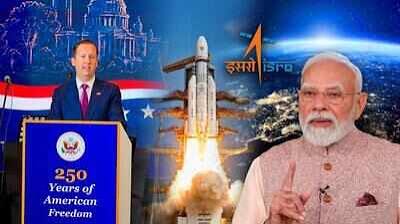
US Ambassador Sergio Gor revealed in Bengaluru that NASA has formally invited ISRO to join its lunar base program, urging India to stand alongside Washington on the Moon. Citing NISAR's earthquake response and Axiom-4 astronaut cooperation, Gor also opened doors for Indian aerospace startups to access the American commercial market.
BENGALURU — The United States has formally invited the Indian Space Research Organisation (ISRO) to join its lunar surface base program, US Ambassador to India Sergio Gor announced on Monday, September 7, 2026, declaring that Washington wants New Delhi standing "by our side" as humanity establishes a long-term presence on the Moon. Speaking at the Bengaluru Space Expo 2026, Gor outlined an accelerating strategic partnership spanning deep-space exploration, joint low-Earth-orbit missions, shared satellite observation systems, and bilateral commercial investments. The development marks an important advancement in civil and commercial space alignment between the two democracies as international competition to access lunar resources intensifies.
NASA Formally Invites ISRO into Lunar Surface Initiative
Addressing delegates, aerospace engineers, and industry leaders at the biennial aerospace convention, Gor confirmed that NASA has officially invited India's national space agency into the lunar surface architecture under the broader Artemis framework. India signed the Artemis Accords in 2023, committing to principles of transparent, peaceful, and interoperable lunar and deep-space exploration.
"NASA has officially invited ISRO to join us in the Moon base program," Gor told attendees. "Make no mistake: we're going back to the Moon, and we want India by our side on the lunar surface."
The invitation directly connects India's proven low-cost, high-precision engineering capacity—demonstrated during its historic Chandrayaan-3 landing near the lunar south pole—with US heavy-lift launch capabilities and private commercial lander programs. Following his formal address, Ambassador Gor noted he had held discussions with ISRO leadership on advancing lunar surface integration and human spaceflight milestones.
Bilateral Synergies: Earth Observation to Crewed Flights
Highlighting existing technological cooperation, Gor pointed to the operational deployment of the joint NASA-ISRO Synthetic Aperture Radar (NISAR) mission. Equipped with dual-frequency radar, the observatory tracks subtle shifts in land mass, glacial shelves, and disaster-affected zones through dense clouds and darkness.
"When a devastating earthquake struck Venezuela just two months ago, NISAR's radar data penetrated dense cloud cover and dust to guide emergency responders directly to ground zero," Gor said, citing the deployment as tangible proof of how combined technology saves human lives during humanitarian crises.
The envoy also highlighted India’s progress in crewed space initiatives, pointing to Group Captain Shubhanshu Shukla’s flight to the International Space Station (ISS) aboard the Axiom-4 commercial crew mission. With five joint scientific investigations conducted during that mission, both space agencies are now harmonizing docking standards, space hardware interoperability, and long-duration astronaut training protocols to prepare for deep-space habitats.
Pitch to Indian Space Startups and Open Governance
Beyond state-run programs, Gor urged Indian commercial aerospace enterprises to scale operations into the North American market. Calling out private firms including Pixxel, GalaxEye, Digantara, Bellatrix Aerospace, Skyroot Aerospace, and Agnikul Cosmos, he stressed that American institutional venture capital is seeking international manufacturing and payload partnerships.
"To every Indian space entrepreneur in this room: the American market is open to you. Our investors are watching you. Our ecosystems welcome you," Gor stated.
The envoy connected commercial space cooperation to global geopolitical stability, warning against unilateral space dominance. He noted that Washington and New Delhi are coordinating space traffic management systems and preparing joint regulatory stances for the International Telecommunication Union's World Radiocommunication Conference in Shanghai to preserve rules-based, open space governance.
Impact on Industry, Science, and Global Markets
The deepening bilateral alignment produces notable impacts across multiple sectors:
Commercial Aerospace Startups: Indian launch vehicle and satellite developers gain clearer regulatory pathways, cross-border testing permissions, and access to American venture capital networks.
Industrial Supply Chains: Standardized docking interfaces and shared avionics standards enable Indian high-precision component manufacturers to supply future lunar infrastructure tenders.
Scientific Research Community: Joint lunar base participation expands flight opportunities for Indian planetary sensors, resource-extraction experiments, and sample-return missions.
Civil Navigation & Telecommunications: Harmonized frequency spectrum management protects critical orbital slots and satellite bands against unilateral terrestrial interference.
Official Sources
Policy announcements and multilateral cooperation objectives were presented by the Embassy of the United States, New Delhi and the National Aeronautics and Space Administration. Mission tracking and scientific research frameworks align with official releases from the Indian Space Research Organisation and national development guidelines issued by the Ministry of Science and Technology.
Quote Section
Addressing the assembled international industry delegates in Bengaluru, US Ambassador Sergio Gor stated:
"When the United States and India work together, we do not just practice addition; we practice multiplication. Not even the sky is the limit. So from Bengaluru, let us look upwards. Let us work together to build a global space economy. Let us return to the Moon together."
Why It Matters
Securing India's direct involvement in NASA's lunar base initiative anchors South Asia's foremost space power to an open, multilateral exploration model at a time when rival geopolitical blocs are actively planning competing lunar research bases. For New Delhi, partnering on lunar surface infrastructure offers access to advanced human-rating technology while validating its commercial aerospace ecosystem as a premier global manufacturing partner.
Key Facts at a Glance
Major Development: NASA officially invites ISRO to participate in its permanent lunar base program.
Key Forum: Remarks delivered by US Ambassador Sergio Gor at the Bengaluru Space Expo 2026.
Human Flight Interoperability: US and India advancing shared docking standards and astronaut training following Group Captain Shubhanshu Shukla’s ISS Axiom-4 flight.
Disaster Response Validation: NASA-ISRO NISAR radar data successfully deployed to guide emergency workers during recent Venezuelan earthquake rescue operations.
Commercial Outreach: Explicit invitation for Indian space startups—including Skyroot, Agnikul, and Pixxel—to enter US capital and launch ecosystems.
Frequently Asked Questions
What did US Ambassador Sergio Gor announce regarding the Moon?
Ambassador Gor announced that NASA has formally invited ISRO to join its lunar surface base program, emphasizing that the United States wants India alongside it as it returns astronauts and infrastructure to the lunar surface.
What is the status of India's participation in the Artemis Accords?
India is an active signatory of the Artemis Accords, which set international guidelines for peaceful, cooperative, transparent civil lunar exploration and space commerce.
Which Indian space companies were specifically highlighted by the US envoy?
Gor highlighted Indian private space startups including Pixxel, GalaxEye, Digantara, Bellatrix Aerospace, Skyroot Aerospace, and Agnikul Cosmos, inviting them to scale operations and raise capital in the US market.
Source: Official addresses from the Embassy of the United States, New Delhi; public mission updates from the National Aeronautics and Space Administration; technical filings from the Indian Space Research Organisation.