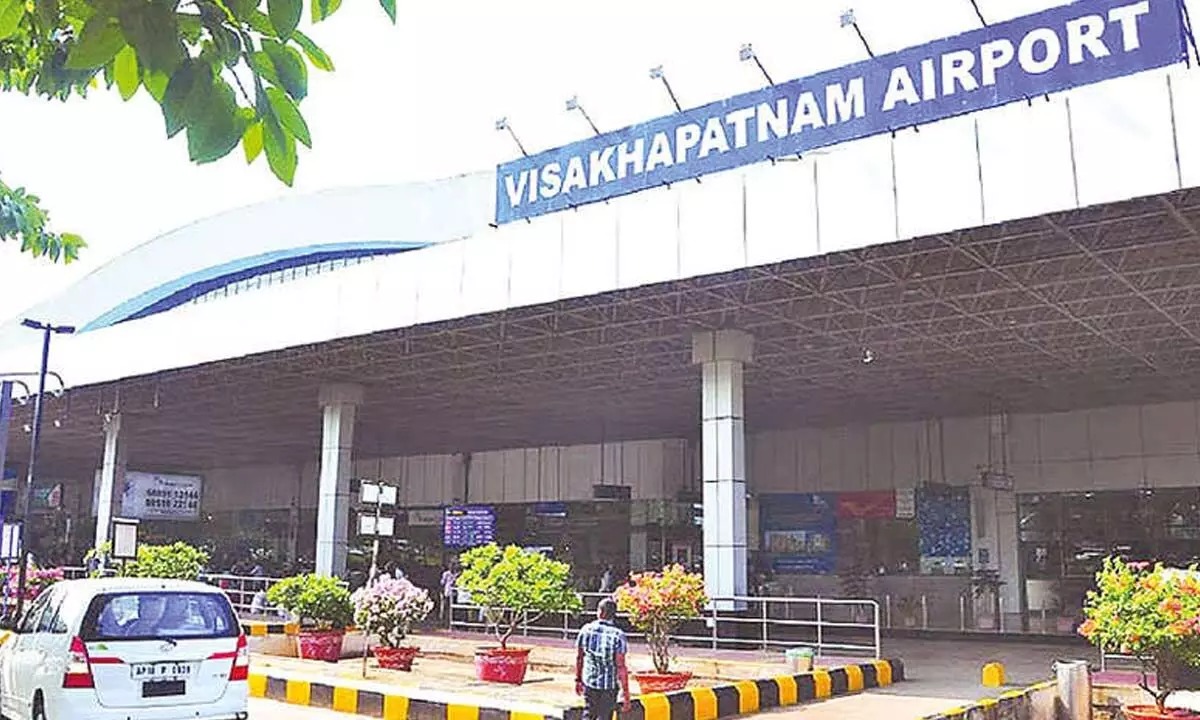
The greater Visakhapatnam region is poised to become a premier international aviation hub following the successful completion and licensing of the greenfield Bhogapuram Airport. The modern facility removes long-standing military slot restrictions, opening the path for unrestricted 24/7 commercial flights, wide-body international operations, and advanced air cargo logistics.
VISAKHAPATNAM — The greater Visakhapatnam region is poised to secure its position as a primary South Asian aviation gateway following the total structural completion of the new Alluri Sitarama Raju International Airport at Bhogapuram. The Union Ministry of Civil Aviation formally issued the mandatory aerodrome license for the greenfield facility, signaling that the multi-billion-rupee infrastructure asset has met all global safety and navigation benchmarks. The transition will permanently shift civilian flights out of the current naval airbase, establishing an unconstrained commercial aviation ecosystem to supercharge regional trade, tourism, and deep-tech manufacturing.
Unlocking 24/7 Airspace and Overcoming Legacy Constraints
For decades, the existing Visakhapatnam International Airport functioned as a restricted civil enclave carved out of the Indian Navy’s premier air station, INS Dega. This shared administrative model severely bottlenecked the city's commercial aviation potential. Commercial airlines faced rigid civilian slot allocations, daily caps on flight frequencies, and a total ban on overnight aircraft parking due to intensive military training flight blocks.
The upcoming opening of the ₹4,500-crore Bhogapuram facility, built by GMR Visakhapatnam International Airport Limited (GVIAL), completely breaks these operational barriers. Operating free from defense restrictions, the region gains immediate access to:
Unrestricted 24/7 Flight Windows: Airlines can schedule late-night international departures, early morning red-eyes, and optimize corporate fleets with dedicated overnight parking slots.
Wide-Body Aircraft Operations: The new 3.8-kilometer asphalt runway is specifically engineered to support wide-body aircraft like the Boeing 777 and Airbus A350. This allows direct, non-stop long-haul flights to major global logistics hubs in Europe, North America, and Southeast Asia for the first time.
Doubled Passenger Thresholds: Phase 1 of the new terminal scales up regional capacity to handle 6.3 million travelers annually, replacing the cramped 3.6 million passenger limit of the old terminal.
Tariff Incentives and Multi-Modal Transit Corridors
To accelerate commercial growth right after launch, the Airports Economic Regulatory Authority (AERA) has approved a targeted ad-hoc tariff structure. The framework includes specific landing and parking fee discounts designed to incentivize domestic and international carriers to introduce entirely new routes. Departing domestic passengers will clear a user development fee (UDF) of ₹835, while international departures are pegged at ₹1,255.
A primary consumer concern regarding the transition has been the 45-to-50 km travel distance between the new site and downtown Visakhapatnam. To mitigate transit times and streamline passenger movement, the Andhra Pradesh Government is developing multiple dedicated high-speed transit corridors.
Construction teams are completing a new beach highway corridor connecting the Visakhapatnam coast line directly to Bhogapuram. Concurrently, the Visakhapatnam Metropolitan Region Development Authority (VMRDA) has fast-tracked arterial road widening projects including the Adavivaram-Sonthyam routes to compress airport travel times. Long-term infrastructure planning also includes integrating the future Vizag Metro network right into the terminal gates.
Economic Windfalls for Commerce and Regional Tech
The transition to a world-class, unconstrained aviation hub impacts far more than leisure travel. Industries operating inside the Visakhapatnam special economic zones including major pharmaceutical manufacturing clusters, information technology parks, and heavy maritime export firms will gain direct access to advanced air cargo facilities.
The GMR Group is leveraging its successful "Aerocity" blueprint from New Delhi and Hyderabad to build out the surrounding airport land. The master plan incorporates specialized Maintenance, Repair, and Overhaul (MRO) hangars, corporate business parks, duty-free retail zones, and international convention hotels. This commercial ecosystem is projected to draw major global logistics investments, turning North Andhra into a primary industrial hub on India's eastern seaboard.
Official Sources Section
The engineering status, licensing parameters, and regional capacity metrics cited in this report are sourced from official project inspections conducted by the Union Ministry of Civil Aviation, structural filings by GMR Airports Infrastructure Limited, and formal tariff orders issued by the Airports Economic Regulatory Authority (AERA).
Quote Section
"The airport has completed all mandatory safety and operational requirements, and the Ministry of Civil Aviation has issued the aerodrome licence... It is set to become a landmark of progress and a symbol of pride for Uttarandhra."
— K. Rammohan Naidu, Union Civil Aviation Minister
"According to officials, running both airports concurrently for commercial flights is legally and financially unfeasible under the public-private partnership (PPP) clauses signed to ensure the greenfield project's economic viability. The old airfield will revert to exclusive military jurisdiction under the Indian Navy."
Why It Matters
For travelers and regional businesses, this transition marks the shift of Visakhapatnam from a minor regional stop into a major international destination. Capping the strict military slot controls allows airlines to schedule flights according to true market demand, offering competitive ticket pricing and varied destination options for consumers. For real estate and industrial investors, the dedicated air cargo and industrial spaces surrounding the airport offer an ideal ecosystem to base high-value export operations along the East Coast.
Key Facts at a Glance
Total Readiness: The new greenfield airport has secured 100% completion status and its official aerodrome license.
Operational Freedom: The shift eliminates naval slot restrictions, allowing for 24/7 flight windows and overnight aircraft parking.
Heavy Jet Capacity: The 3.8-kilometer runway is built to accommodate wide-body aircraft for direct international flights.
Expanded Footprint: Phase 1 expands regional passenger capacity to 6.3 million annually, with long-term scaling up to 40 million.
FAQ Section
What is the official name and location of the new airport?
The facility is officially named the Alluri Sitarama Raju International Airport. It is located in the Bhogapuram zone of the Vizianagaram district, roughly 45 km northeast of Visakhapatnam city center.
What will happen to the existing Visakhapatnam International Airport?
Upon the launch of commercial operations at Bhogapuram, the old city airport will permanently end civilian operations. The airspace and runways will return to the exclusive operational control of the Indian Navy’s INS Dega airbase.
How much are the approved User Development Fees (UDF) for travelers?
Under AERA's approved ad-hoc tariff order, departing domestic passengers will pay a fee of ₹835, while arriving domestic passengers pay ₹355. For international travelers, the fee is set at ₹1,255 for departures and ₹545 for arrivals.
Source: Ministry of Civil Aviation Press Bureau, GMR Visakhapatnam International Airport Limited Portal, Airports Economic Regulatory Authority (AERA) Tariff Registry.