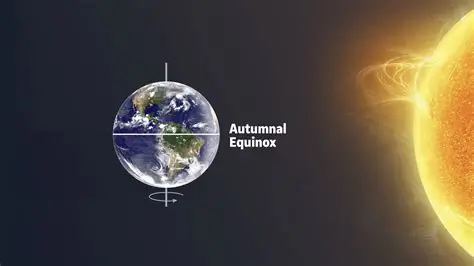
The 2026 autumn equinox arrives globally on September 23 at 00:06 UTC (5:36 AM IST), marking equal daylight shifts and the onset of astronomical fall in the Northern Hemisphere. Astrologically, the Sun enters Libra, prompting collective focus on relational balance, accountability, and seasonal transition protocols across agriculture and daily life.
The autumn equinox occurs globally on September 23, 2026, at 00:06 UTC (5:36 AM IST), marking the exact astronomical moment the Sun crosses the celestial equator heading south. For the Northern Hemisphere, this event signals the official start of astronomical autumn, transitioning daylight dominance into longer nights. In astrology, the September equinox coincides with the Sun’s entry into Libra, shifting collective focus toward equilibrium, relationships, boundaries, and accountability. As seasonal temperatures drop and agricultural harvest peaks, this planetary milestone offers a structural reset for personal reflection and relational rebalancing.
Astronomical Mechanics and Regional Timing
The autumn equinox is a planetary event rather than a 24-hour calendar date, driven by Earth’s axial tilt relative to its orbital plane around the Sun. According to data from the Royal Observatory Greenwich and astronomical almanacs, the exact global timestamp is September 23, 2026, at 00:06 UTC.
Because of time zone conversions, local calendar dates shift across regions:
North America (EDT/CDT/PDT): September 22, 2026 (evening hours, e.g., 8:06 PM EDT)
United Kingdom & Western Europe (BST/CEST): September 23, 2026, at 01:06 / 02:06 local time
India (IST): September 23, 2026, at 05:36 AM IST
Japan & East Asia (JST): September 23, 2026, at 09:06 AM local time
Contrary to popular assumption, day and night are not mathematically identical across the globe on the equinox. Atmospheric refraction of sunlight adds several minutes of daylight, placing the true day-night equalization (the equilux) a few days later depending on latitude, as noted by astronomical references.
Astrological Framework: Entering Libra Season
In tropical astrology, the autumn equinox marks the exact ingress of the Sun into Libra, the cardinal air sign ruled by Venus. Astrologers view cardinal equinox points as energetic launchpads that redefine the astrological weather for the subsequent quarter.
Libra energy governs scales, justice, partnerships, aesthetic harmony, and diplomatic resolution. Astrological consensus indicates that sun ingress into Libra emphasizes interpersonal dynamics, contract reviews, and conscious decoupling or commitment recalibration. Because Libra sits opposite Aries (the sign of the spring equinox and self-assertion), autumn asks individuals to reconcile personal ambition with collective compromise. Astrologers note that this transit highlights shadow work around people-pleasing, codependency, and decision fatigue, urging balanced reciprocity over passive accommodation.
Impact on Agriculture, Energy, and Daily Routines
The practical consequences of the autumn equinox ripple across multiple sectors:
Agriculture & Supply Chain: Farmers accelerate autumn harvests (traditionally tied to the Harvest Moon cycle), managing crop storage and winter-hardy sowing.
Energy & Utilities: Shorter daylight hours drive early residential and commercial lighting loads, while HVAC demand transitions from summer cooling peaks to baseline autumn loads.
Consumer & Wellness: Retail sectors pivot inventory toward seasonal transition wear, while circadian rhythms adjust to shifting sunrise-sunset windows, prompting sleep and dietary adjustments.
Official Sources Section
Data compiled from astronomical bulletins issued by the Royal Observatory Greenwich (UK), International Earth Rotation and Reference Systems Service (IERS) equinox tables, and tropical ephemeris calculations.
Quote Section
According to astronomical observatories and timekeeping references, the equinox represents the celestial intersection where "the Sun crosses the celestial equator heading south, swinging the Northern Hemisphere into meteorological and astronomical decline in daylight hours."
Why It Matters
The autumn equinox serves as an objective planetary marker for seasonal planning, biological circadian adaptation, and macroeconomic agricultural rotation. Tracking the exact transition prevents calendar ambiguity in logistics, energy forecasting, and agricultural timing while providing a cultural benchmark for seasonal closure.
Key Facts at a Glance
Global Equinox Timestamp: September 23, 2026, at 00:06 UTC.
Indian Standard Time Equivalent: September 23, 2026, at 5:36 AM IST.
Astronomical Definition: Sun crosses celestial equator southward.
Astrological Ingress: Sun enters Libra (cardinal air).
Next Seasonal Milestone: Winter solstice on December 21, 2026.
Frequently Asked Questions
Does the autumn equinox happen on the same calendar date everywhere?
No. While it represents a single global physical instant (00:06 UTC on September 23, 2026), local time zone differences mean Western Hemisphere locations experience the calendar date as late evening on September 22.
What does Libra season mean during the autumn equinox?
It marks the Sun moving into Libra, emphasizing balance, legal or relational equity, boundary re-evaluation, and diplomatic conflict resolution over independent drive.
Are day and night equal on the equinox day?
Not precisely. Due to atmospheric bending of light and sunrise/sunset definition mechanics, actual equal day-night length (the equilux) occurs a few days later.
Source: Royal Observatory Greenwich astronomical data; international ephemeris and time zone conversion standards; astronomical research summaries.