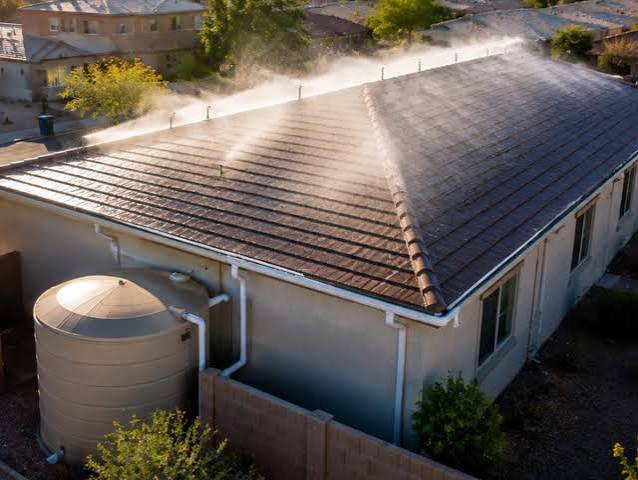
A University of Manchester study published in Earth's Future reveals that harvesting rooftop rainwater and spraying it onto hot building surfaces via AI control reduces air conditioning demand and outdoor urban heat. Tested in Tokyo, the system effectively lowers city temperatures and cuts heatwave frequency.
MANCHESTER — Collecting rainwater from building rooftops and automatically spraying it back onto roof surfaces during peak heat conditions can lower urban temperatures, cut air conditioning energy demand, and reduce the total number of heatwave days, according to new research released by The University of Manchester. Published in the journal Earth's Future on August 5, 2026, the study demonstrates that deploying artificial intelligence (AI) to optimize rainwater harvesting and roof sprinkling systems offers a scalable, nature-based cooling mechanism for warming metropolitan areas.
Breaking the Air Conditioning Feedback Loop
Conventional urban cooling relies heavily on mechanical air conditioning units, which create a compounding environmental problem. While air conditioners lower indoor temperatures, they expel large amounts of waste heat directly into surrounding streets and alleys, worsening the "urban heat island" effect.
To break this cycle, a team led by Dr. Zhonghua Zheng at the Manchester Environmental Research Institute designed a process-based numerical model paired with AI algorithms to test a Rainwater Harvesting and Roof Sprinkling System (RWTSP). Using Tokyo as a primary real-world test case across a 0.6-square-kilometer zone containing nearly 2,000 rooftops, the simulation demonstrated that evaporative cooling on roof surfaces significantly prevents thermal energy from penetrating building interiors.
The dual cooling mechanism produces two structural results:
Indoor Thermal Shielding: Cooler roofs transfer significantly less heat into upper building floors, directly curbing indoor power consumption for space cooling.
Outdoor Waste Heat Reduction: Decreased air conditioning usage reduces the volume of hot exhaust air dumped into city streets, lowering overall ambient air temperatures and curtailing localized heatwave days.
AI Optimization and Water Efficiency Findings
To evaluate system efficiency, the researchers trained a machine-learning model (TabPFN) combined with genetic optimization algorithms to analyze variables such as tank capacity, trigger temperatures, and water delivery rates. The findings revealed that automated activation timing plays a far more critical role than tank capacity or total water volume.
| System Parameter | Research Finding | Operational Impact |
| Activation Timing | Temperature-triggered sprinkling yields maximum evaporative efficiency. | Sprinklers engage automatically only when roof surfaces exceed set heat thresholds. |
| Tank Capacity | Modest storage tanks capture most energy savings; oversized tanks offer diminishing returns. | Lower capital installation costs for building owners through smaller water retention tanks. |
| Water Volume | Excess water application produces diminishing cooling benefits. | Prevents water waste by avoiding standing water accumulation on roof membranes. |
| Climate Scaling | System performance improves during hotter summers. | Energy savings and cooling efficiency increase as atmospheric warmth intensifies. |
Beyond thermal management, the researchers identified a key hydrological benefit: retaining rainwater on rooftops before controlled release reduces flash flooding and storm-runoff surges across municipal drainage networks during intense rainfall events.
Official Sources Section
Research metrics, simulation parameters, and mathematical modeling details contained in this dispatch are sourced from official scientific publications released by The University of Manchester and the peer-reviewed journal Earth's Future published by the American Geophysical Union (AGU).
Quote Section
"Air conditioning can help keep people safe and comfortable, but it also consumes large amounts of energy and releases additional heat into the urban environment. Our study shows that harvesting rainwater from roofs and using it strategically for cooling could provide a practical way to reduce both energy demand and urban temperatures. What is particularly encouraging is that the benefits become even greater during hotter years," stated Dr. Zhonghua Zheng, Senior Lecturer in Environmental Analytics at The University of Manchester.
Why It Matters
Implementing AI-managed rooftop rainwater cooling offers urban planners and municipal governments a cost-effective, blue-green infrastructure solution to climate adaptation. By reducing peak electricity demand during extreme heat waves, cities can stabilize municipal power grids, lower greenhouse gas emissions from fossil-fuel power plants, and mitigate public health risks associated with prolonged urban heat exposure.
Key Facts at a Glance
Study Institution: The University of Manchester (published in AGU's Earth's Future).
Primary Methodology: Process-based numerical simulations paired with AI genetic optimization algorithms.
Core Test City: Tokyo, Japan (analyzing nearly 2,000 rooftops across 0.6 square kilometers).
Key Benefits: Reduces AC energy consumption, lowers ambient city temperatures, decreases heatwave frequency, and mitigates urban storm runoff.
FAQ Section
How does rooftop rainwater harvesting reduce air conditioning use?
By storing rainwater and spraying it onto hot roof surfaces, the system uses evaporative cooling to prevent heat from entering the building. Cooler interiors reduce the energy required by air conditioning systems to maintain comfortable indoor temperatures.
Why does reducing air conditioner use help cool an entire city?
Air conditioners extract indoor heat and vent it outside as waste heat. When thousands of air conditioners run simultaneously, they raise outdoor temperatures, intensifying the urban heat island effect. Lowering AC usage reduces this outdoor heat exhaust.
Do building owners need very large water tanks for this system to work?
No. The study demonstrated that modest storage tanks provide significant cooling performance. Oversized tanks yield diminishing returns because automated timing is more important than total water volume.
Does this system work during dry spells without rain?
The system relies on pre-stored rainwater collected during preceding precipitation events. Intelligent AI management optimizes tank reserves so stored water is released only during peak thermal conditions.
Source: The University of Manchester Press Office, Earth's Future / AGU Journal, American Geophysical Union.