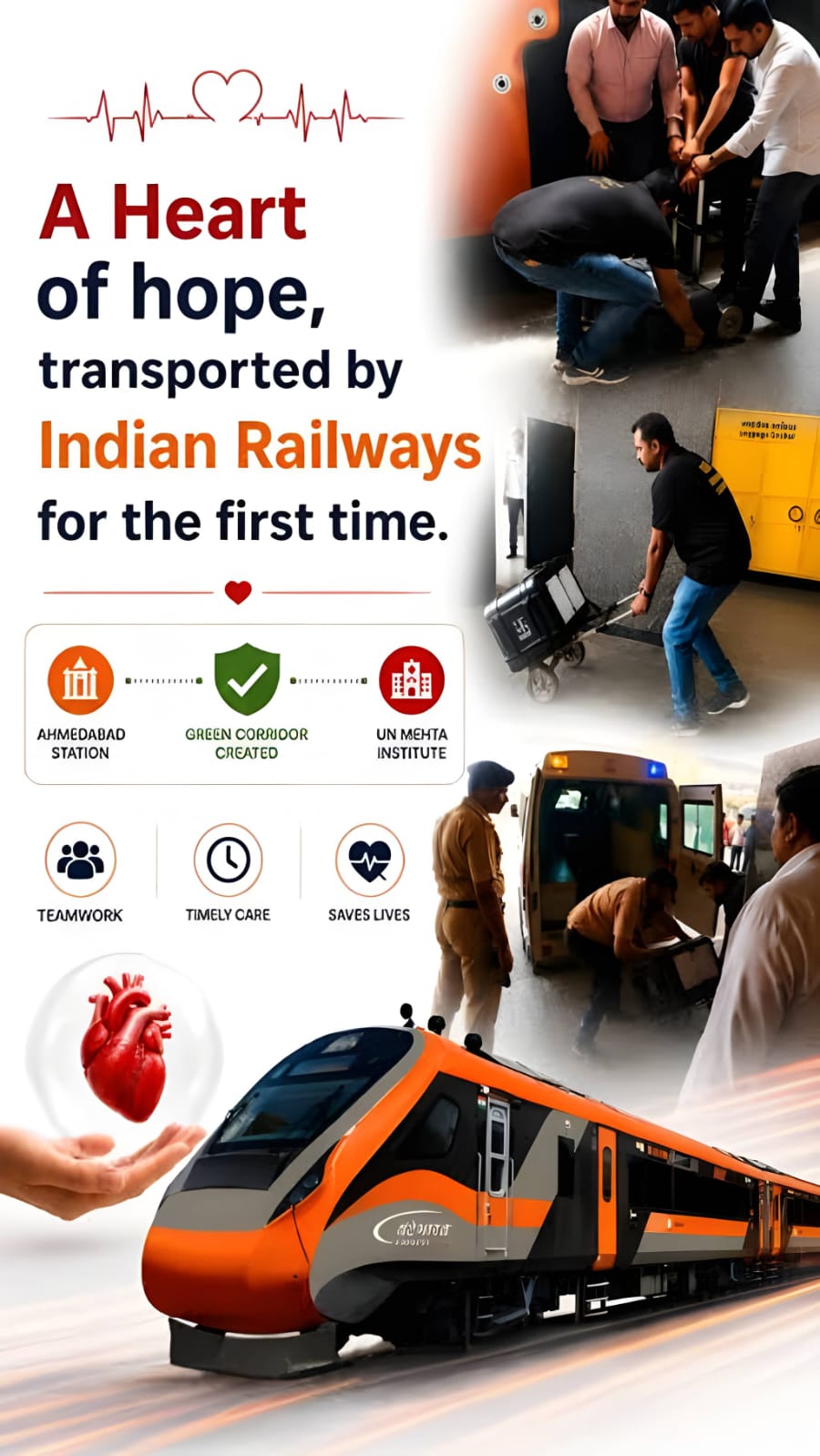
In an unscheduled operational maneuver, India’s Vande Bharat Express made a historic unscheduled stop at Ankleshwar Railway Station on Sunday to transport a harvested human donor heart to Ahmedabad for emergency transplantation surgery. The high-speed transit highlights the expanding utility of passenger rail networks in medical logistics.
AHMEDABAD, India — Indian Railways made an unscheduled operational stoppage of the semi-high-speed Vande Bharat Express at Ankleshwar Railway Station on Sunday, August 2, 2026, to transport a live human donor heart to Ahmedabad for an urgent transplant procedure. The vital organ was harvested at Smt. Jayaben Modi Multi-Specialty Hospital in Ankleshwar and transported rapidly via a coordinated "Green Corridor" to the platform before being boarded onto the express train bound for Ahmedabad's U.N. Mehta Institute of Cardiology and Research Centre. This emergency mission represents the second time within three days that Indian Railways has utilized its flagship high-speed rail assets for critical organ transit in Gujarat.
Precision Coordination and Medical Green Corridors
The emergency operation was triggered following the successful harvesting of a donor heart at the Smt. Jayaben Modi Multi-Specialty Hospital in Ankleshwar. Human hearts harvested for organ transplantation have a viable cold ischemia time window of roughly four hours, requiring seamless inter-agency coordination between medical teams, law enforcement, and railway dispatchers.
To facilitate the movement, local administration and the Gujarat State Police established an uninterrupted surface Green Corridor from the hospital to Platform No. 1 at Ankleshwar Railway Station, clearing traffic and enabling the ambulance to arrive within minutes. A dedicated team of cardiac specialists from U.N. Mehta Institute was present on board the Vande Bharat Express to monitor the organ container during transit.
Upon arrival at Ahmedabad Railway Station, a secondary Green Corridor organized by the Railway Protection Force (RPF) and Gujarat Police allowed immediate, unhindered transfer from the train platform directly into the surgical suite at the U.N. Mehta Institute. Hospital authorities confirmed that the procedure marked the institution's 78th successful cardiac transplant.
Rapid Expansion of Rail-Based Organ Logistics
Sunday’s operation follows a precedent set just two days prior. On Friday, July 31, 2026, Indian Railways recorded the first-ever train-based live heart transit in India when the Mumbai Central–Gandhinagar Capital Vande Bharat Express (Train No. 20901) delivered a donor heart across 250 kilometers from Surat to Ahmedabad in approximately two hours and 30 minutes.
Historically, long-distance medical organ transit in India relied heavily on dedicated air ambulances, charter flights, or extensive highway police escorts. However, adverse weather, air traffic constraints, and highway congestion often introduce unpredictable delays. The high operational speeds, strict punctuality, and dedicated track priority of semi-high-speed rail services offer healthcare providers a reliable terrestrial alternative for inter-city organ transfers.
The integration of high-speed passenger rail into medical emergency networks demonstrates a growing synergy between transport infrastructure and public health services. Senior officials noted that standardized operational protocols are being evaluated to formalize organ transit procedures across the national rail system.
Official Sources Section
Information regarding this medical transit operation was verified through official communications from the following organizations:
Ministry of Railways (Government of India): Official press briefing and operational releases covering Western Railway and Western Zone train dispatching.
Western Railway / Ahmedabad Railway Division: Statements issued by Divisional Railway Management (DRM) regarding platform management and Green Corridor coordination.
U.N. Mehta Institute of Cardiology and Research Centre: Medical updates regarding transplant surgical execution and patient admission status.
Gujarat State Police & Railway Protection Force (RPF): Traffic management and security enforcement records regarding green corridors in Ankleshwar and Ahmedabad.
Quote Section
According to officials from the Ahmedabad Railway Division, the life-saving mission showcased seamless inter-agency collaboration under strict time constraints.
"The successful transportation of a live donor heart from Ankleshwar to Ahmedabad through the Vande Bharat Express demonstrates our commitment to serving society beyond conventional passenger and freight transportation," stated Ved Prakash, Divisional Railway Manager (DRM) of the Ahmedabad Division. "In such life-saving missions, every minute is crucial, and Indian Railways will continue to serve as a vital partner in emergency healthcare services."
Organizers and state government representatives echoed these sentiments, noting that the combination of high-speed rail capabilities and dedicated traffic management has opened new possibilities for organ preservation and delivery.
Why It Matters
The successful execution of this emergency run carries practical implications for patients, healthcare logistics providers, and urban planners:
Extended Range for Organ Procurement: High-speed rail connections enable regional hospitals in tier-2 and tier-3 cities—such as Ankleshwar—to act as organ donor centers for major metropolitan transplant hubs like Ahmedabad.
Cost-Effective Alternative to Air Transit: Utilizing existing rail schedules with scheduled or special stops reduces the high financial burden associated with air ambulance chartering for critical organ delivery.
Reliability Under All Weather Conditions: Unlike helicopters or light aircraft, which are susceptible to monsoon rains and low visibility, high-speed rail operates predictably regardless of adverse weather.
Key Facts at a Glance
Route Covered: Ankleshwar Railway Station to Ahmedabad Railway Station, Gujarat.
Organ Transported: Human donor heart retrieved from Smt. Jayaben Modi Multi-Specialty Hospital.
Destination Facility: U.N. Mehta Institute of Cardiology and Research Centre, Ahmedabad (78th heart transplant).
Inter-Agency Logistics: Joint Green Corridor established by Gujarat State Police and Railway Protection Force (RPF).
Operational Milestone: Second live organ transit carried out by the Vande Bharat Express network within three days.
FAQ Section
How long can a donor heart remain viable during transport?
A harvested donor heart typically remains viable outside the body for approximately four to six hours during cold ischemia. Fast transportation networks are critical to ensure surgery begins well within this safety window.
Why was the Vande Bharat Express chosen for this transfer?
The Vande Bharat Express offers high operating speeds, dedicated track signaling priority, and strict punctuality, making it a reliable terrestrial mode for organ transport when air travel or highway transit is impractical.
Did the emergency stop cause major delays for train passengers?
Railway officials managed the emergency stoppage efficiently at Ankleshwar Railway Station, boarding the medical team and organ container within minutes to minimize impacts on regular passenger timetables.
How does a "Green Corridor" work during organ transportation?
A Green Corridor is a temporarily cleared traffic route coordinated by local police and transit authorities. All traffic signals along the route are set to green, and intersections are manually controlled to allow ambulances or transport vehicles to travel without stopping.
Sources: Ministry of Railways - Government of India, U.N. Mehta Institute of Cardiology and Research Centre