Akanksha Dubey, 27, Co-Founder for Business and Strategy, and Shivam Sharma, Co-Founder and technical lead, founded Cinefai in 2020 and launched the studio commercially in March 2025. India's first Gen-AI-powered content studio, Cinefai generated ₹50 lakh revenue in its first nine months at 70% profit margins, secured ₹50 lakh equity plus ₹50 lakh debt from Ritesh Agarwal on Shark Tank India Season 5 Episode 11, and is building AI mythology epics including the Ramayana and a Shiva-Vishnu battle.
Founded in 2020, Launched in 2025, and a Question That Would Not Go Away
Cinefai was founded in 2020 by Shivam Sharma and Akanksha Dubey in Mumbai. Akanksha, 27, leads Business and Strategy. Shivam drives the technical architecture. Together they spent years building the foundational AI infrastructure before launching the studio commercially in March 2025 under the legal entity Cinefai Studios Private Limited, registered with ROC Mumbai on August 5, 2025 at Mohid Height, Andheri West.
The founding conviction was both simple and radical: cinematic storytelling had historically required enormous resources, technical crews, expensive equipment, and months of production. Generative AI had fundamentally changed what was possible. The question was who would build the infrastructure to make those capabilities accessible to the creators who needed them most.
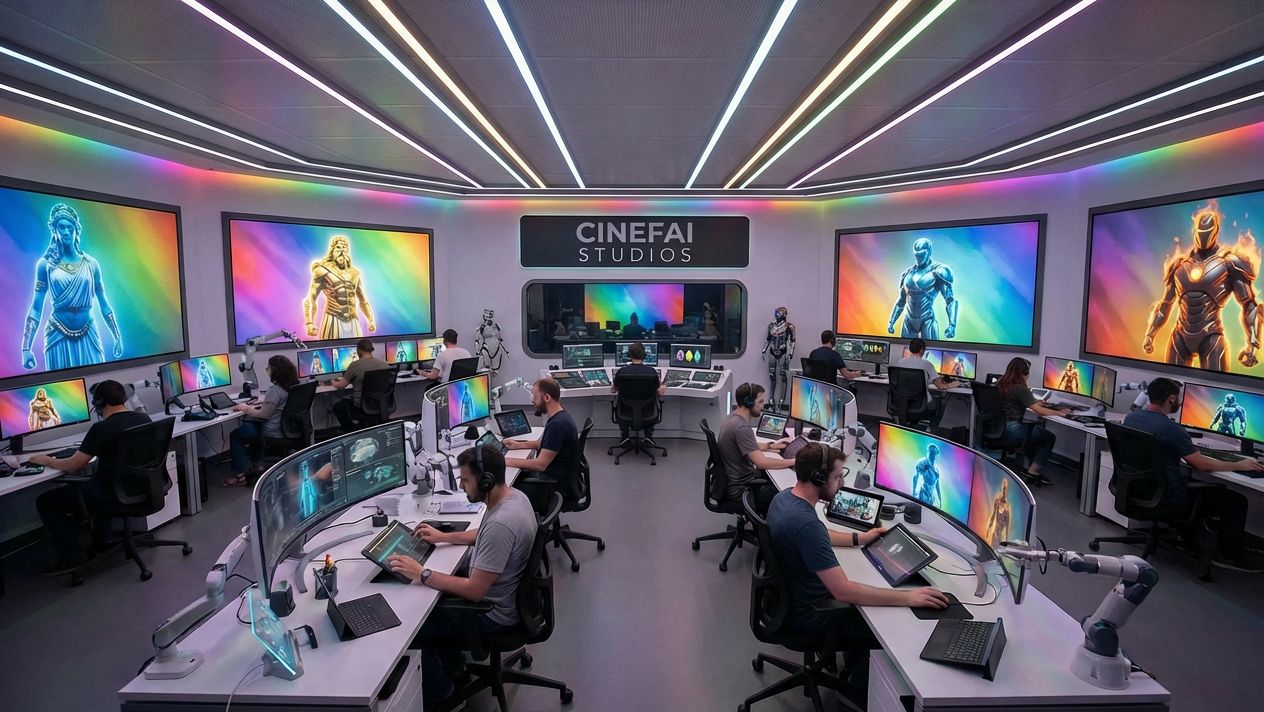
Cinefai set out to answer that question by building India's first genuinely AI-native content studio, a platform that transforms ideas, scripts, or audio recordings into full-length videos or film scripts, supporting marketing videos, audio stories, explainer clips, and film scripts. It blends open-source AI tools with a custom storyboarding agent, allowing faster, lower-cost content creation without traditional production pipelines.
The studio's founding philosophy was precise: AI technology empowers creators. It does not replace them. Human storytellers guide the cinematic worlds. AI builds them.
Ramayana, Microdrama Dystopian Sci-Fi, Shiva vs Vishnu, and a Superhero Film Built for the Room
The boldest creative decision Cinefai made was to build India's mythology as its proof of concept, the most visually complex, culturally significant, and emotionally resonant content category available, and demonstrate the platform's capability on exactly that stage.
The studio created AI-powered explorations of Indian mythology including a dramatized battle between Lord Shiva and Lord Vishnu and an original microdrama dystopian sci-fi series before embarking on its most ambitious project: an AI-led reinterpretation of the Ramayana told as an episodic series. The studio has already unveiled both a trailer and the first episode of the Ramayana series on YouTube, making the project publicly accessible and inviting the world to see what AI-native cinema could achieve at its most ambitious. That body of work, mythology at AI scale and genre-defying original sci-fi storytelling, became the creative credential behind everything that followed.
For the Shark Tank pitch, Akanksha and Shivam made a different kind of film entirely. They created an AI-generated superhero film specifically featuring the Sharks as the characters, screened it live in the tank, and watched the room react in real time. The Sharks were visibly impressed by the visual quality, pacing, and ambition. An AI-generated film had done in ninety seconds what a hundred slides could not: made the technology feel personal, real, and undeniably powerful.
The Shark Tank Moment — One Shark Saw What Others Missed
Cinefai Studios appeared on Shark Tank India Season 5 Episode 11. Akanksha and Shivam entered seeking ₹1 crore for 5% equity at a ₹20 crore valuation.
The Sharks were impressed by the demonstration but divided on the investment case. Questions emerged around whether Cinefai was a scalable business or still an early creative experiment, the repeatability of episodic AI storytelling, and the long-term sustainability of a studio model built on generative AI. Every Shark except one stepped back.
Ritesh Agarwal, founder of OYO, stepped in with a structured offer: ₹50 lakh for 5% equity plus ₹50 lakh as debt at 9% interest for five years, a combined investment package worth ₹1 crore. Akanksha and Shivam accepted, securing both capital and one of India's sharpest young investors as a strategic partner.
Scale and Real-World Impact
| Performance and Industry Category | Strategic Operational Metrics & Details |
| Corporate Foundations | Founded in 2020 • Headquartered in Andheri West, Mumbai |
| Legal Entity Identification | Cinefai Studios Private Limited • Registered August 5, 2025 |
| Commercial Launch Window | Launched commercially in March 2025 |
| Financial Execution Track | Generated ₹50 lakh in revenue within nine months at nearly 70% profit margins |
| Total Venture Capital Stack | Stands at $54.9K across two total rounds |
| Capital Event Timeline | First angel round and conventional debt round both executed January 21, 2026 |
| Shark Tank Capitall | Ritesh Agarwal is verified as the sole Shark Tank investor |
| Market Density Position | Operates among 263 active global competitors (including Lightricks, VideoVerse, and Runway), of which 35 are funded |
| Public Platform Showcases | The Ramayana episodic series trailer and first episode are live on YouTube |
| Macro Policy Framework | Budget 2026 places Animation, VFX, Gaming, and Comics at the center of India's jobs strategy, targeting 2 million professionals by 2030 and creator labs across 15,000 schools and 500 colleges |
The Most Powerful Product Demonstrations Are the Ones That Make the Audience the Star
The sharpest lesson from Cinefai Studios' journey is this: the most memorable pitches in any room are not the ones that explain what the technology can do. They are the ones that show the audience what the technology can do for them.
Akanksha and Shivam could have described Cinefai's capabilities. They could have shown a reel of client work. They chose instead to make the Sharks the heroes of a film and let the experience speak for itself. That decision changed the entire energy of the room. It proved the platform's capabilities in real time. And it created one of the most talked-about moments in Shark Tank India Season 5.
The future of cinema is being built from a platform, not a set. A 27-year-old building the business. A technical co-founder building the infrastructure. A mythology epic on YouTube. And one Shark who saw it first.
Sources: Zee Business, Crunchbase, PitchBook, LinkedIn, Startup Hyderabad, Tracxn, StartupArticle, Angeltors Blog