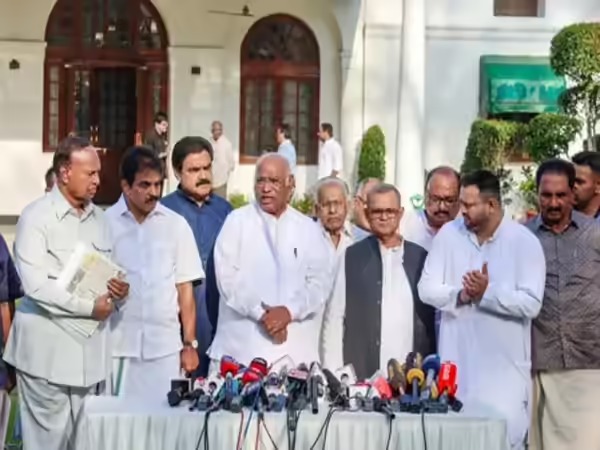
Twenty-three opposition parties are meeting at New Delhi's Constitution Club today for the "INDIA Janbandhan" summit. Led by Mallikarjun Kharge and Mamata Banerjee, the coalition aims to align on key economic and constitutional policies while navigating a boycott by the DMK and simmering electoral disputes in Kerala and Jharkhand.
NEW DELHI — Leaders from 23 opposition parties are scheduled to convene at the Constitution Club in the national capital today, Monday, June 8, 2026, for a high-stakes meeting of the Indian National Developmental Inclusive Alliance (INDIA) bloc. This marks the coalition's first major organizational huddle following recent state legislative assembly election setbacks and amid escalating friction between key regional partners.
The strategy session, officially designated by leadership as the "INDIA Janbandhan" assembly, comes at a precarious moment for the opposition. While senior managers aim to present a unified national front against the ruling Bharatiya Janata Party (BJP), the summit must navigate immediate challenges, including a formal boycott by the Dravida Munnetra Kazhagam (DMK) and simmering ideological disputes in Kerala and West Bengal.
High-Profile Attendees and Coordination Strains
The conference is expected to draw prominent national and regional figures. According to administrative alerts circulated by the Indian National Congress, the delegation will be anchored by Congress President Mallikarjun Kharge, Leader of the Opposition Rahul Gandhi, and Priyanka Gandhi Vadra.
Key regional leaders confirming physical participation include:
Mamata Banerjee and Abhishek Banerjee representing the All India Trinamool Congress (TMC).
Uddhav Thackeray leading the Shiv Sena (UBT).
Akhilesh Yadav representing the Samajwadi Party (SP).
Tejashwi Yadav of the Rashtriya Janata Dal (RJD).
Kalpana Soren representing the Jharkhand Mukti Morcha (JMM).
Despite these confirmations, internal organizational rifts remain highly visible. The DMK, a core pillar of the alliance in southern India, explicitly announced its decision to skip the Delhi session. DMK leadership categorized the Congress party's recent post-election alignment with the Tamilaga Vettri Kazhagam (TVK) in Tamil Nadu as a strategic "betrayal" of their local seat-sharing pact, subsequently requesting independent seating blocks within the Lok Sabha.
Multi-Layered Policy Agenda and Domestic Critiques
While a finalized legislative agenda has not been publicly formalized, Congress General Secretary (Communications) Jairam Ramesh detailed the primary thematic fronts the alliance intends to coordinate on. The alliance's overarching strategy centers on constructing unified parliamentary resistance against what they characterize as the centralization of state power.
According to statements broadcast via Ramesh’s official communications channel, the 23 attending units are seeking alignment on five core challenges:
Countering alleged systemic adjustments affecting the electoral franchise of marginalized citizens.
Challenging institutional overreach directed at regional opposition figures via central investigative agencies.
Formulating economic interventions to address persistent double-digit inflation and widening unemployment.
Addressing structural vulnerabilities within current domestic agricultural frameworks.
Evaluating recent modifications in national foreign policy frameworks.
The focus on national issues also serves an internal purpose: anchoring the coalition around shared macro policy goals to distract from severe localized disputes. For instance, the TMC arrives in Delhi immediately following severe electoral losses in the West Bengal assembly elections and amidst internal party updates designed to suppress a rebellion of 58 state legislators.
Resolving Frontline Friction in Kerala and Jharkhand
A secondary, critical component of today's huddle will be managing localized friction points that threaten the long-term survival of the bloc. The Communist Party of India (Marxist) confirmed it will send Rajya Sabha Member of Parliament John Brittas to the session, but only to formally demand administrative clarifications from the Congress high command.
The dispute stems from a formal letter dispatched by CPI(M) General Secretary M.A. Baby to Mallikarjun Kharge. The Left leadership expressed sharp objections to campaign rhetoric deployed by Rahul Gandhi and other senior Congress officials during the Kerala state elections, where Congress repeatedly accused then-Kerala Chief Minister Pinarayi Vijayan of maintaining a covert political understanding with the BJP.
Concurrently, tensions with the JMM remain strained over candidate selections. JMM leadership expressed formal dissatisfaction after Congress unilaterally declared its own representative for an upcoming Rajya Sabha vacancy in Jharkhand, prompting JMM to subsequently nominate former Minister Baidyanath Ram. Today's meeting represents a critical operational test of whether the alliance can build sustainable dispute-resolution mechanisms or if it faces further structural fragmentation.
Official Sources Section
The schedule, venue logistics, and list of participating political entities were formally validated through public announcements by Congress General Secretary Jairam Ramesh and official media briefs issued by the All India Trinamool Congress media bureau.
Quote Section
In a statement issued on the eve of the gathering, Jairam Ramesh sought to minimize public speculation regarding a broader collapse of the opposition framework:
"Like India, the INDIA janbandhan continues to stand united through its diversity. There are some parties that have expressed their inability to attend this particular meeting for their own reasons, even though they have conveyed their strong opposition to the Modi government's policies."
Why It Matters
For everyday citizens, businesses, and investors, the outcome of today's INDIA bloc meeting determines the stability and character of political governance in India. A coherent, functional opposition alliance ensures robust debate on economic policies, taxation, and inflation within Parliament, acting as a crucial check on unilateral lawmaking. Conversely, if the coalition fails to resolve its regional disputes, increased political fragmentation could weaken parliamentary oversight on key consumer, corporate, and infrastructure expenditures.
Key Facts at a Glance
Participation Threshold: Twenty-three distinct opposition parties have confirmed attendance at the Constitution Club meeting today.
Major Absence: The DMK is boycotting the Delhi session, citing a breakdown of trust with Congress following the Tamil Nadu assembly elections.
Left-Wing Grievance: The CPI(M) has demanded an official retraction from Congress regarding campaign allegations made in Kerala.
TMC Presence: West Bengal leader Mamata Banerjee is personally attending the summit despite facing internal party strains and recent assembly defeats.
FAQ Section
1. Why was this specific INDIA bloc meeting called?
The meeting was organized to rebuild a unified opposition strategy following recent state assembly election cycles, coordinate parliamentary pushbacks against central government policies, and resolve growing regional disputes between alliance members.
2. Which prominent political parties are skipping today's session?
The Dravida Munnetra Kazhagam (DMK) is boycotting the meeting due to political disputes with Congress in Tamil Nadu. The Aam Aadmi Party (AAP) is also unlikely to participate in today's active discussions.
3. What are the main policy items on the opposition's agenda?
The 23 parties are seeking common ground on tackling inflation, addressing high unemployment rates, protecting constitutional norms, and resisting the alleged misuse of central investigative agencies against regional leaders.
4. What internal dispute is the CPI(M) raising at the meeting?
The CPI(M) is seeking a formal clarification regarding statements made by top Congress leaders during the Kerala election campaign, which alleged a hidden understanding between the Left leadership and the BJP.
Source: Official statements from Congress Communications General Secretary Jairam Ramesh, administrative briefings from the Indian National Congress, and public correspondence from the CPI(M) Central Committee.