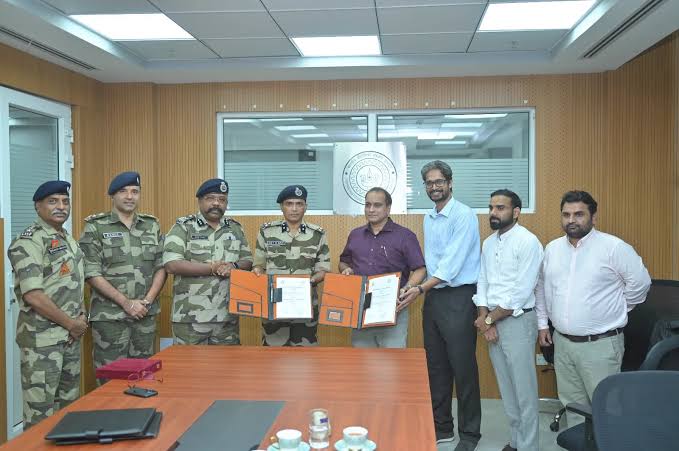
The CISF and IIT Kanpur executed dual institutional frameworks to overhaul national infrastructure defenses. These strategic pacts establish specialized cyber security training and a dedicated counter-drone hub in Rajasthan. Authorities mandate deep research into autonomous aerial threats and digital intrusions to protect India's aviation, nuclear, and heavy industrial grid networks.
The Central Industrial Security Force executed dual institutional agreements on September 14 to combat autonomous aerial threats and operational technology breaches across strategic domestic grids.
The Central Industrial Security Force formalized the CISF IIT Kanpur pact on September 14, locking in dual institutional agreements to modernize national infrastructure defense parameters. Executives executed the frameworks to mitigate escalating vulnerabilities across domestic aviation networks, nuclear installations, and energy sectors. Authorities mandate aggressive intervention protocols against unmanned aerial vehicles and digital network incursions.
Reason 1: Scaling Cyber Resilience Across Heavy Industry
The initial three-year framework activates a six-week residential training block at C3iHub. Zero commercial fees apply. Each cohort processes 40 nominated security operators. The mandated curriculum demands deep tactical integration against artificial intelligence vectors, Internet of Things vulnerabilities, deepfake manipulation, and cloud computing risks. Multi-sector crisis simulations force active participation. Operators must execute digital forensics and incident detection protocols across mock environments replicating severe aviation or nuclear grid failures. This structural upgrade limits domestic exposure to remote operational technology breaches.
Reason 2: Localizing Counter-UAV Hardware Development
The second mandate spans five years. It directs resources toward the Major Police Training and Recruitment Centre in Behror, Rajasthan. Engineering teams will deploy an advanced Centre of Excellence focused entirely on anti-UAV combat parameters. Core research targets radio-frequency interception and micro-Doppler detection systems. Simulated high-altitude rogue drone engagements dictate the primary research scope, forcing operators to execute hardware overrides. Establishing this testing ground accelerates indigenous technological sourcing for critical defense infrastructure.
Reason 3: Shifting Force Readiness Toward Autonomous Threats
These strategic shifts follow explicit directives issued during the 2024 DsGP/IsGP Conference. The CISF IIT Kanpur pact expands an existing academic network built to handle aerial threats. Earlier agreements involving the Drone Federation of India established standard operating procedures for hardware neutralization. Field personnel already total 3,000 operators trained in primary counter-drone protocols. Administrators demand modernized defense units capable of independently tracking swarm drone deployments across 370 highly sensitive installations nationwide.
Official Sources
Central Industrial Security Force Directorate General Filings (September 14, 2026)
IIT Kanpur C3iHub Program Disclosures
Ministry of Home Affairs DsGP/IsGP Conference-2024 Directives
Drone Federation of India Partnership Filings (August 2026)
Official Quote
According to institutional disclosures, CISF officials confirmed the agency mandates the Behror facility to scale into a specialized testing ground. This ensures realistic threat modeling against evolving hardware incursions. Company filings noted that the CISF IIT Kanpur pact aligns directly with the government's mandate to secure critical infrastructure using indigenous technological sourcing.
Why It Matters
Critical infrastructure asset managers face escalating attack vectors from commercial-grade hardware and software breaches. Executing the CISF IIT Kanpur pact limits reliance on imported counter-measures. Airport operators and power plant administrators will interface with a fundamentally modernized defense unit. Indigenous hardware integration accelerates response times against autonomous intrusions.
Key Facts at a Glance
IIT Kanpur’s C3iHub will host a zero-cost, six-week cyber curriculum for 40-person cohorts.
Rajasthan’s MPRTC Behror facility receives a new Counter-UAS Centre of Excellence under a five-year blueprint.
Curriculum elements tackle machine learning threats, digital forensics, and operational technology vulnerabilities.
Research priorities target swarm drone interception, RF detection, and micro-Doppler tracking protocols.
FAQ Section
Q1: What does the CISF IIT Kanpur pact cover?
A1: It mandates specialized digital defense training and funds a dedicated anti-drone research facility in Rajasthan.
Q2: Who pays for the cyber training modules?
A2: C3iHub operates the six-week residential program on a non-commercial basis without charging training fees.
Q3: What hardware threats will the Behror center analyze?
A3: Personnel will model responses against rogue-drone incursions using radio-frequency mapping and micro-Doppler detection tools.
Q4: How does this impact domestic infrastructure?
A4: Aviation and nuclear plants gain better protection from operators trained against modern deepfake, IoT, and automated aerial risks.
SOURCE: CISF Official Press Communications & IIT Kanpur C3iHub Public Filings