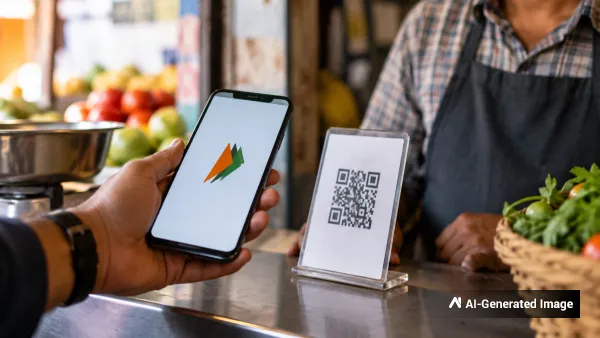
The Ministry of Finance confirmed that person-to-person UPI transfers stay completely free for any amount. Addressing panic over a new 0.4% merchant fee starting October 15, officials reiterated that P2P flows—making up 70% of transaction value—face zero charges, protecting everyday peer-to-peer digital payments.
NEW DELHI, September 15, 2026 — Amid mounting confusion over upcoming digital payment adjustments, the Ministry of Finance officially clarified that person-to-person (P2P) Unified Payments Interface (UPI) transactions will remain completely free with no limits on transaction size. Issued from New Delhi following stakeholder anxiety over newly gazetted merchant processing rules, the announcement aims to distinguish everyday peer transfers from upcoming business-side fee structures taking effect October 15, 2026. For millions of retail users, family remitters, and everyday senders, the clarification resolves persistent rumors regarding hidden peer-to-peer taxation.
Deconstructing the Confusion: Why ₹2,000 Sparked Panic
Public apprehension peaked after regulatory filings and National Payments Corporation of India (NPCI) circulars outlined a 0.4% Merchant Discount Rate (MDR) for certain person-to-merchant (P2M) transactions exceeding ₹2,000, alongside flat ₹5 fees for specialized essential sectors.
Social media speculation misconstrued the ₹2,000 threshold as a universal spending cap or a trigger for consumer transaction fees. Government officials emphasized that P2P transfers—accounting for 37% of total volume and 70% of total value across the national real-time payment architecture—sit entirely outside the MDR framework. Sending ₹5,000 to a friend or moving funds across self-owned accounts incurs zero direct or indirect consumer charges.
Framework Breakdown: P2M vs. P2P
| Parameter | Person-to-Person (P2P) | Person-to-Merchant (P2M) |
| Applicable Scope | Transfers to family, friends, personal handles | Payments to registered business QR/POS terminals |
| Transaction Fee | ₹0 (Free, any amount) | Free up to ₹2,000; 0.4% above ₹2,000 (capped at ₹300) |
| Small Vendor Rule | N/A | Zero MDR for vendors under ₹1 lakh/month QR receipts |
| Effective Date | Ongoing zero-fee policy | October 15, 2026 |
Official Sources Section
Ministry of Finance official release and policy clarification (September 2026).
National Payments Corporation of India (NPCI) UPI & Services Steering Committee guidelines.
Gazette notification under Section 10A of the Payment and Settlement Systems Act, 2007.
Quote Section
According to official statements issued in the Ministry of Finance release: “For person-to-person (P2P) transactions, there will be no charges at all, irrespective of transaction value. P2P transactions constitute 37% of the total UPI transactions in volume terms and 70% in value terms.”
Addressing consumer safeguards, ecosystem participants noted that MDR represents a back-end merchant processing distribution metric rather than a consumer tax.
Why It Matters
Transparent demarcation between consumer-facing peer transfers and merchant acquisition costs preserves public trust in India's digital public infrastructure. With UPI processing hundreds of billions of annual transfers, shielding P2P rails from friction ensures grassroots financial inclusion remains uncompromised while back-end network sustainability is managed via targeted corporate-side contributions.
Key Facts at a Glance
P2P UPI transfers remain 100% free regardless of the amount sent or received.
The ₹2,000 threshold applies strictly to select merchant (P2M) categories starting October 15, 2026.
P2P traffic represents 37% of transaction volume and 70% of total value nationwide.
Small neighborhood vendors collecting under ₹1 lakh monthly via QR retain zero-MDR status [cite: 1.1.5].
FAQ Section
Will I pay a fee if I transfer ₹10,000 to a family member via UPI?
No. P2P transfers carry zero charges regardless of the transferred amount .
Does the ₹2,000 rule mean everyday UPI shopping costs extra for consumers?
No. MDR is borne by applicable merchants, and government advisories direct that processing fees not be illegally shifted to retail buyers.
Do recurring auto-pay (UPI AutoPay/Mandates) utility bills face this charge?
No, recurring automated instruction structures for utilities and subscriptions are exempt from these percentage MDR levies.
When do the new merchant rules kick in?
October 15, 2026, giving payment apps and banks lead time for system updates.
Source: Ministry of Finance, Government of India; National Payments Corporation of India (NPCI); Gazette Notification on Payment and Settlement Systems.