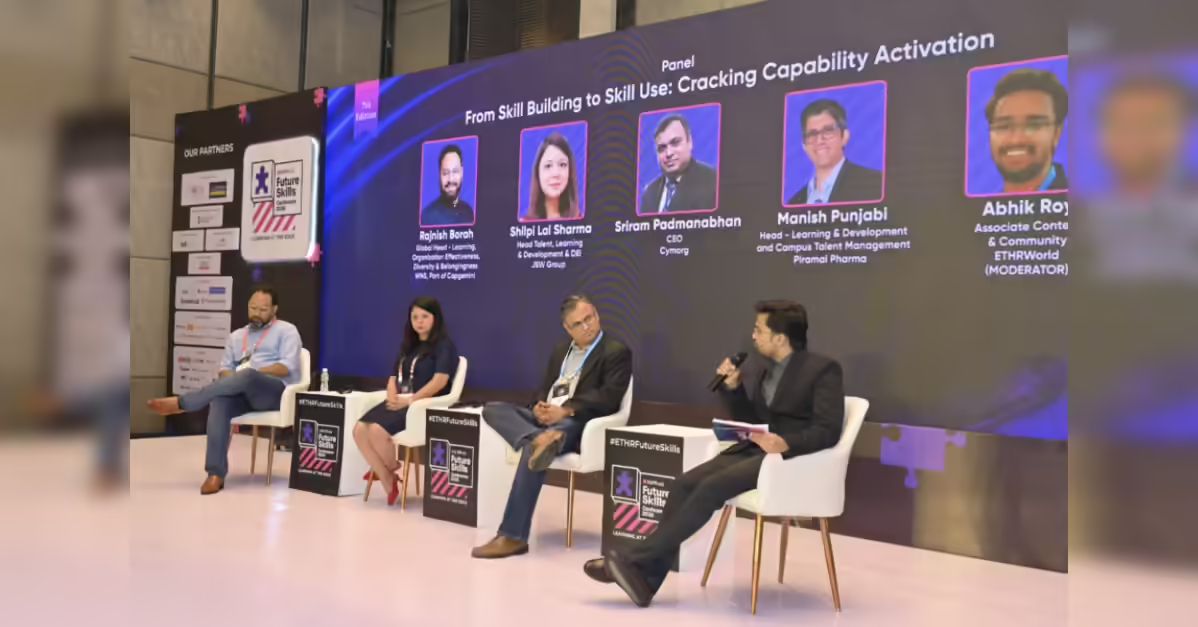
At the ETHRWorld Future Skills Conference 2026, corporate learning leaders from WNS, JSW Group, and Cymorg stressed that capability building must shift focus from training completion to skill activation. Organizations must leverage diagnostics, business ownership, and simulations to turn upskilling investments into clear business outcomes and internal mobility.
MUMBAI — Global corporations are investing heavily in employee upskilling programs, yet the true competitive advantage rests on whether workforce talent can successfully deploy those capabilities in high-stakes operational moments. At a premier national human resources conclave, leading corporate learning and development (L&D) executives collectively stated that organizational capability building must aggressively move past mere "training completion" metrics to prioritize active, baseline "skill activation."
According to corporate dispatch reports published on June 12, 2026, by the specialized HR platform ETHRWorld from The Economic Times, this structural shift dominated panel panels at the high-profile ETHRWorld Future Skills Conference 2026. Top human resource executives from prominent industrial firms, including WNS, JSW Group, and tech firm Cymorg, detailed how traditional L&D investments often lose commercial traction because companies measure training success by the hours logged in classrooms rather than real-world on-the-job application.
Technical Allocation of the Skill Activation Matrix
To transform massive upskilling investments into measurable, bottom-line business value, panel executives outlined a structured, four-tier operational framework.
According to programmatic data presented by industry leaders, traditional learning frameworks frequently fail because they operate in complete isolation from daily business realities. Executives agreed that the baseline value of modern workforce training is realized only when newly acquired skills are visibly utilized to sharpen executive decision-making, elevate customer engagement parameters, systematically troubleshoot workflow problems, and optimize internal corporate career pathways.
Redefining the Structural Relationship Between HR and Business Units
A major topic during the conference focused on rewriting the corporate playbook regarding who owns the ultimate responsibility for continuous employee learning.
Moving From Simple Order-Takers to Strategic Challengers
Sanjay Borah, Co-Chief Human Resources Officer at professional services firm WNS, argued that business units must stop treating training as an outsourced human resources task and start taking active operational ownership of the entire capability lifecycle.
According to the official panel transcription, the structural breakdown of this cultural transition includes:
The Strategic Refusal: Corporate learning teams must stop functioning as passive order-takers. They need to challenge internal requests, ask sharper questions, and actively reject training modules that do not solve a real, documented business problem.
The Discernment Factor: Prerna Sharma, Head of Learning and Organization Development at JSW Group, pointed out that organizations regularly mix up a superficial demand for training with actual capability gaps. The true core of an L&D professional’s job lies in looking past surface-level employee "wants" to find underlying business "needs."
Targeting "Difficult Skills": Apurva Padmanabhan, Co-Founder and Chief Product Officer at Cymorg, stressed the clear difference between easy-to-teach technical skills and highly complex behavioral traits, such as advanced situational judgment under severe corporate market pressures.
Linking Artificial Intelligence Training to Live Operational Proofs
Sanjay Borah shared that at WNS, employees undergoing advanced artificial intelligence capabilities programs are explicitly required to execute functional capstone projects, proofs of concept (PoCs), and working prototypes that link back directly to their active day-to-day business workflows. The firm uses this hands-on approach to force employees to physically reimagine actual, live work using their newly gained technical knowledge.
Crucially, Borah warned that if an organization spends capital training its staff but fails to provide open internal career pathways where those advanced skills can be regularly exercised, trained employees become deeply frustrated and quickly leave the company for external rivals.
Systemic Integration and Hyper-Contextual Simulation
The panel concluded that sustaining long-term capability gains requires a complete systems-thinking overhaul across the corporate landscape.
"According to executive industry briefs captured by The Economic Times, advanced learning programs cannot function as isolated corporate silos. True talent optimization happens only when skill acquisition is directly woven into core performance management systems, regular internal talent mobility, and structural corporate succession planning."
Apurva Padmanabhan noted that utilizing advanced simulation platforms allows employees to experience realistic, high-pressure business scenarios safely before stepping into new management positions. The panel concluded that creating a progressive corporate culture where managers are directly recognized and rewarded for sharing talent across internal boundaries—rather than hoarding top performers inside their own isolated departments—remains a critical hurdle for modern enterprise retention.
Why It Matters
For enterprise leaders, C-suite executives, and institutional investors, this change in perspective completely redefines how corporate efficiency is calculated. Shifting the spotlight from total training hours to clear skill activation allows companies to cut wasteful spending on redundant, generic video courses and put those resources toward highly customized, high-yield coaching that directly increases profit margins.
For corporate employees and knowledge workers, this strategy moves career advancement away from passive credentials toward verified proof of capability. By tying skill development directly to immediate internal transfers and special assignments, professionals can rapidly scale corporate ladders based on visible performance, keeping their skill sets highly relevant and protected against broader market changes.
Key Facts at a Glance
The Paradigm Shift: Corporate learning executives are calling for an industry-wide pivot away from training completion metrics to track real-world on-the-job skill application instead.
Strategic Refusals Mandated: Modern L&D professionals are being urged to stop taking passive orders from management, giving them the authority to reject training requests that do not align with clear business needs.
The AI Capstone Rule: Top-tier companies like WNS now require employees to build functioning prototypes and proofs of concept directly tied to their own business lines as part of their tech training.
The Retention Hazard: Panelists warned that failing to create immediate internal job vacancies for newly upskilled workers dramatically increases the risk of those employees leaving the firm.
Frequently Asked Questions
What does the phrase "skill activation" mean in a modern corporate setting?
Skill activation is the practical, measurable transition an employee makes from simply finishing an educational course to actively using those new techniques in daily business problem-solving, client interactions, or productivity upgrades.
How can an organization successfully differentiate between a training "want" and a "need"?
A corporate "want" is a generic request for a training course, often driven by current market trends. A true "need" is identified through careful data diagnostics that highlight a specific capability bottleneck currently holding back a business unit's performance.
Why do managers frequently block successful internal employee mobility?
Many managers operate under short-sighted performance goals, leading them to hoard top talent inside their teams to protect their own near-term outputs rather than supporting a culture that advances long-term corporate careers across the wider firm.
Sources:
Executive panel recordings, keynote transcripts, and strategic corporate research papers distributed at the ETHRWorld Future Skills Conference 2026.
Operational human capital optimization files and internal workforce development updates archived by the corporate communications wing of WNS.
Enterprise organization development and technical education framework guidelines published by the JSW Group learning registry.