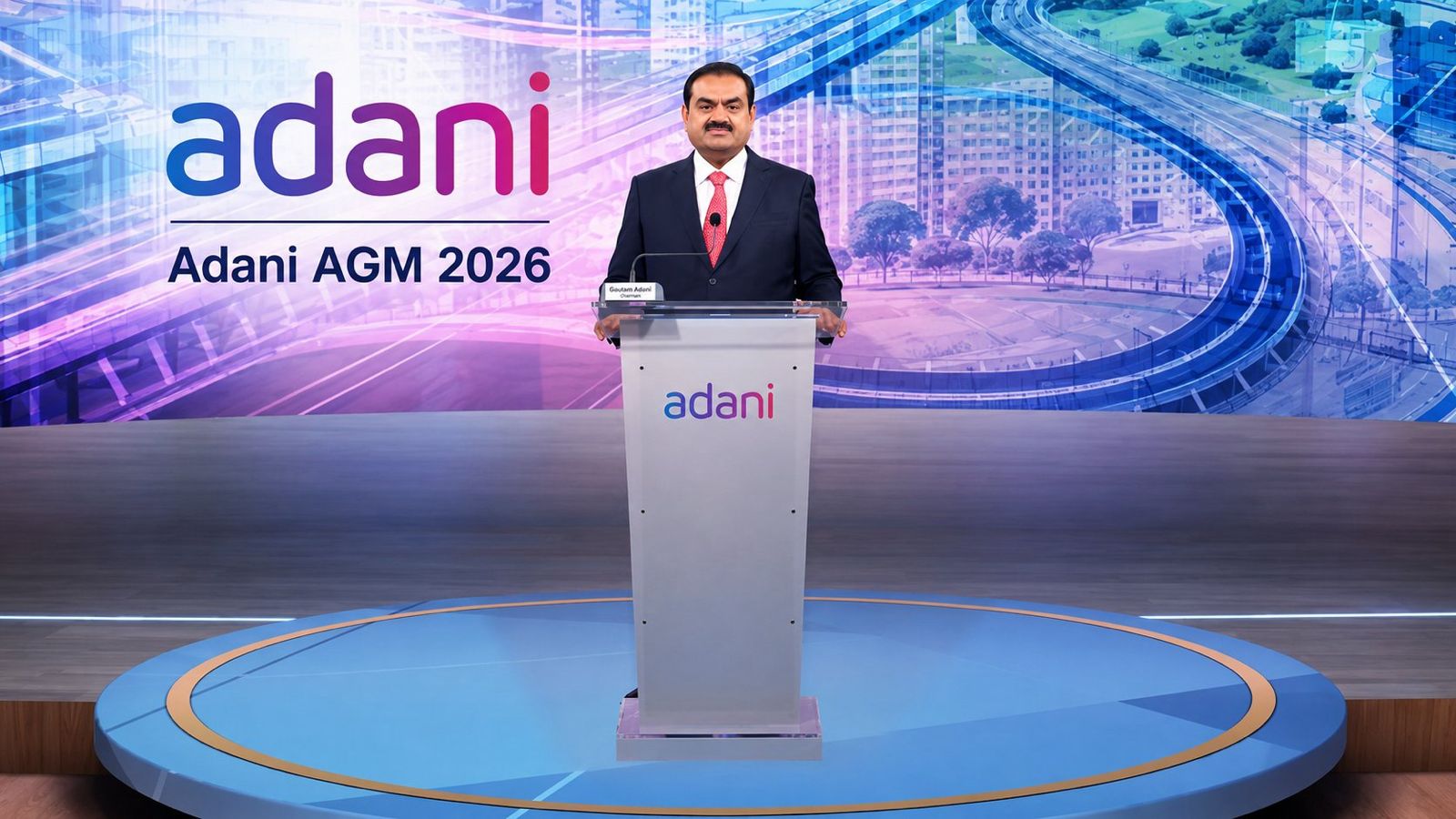
Gautam Adani’s AGM 2026 address positioned infrastructure and intelligence as the twin engines for India’s global growth. The Adani Group committed over Rs 1.5 lakh crore in capital expenditure in FY26, focusing on sovereign AI capabilities, energy transition, and large-scale digital infrastructure to ensure India powers its own future.
NEW DELHI — Adani Group Chairman Gautam Adani has outlined a bold strategic vision for India’s future, identifying infrastructure and intelligence as the “twin global engines” required to secure the nation’s sovereignty and accelerate its economic ascent. Addressing shareholders at the 34th Annual General Meeting (AGM) held on June 24, 2026, Adani emphasized that these two pillars are no longer distinct, but are increasingly inseparable in defining national strength in the 21st century.
"Infrastructure provides the national muscle, while intelligence grants mastery," Adani stated, arguing that India must prioritize building, powering, and owning its digital and physical foundations on domestic soil rather than relying on external ecosystems.
A Vision for Sovereign Growth
The conglomerate’s roadmap, themed "Accelerating Infrastructure, Leveraging Intelligence," posits that India's geopolitical and economic trajectory depends on its ability to control the complete artificial intelligence (AI) value chain. Adani stressed that energy security and digital security have become the "twin pillars of national power."
According to Adani, the assumption that the world remains flat and open is being dismantled by rising geopolitical fragmentation. "Data is being treated as a national resource, and clouds are being weaponized," he noted, urging India to move away from an IT model that merely writes code for the world toward one that builds and hosts intelligence locally. This sovereign approach, he argued, is essential to ensure that India’s future is written at home rather than on "distant shores."
Massive Capital Expenditure in FY26
Reflecting on the group's performance during the financial year 2025–26, Adani highlighted a period of resilience marked by "extraordinary scrutiny" and global volatility. Despite these challenges, the group remained on a path of aggressive expansion:
Capex Milestone: The group recorded a capital investment of over Rs 1.5 lakh crore in hard infrastructure, representing more than 30% of India’s total new private-sector capital expenditure for the year.
Financial Performance: Consolidated portfolio revenue reached Rs 2.92 lakh crore, a 7.4% year-on-year increase, with an EBITDA of Rs 94,834 crore.
Operational Scale: Adani Ports handled over 500 million tons of cargo, while the group’s power arm executed a Rs 2 lakh crore plan targeting 45 gigawatts of capacity over the next five years.
Digital Reach: The group’s data center business is scaling toward a 3-gigawatt platform by 2030, bolstered by a significant MOU with Google.
Strengthening India's Global Stature
Beyond domestic metrics, the Adani Group is expanding its international footprint through strategic energy projects, including a partnership with Bhutan’s Druk Green Power Corporation to develop 5,000 megawatts of hydro capacity and the establishment of Adani Atomic Energy with a 10-gigawatt clean energy target by 2035.
Adani rejected the narrative that AI would primarily lead to job losses in India. Instead, he maintained that the nation's scale—combined with rising electricity demand, rapid urbanization, and digital adoption—positions it uniquely to use AI to expand productivity and empower small businesses.
Why It Matters
For India, Adani’s vision underscores a shift toward "AI sovereignty," where energy and compute infrastructure are treated as critical national assets. This strategic pivot aims to insulate India from external geopolitical pressures, such as the weaponization of cloud data or semiconductor supply chains. For investors and the broader industry, the group’s focus on the "intelligence value chain" suggests a long-term transition from traditional infrastructure projects to high-tech, data-driven platforms.
Key Facts at a Glance
Twin Foundations: Infrastructure (physical) and intelligence (digital) are identified as the primary drivers of India’s sovereignty and global influence.
Aggressive Capex: Over Rs 1.5 lakh crore invested in FY26, accounting for over 30% of India's new private-sector infrastructure spending.
AI Ambition: A push to build, power, and own AI infrastructure domestically to avoid "renting" the nation’s intelligence future.
Financial Resilience: The group reported positive growth in FY26, maintaining a net debt to EBITDA ratio of 3.3x.
FAQ
What does Adani mean by "renting" India's intelligence future?
Adani argues that if India relies on foreign-owned data centers, chips, and cloud platforms for its AI needs, it becomes vulnerable to external control, meaning the nation must build its own domestic compute infrastructure.
What is the core of the Adani Group’s 2030 digital strategy?
The group aims to establish a 3-gigawatt data center platform, supported by significant energy investments to ensure these facilities are powered sustainably.
How is the Adani Group addressing concerns about national resilience?
The group emphasizes its heavy investment in hard assets and energy transition as a way to "provide national muscle," ensuring India is self-reliant in both industrial power and digital compute.
Source: Adani Group AGM 2026 Disclosure, ANI News, NDTV Profit