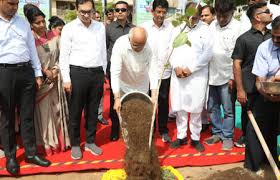
Gujarat Chief Minister Bhupendra Patel launched a mega afforestation drive on World Environment Day, targeting the plantation of 50 lakh trees across Ahmedabad. Led by the municipal corporation, the initiative leverages mobile app integration and corporate partnerships to aggressively expand urban green cover and lower localized Air Quality Index (AQI) hotspots.
AHMEDABAD - On the occasion of World Environment Day, observed globally on June 5, 2026, Gujarat Chief Minister Bhupendra Patel officially inaugurated an expanded urban greening and air quality initiative in the Chandkheda district of Ahmedabad. The campaign, structurally organized under the "Mission Five Million Trees" framework, has set an operational target to plant 50 lakh (5 million) trees across the municipal limits during the 2025–26 fiscal year.
Administered in coordination with the Ahmedabad Municipal Corporation (AMC), this environmental development is deployed to structurally improve the city's Air Quality Index (AQI) metrics. The state executive confirmed that this targeted afforestation approach will explicitly concentrate resources within documented urban pollution hotspots rather than relying on generalized regional coverage.
Targeted Hotspot Afforestation to Mitigate AQI Spikes
According to data released by the Ahmedabad Municipal Corporation, the civic body's Air Quality Department has mapped specific geographic sectors experiencing elevated particulate matter (PM2.5 and PM10) levels. Under the current directive, the AMC will prioritize dense tree buffers along major industrial transport corridors, traffic intersections, and public dividers.
Municipal documents outline that this approach builds upon previous structural baselines. From 2020–21 through 2024–25, the civic body recorded the planting of 93 lakh trees, which successfully expanded Ahmedabad's total canopy to approximately 60 square kilometers—equivalent to 12.5% of the total municipal land area. The current 50 lakh target aims to raise the per capita urban green density beyond the current recorded standing of 8.4 square kilometers.
Institutional Agreements and Corporate Funding
To sustain the maintenance and watering protocols required for high sapling survival rates, the government of Gujarat has executed formal legal frameworks with non-state entities. Memorandums of Understanding (MoUs) have been ratified between the AMC and several Public-Private Partnership (PPP), Corporate Social Responsibility (CSR), and Corporate Environmental Responsibility (CER) institutions.
Under these agreements, corporate participants will manage the long-term irrigation networks and physical security structures for the newly established urban forests and oxygen parks, minimizing the fiscal burden on the municipal treasury.
Digitized Citizen Engagement Programs Launched
The municipal corporation has concurrently integrated citizen-led programs into its administrative application, the AMC Seva Mobile App. Homeowners and local administrative bodies can participate via two distinct mechanisms:
Green Volunteer Program: Citizens register digitally to adopt, monitor, and report the health metrics of public saplings planted in their immediate neighborhoods.
Green Societies Drive: Residential welfare associations (RWAs) can submit spatial requests through the application. Following verification, specialized AMC teams deploy and execute complete tree plantation procedures inside private residential perimeters at zero cost to the inhabitants.
Official Sources Section
The operational details, historic planting metrics, and spatial statistics cited in this report originate from official policy briefs published by the Office of the Chief Minister of Gujarat and the official project logs of the Ahmedabad Municipal Corporation Air Quality Department.
Quote Section
"According to officials from the urban development department, the transition toward a data-driven greening model ensures that botanical interventions are placed where traffic emissions are highest. The objective remains focused on driving a measurable reduction in ambient particulate matter while preparing municipal infrastructure for long-term climate resilience."
Why It Matters
For residents and urban commuters in Ahmedabad, the intensive tree canopy expansion provides a direct mechanism to filter atmospheric pollutants and lower the urban heat island effect. For corporate stakeholders and institutional investors, the formalized PPP and CSR frameworks establish predictable regulatory pathways to fulfill mandated environmental compliance goals while improving the city's public health index.
Key Facts at a Glance
Operational Target: Implementation of a 50 lakh tree plantation directive across Ahmedabad for 2025–26.
Strategic Focus: Placement prioritized within identified air pollution hotspots to reduce regional AQI levels.
Historical Baseline: Green cover in the municipal area reached 12.5% following the planting of 93 lakh trees over the preceding five years.
Civic Infrastructure: Delivery of free residential sapling plantation services managed via the AMC Seva mobile platform.
FAQ Section
Q1: How can individual residential societies apply for the free tree plantation drive?
A1: Citizens can log into the official AMC Seva Mobile Application, navigate to the 'Green Societies' portal, and input their structural location data for free civic deployment.
Q2: What species of trees are being prioritized under the Mission Five Million Trees drive?
A2: The AMC Air Quality Department selects native, broad-leaved species that exhibit high particulate matter absorption capacities and require low to moderate water tables once established.
Q3: Who covers the maintenance costs for trees planted along public roads and dividers?
A3: Maintenance, irrigation, and security costs are funded via the newly signed corporate partnerships under formalized PPP, CSR, and CER agreements.
Source: Ahmedabad Municipal Corporation (AMC), Office of the Chief Minister of Gujarat, National Horticultural Board.