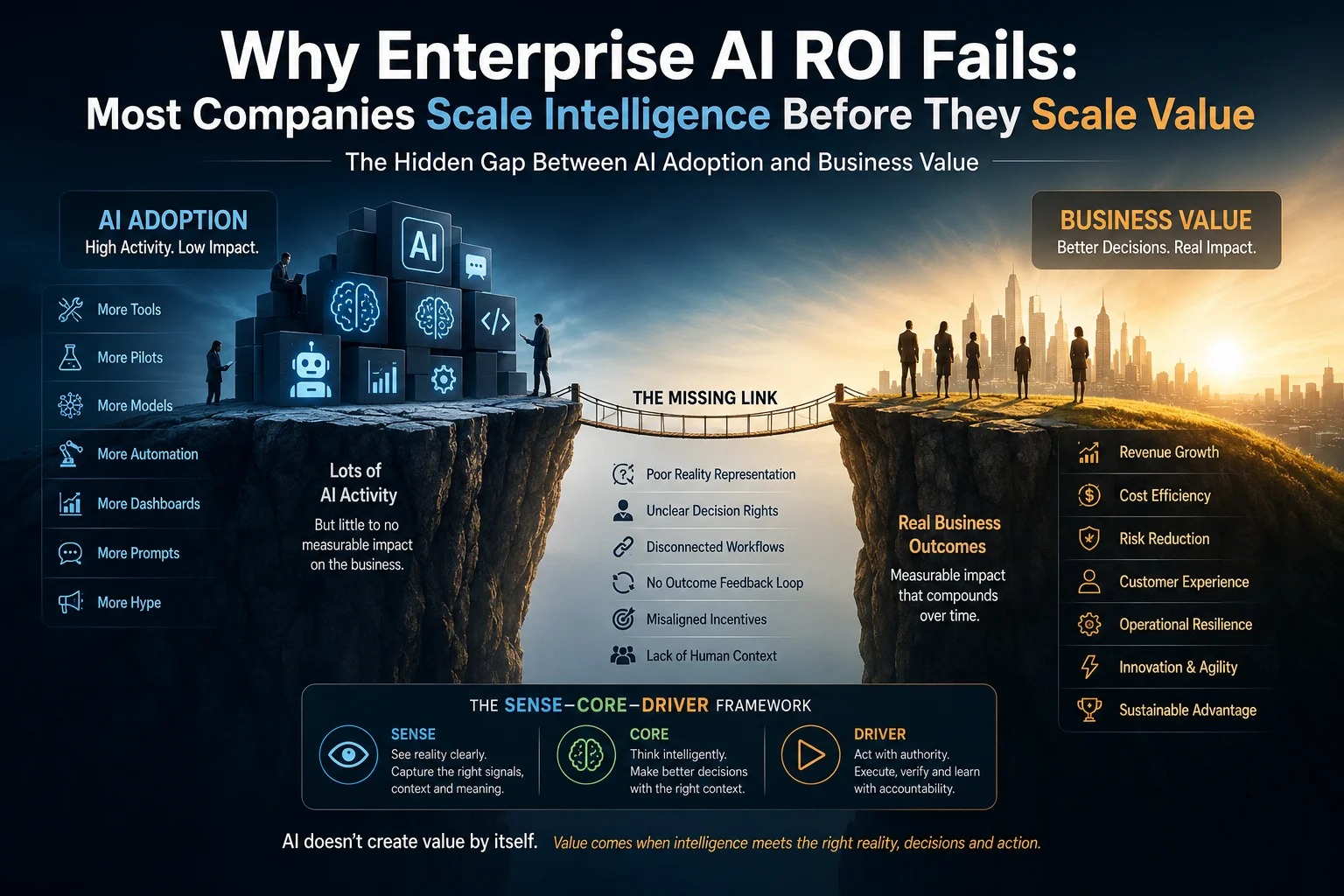
Corporate executives are rethinking how they evaluate artificial intelligence investments, shifting from vanity metrics like logins to concrete workflow outcomes. To ensure real returns, leaders are focusing on organizational readiness, shared infrastructure, and deploying AI to accelerate complex business decisions rather than simple repetitive tasks.
NEW YORK, United States — As enterprise deployments of artificial intelligence tools reach record levels across global corporations, business leaders and technology executives face an emerging accountability crisis: determining whether their substantial investments in AI platforms are delivering actual productivity and revenue returns. According to operational research and corporate technology audits released on July 21, 2026, a majority of enterprises continue to measure AI adoption using traditional software metrics such as seats provisioned and user logins rather than tracking workflow acceleration, decision-making velocity, or error reduction.
Moving Beyond Vanity Metrics in AI Evaluation
For decades, enterprise software adoption was evaluated by simple usage volume: if employees logged into a customer relationship management (CRM) platform or corporate email suite, the software was considered active and successful. However, technology analysts caution that applying those legacy metrics to generative AI and automated systems creates a false sense of productivity.
"Using an AI tool daily does not automatically equate to increased business productivity," notes corporate workflow analysis from enterprise technology experts. While employees may enter dozens of prompts per day, significant time is often spent refining, correcting, and verifying outputs to eliminate factual inaccuracies or "hallucinations" a process that can sometimes take longer than completing tasks manually.
The Three Dimensions of AI Value Creation
To establish true visibility into software return on investment (ROI), enterprise technology councils recommend evaluating AI deployments across three structural dimensions:
Organizational Readiness: Assessing whether institutional knowledge is structured so AI models can process operational decisions rather than relying on unwritten employee memory.
High-Value Opportunity Mapping: Shifting focus away from basic repetitive tasks toward "judgment at speed"—such as empowering deal desks to evaluate complex customer terms using historical data.
Shared Infrastructure and Guardrails: Building common governance layers so individual departments do not duplicate setup costs or run into legal and compliance barriers.
Official Sources Section
The strategic frameworks and enterprise evaluation metrics were compiled from official industry reports and executive research publications:
Quote Section
"According to officials, the primary bottleneck facing enterprise executives today is not whether AI capability exists, but whether organizations possess the visibility, governance guardrails, and structured workflows required to translate usage into measurable enterprise value."
Why It Matters
Unchecked AI spending without clear productivity verification risks straining corporate technology budgets and creating operational friction. Establishing rigorous evaluation frameworks allows businesses to eliminate underperforming software subscriptions, redirect capital toward high-impact automation, and ensure human judgment remains integrated into critical decision-making processes.
Key Facts at a Glance
Evaluation Shift: Executives are abandoning seat-licensing counts in favor of workflow-based performance metrics.
Time Trade-Off: High prompting frequency often masks time spent reviewing and correcting AI errors.
Core Value Area: AI yields the highest returns when accelerating complex decisions rather than basic data entry.
Governance Barrier: Lack of shared infrastructure and risk protocols remains a leading cause of stalled deployments.
Frequently Asked Questions (FAQ)
Why are traditional software metrics failing for AI tools?
Traditional metrics only track logins and accounts, whereas AI value depends on output accuracy, time saved, and decision speed rather than mere platform activity.
What is "judgment at speed" in AI deployment?
It refers to using AI to analyze complex historical data rapidly—such as contract exceptions or customer churn signals—enabling employees to make faster, better-informed business decisions.
How can companies verify if an AI tool is working effectively?
Organizations should establish baseline metrics before deployment, track task completion speed alongside error correction time, and verify that outputs align with compliance standards.
Source: Official operational reports and research published by the Forbes Tech Council, Harvard Business School, and The Law Society.