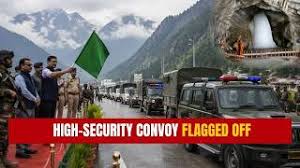
The Jammu and Kashmir administration successfully completed a comprehensive convoy dry run from Jammu to Banihal ahead of the Amarnath Yatra 2026. Senior civil, police, and CRPF officials monitored the trial along the Jammu–Srinagar National Highway to verify security, traffic regulations, and pilgrim amenities before the pilgrimage starts on July 3.
JAMMU — In a major logistical step to ensure the safety and seamless passage of thousands of devotees, the Jammu and Kashmir administration conducted a full-scale dry run of the Shri Amarnath Ji Yatra convoy on Monday, June 29, 2026. The fully equipped trial convoy departed from the Bhagwati Nagar Yatri Niwas Base Camp in Jammu during the early morning hours and traveled along the strategically vital Jammu–Srinagar National Highway (NH-44) through Udhampur, reaching Ramban and the highway town of Banihal. The exercise allowed high-ranking civil, police, and paramilitary officials to inspect route management, security measures, and transit facilities firsthand before the official start of the annual pilgrimage.
Inter-Agency Coordination and Strategic Highway Management
The comprehensive exercise was closely supervised by senior administrative and security personnel, including Jammu Divisional Commissioner Ramesh Kumar, Inspector General of Police (IGP) Jammu Bhim Sen Tuti, and Inspector General of CRPF Jammu Sector Amol V. Homkar. To evaluate the transit experience directly, top officials boarded the lead convoy buses at 5:00 AM, monitoring real-time vehicle movement and communications infrastructure throughout the journey.
A critical focus of the operational trial was the execution of temporary traffic regulations. Civilian traffic on NH-44—the sole all-weather road corridor connecting the Kashmir Valley with the rest of India—was temporarily suspended as the heavily guarded convoy advanced toward Ramban. Traffic officials confirmed that civilian movement from Qazigund will be strictly regulated in a similar manner during the actual pilgrimage to prioritize the secure passage of the official Yatra vehicles.
Rigorous Quality Audits of Pilgrim Transit Hubs
The convoy completed the journey from Jammu to the Ramban district headquarters within approximately four hours. Along the route, the monitoring committee conducted multi-point inspections of essential logistics and emergency support infrastructure:
Chanderkote Facility Audit: The delegation halted at the Chanderkote Yatra Langar site, where Deputy Commissioner Ramban delivered a comprehensive briefing on community kitchen operations, power connectivity, backup water supplies, and sanitation infrastructure.
Lamber Base Inspection: The convoy subsequently advanced to Lamber in Banihal. At this critical transit junction, officials reviewed overnight accommodation readiness, public utilities, and the layout of dedicated medical rooms designed to address high-altitude sickness or transit emergencies.
Multi-Layered Emergency Response: Security personnel from the Indian Army, Jammu and Kashmir Police, Central Reserve Police Force (CRPF), and disaster management teams engaged in synchronized drills to test quick-response communication channels.
Dual Routes Ready for Thousands of Devotees
The successful execution of the dry run marks the final phase of administrative preparations before the official rollout of the 57-day pilgrimage. The first batch of devotees will be formally flagged off from the Bhagwati Nagar base camp in Jammu on July 2, 2026.
The annual pilgrimage to the holy cave shrine in the Himalayas will officially commence on July 3, 2026, operating via its two established routes. Pilgrims can choose between the traditional, 48-kilometer Pahalgam track in south Kashmir's Anantnag district or the steeper, shorter 14-kilometer Baltal route in central Kashmir's Ganderbal district. The pilgrimage is scheduled to conclude on August 28, 2026.
Official Sources Section
The logistical details, routes, and security frameworks detailed in this report are verified by:
Official operational updates from the Office of the Divisional Commissioner, Jammu.
Traffic management guidelines and security protocols issued by the Jammu and Kashmir Police.
Standard operating procedures published by the Shri Amarnathji Shrine Board (SASB).
Quote Section
"The dry run was conducted to ensure seamless coordination between various stakeholders, assess convoy movement, review security measures, and finalize emergency response mechanisms," stated an official from the Jammu and Kashmir civil administration.
"According to officials, civilian traffic on the key highway sectors will be systematically coordinated to ensure a safe, secure, and hassle-free transit environment for all registered devotees."
Why It Matters
For thousands of daily commuters, logistics operators, and local businesses along NH-44, the dry run establishes the baseline for the traffic control measures that will govern the region for nearly two months. For incoming pilgrims and their families, the successful trial provides formal assurance of multi-tiered security, medical backup, and food safety protocols across the transit corridor. The rigorous inter-agency coordination reduces the risk of long traffic standstills, helping to protect both the local economy and the safety of the long-distance travelers.
Key Facts at a Glance
Operational Scope: The dry run successfully tested convoy movement from the Bhagwati Nagar base camp in Jammu up to the Lamber halt in Banihal.
Timeline Set: The official flagging off of the first pilgrim batch from Jammu is scheduled for July 2, with the main pilgrimage beginning on July 3, 2026.
High-Level Oversight: Top leaders from the civil administration, J&K Police, and the CRPF personally rode in the convoy to review route safety.
Two Transit Paths: The 57-day religious journey will run through both the traditional 48-km Pahalgam route and the shorter 14-km Baltal route until August 28, 2026.
FAQ Section
Q1: What is the purpose of conducting a convoy dry run for the Amarnath Yatra? A1: The dry run is a comprehensive operational drill designed to evaluate security deployments, assess convoy travel times, test inter-agency communications, and check the readiness of food, water, and medical facilities before the actual pilgrims arrive.
Q2: Will civilian traffic on the Jammu–Srinagar National Highway (NH-44) be affected during the Yatra? A2: Yes. To ensure security and prevent bottlenecks, civilian vehicle movements will be temporarily suspended or regulated by traffic authorities while the official pilgrim convoys are in transit.
Q3: When does the Amarnath Yatra 2026 officially begin and end? A3: The first batch of pilgrims leaves Jammu on July 2, 2026, with the high-altitude tracks officially opening on July 3. The annual pilgrimage will conclude after 57 days on August 28, 2026.
Source: Shri Amarnathji Shrine Board (SASB), Jammu & Kashmir Police Department Traffic Advisory Division.