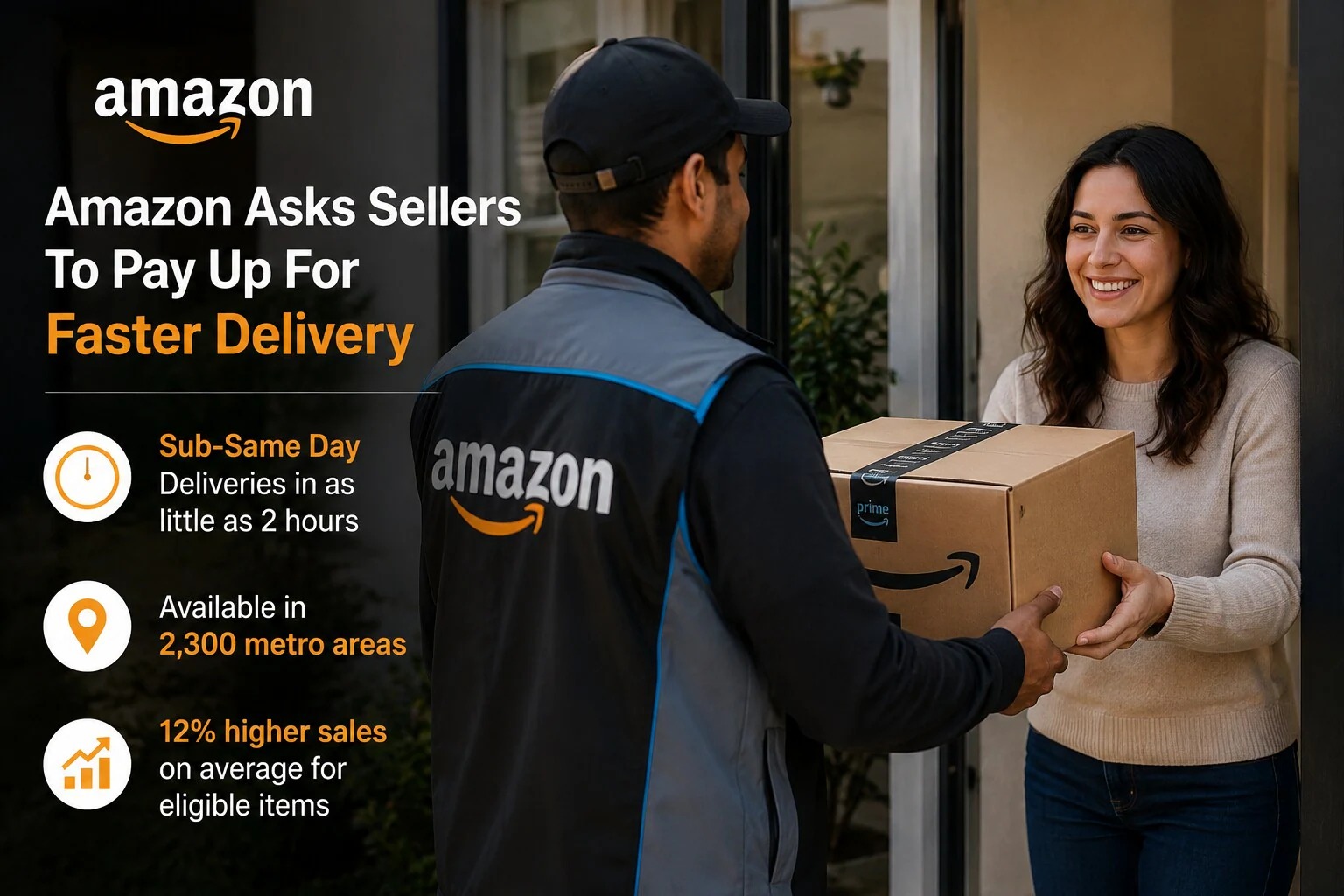
Amazon is asking U.S. third-party sellers to bid for placement in its sub-same-day delivery network, a move designed to expand two-hour shipping options while introducing new variable costs for merchants seeking a competitive sales boost.
Amazon is asking third-party merchants to bid for faster delivery placement as the e-commerce giant expands its ultra-fast logistics network.
SEATTLE — Amazon has initiated a competitive bidding system for select United States merchants using its Fulfillment by Amazon (FBA) network, inviting them to pay additional fees to secure placement in its sub-same-day delivery program. According to corporate communications distributed to marketplace vendors, the e-commerce giant is seeking to scale an infrastructure tier capable of delivering consumer goods in as little as two hours across 2,300 metropolitan areas. This operational shift alters traditional third-party fulfillment dynamics by introducing a pay-to-play model for speed, forcing merchants to weigh increased marketing and logistics overhead against potential sales velocity.
Shifting Fulfillment Economics and Bidding Mechanics
The newly implemented structure requires participating vendors to submit specific financial bids for individual product ASINs to qualify for expedited routing. Unlike traditional FBA fees—which cover standardized storage, packing, and shipping services at fixed or predictable rates—the sub-same-day auction model bills merchants only for units that successfully ship through the accelerated channel at their designated bid price.
Company documentation indicates that items featured within the sub-same-day footprint register an average sales increase of 12% compared to standard fulfillment options. However, logistics consultants note that meeting the stringent inventory distribution prerequisites for ultra-fast nodes requires merchants to split shipments across multiple specialized warehouses, elevating foundational operational friction.
Industry Response and Marketplace Impact
Independent merchants and retail analysts have expressed mixed reactions regarding the commercial viability of the bidding framework. While brands operating in high-demand, impulse-buy categories view the two-hour delivery window as essential for outperforming market competitors, smaller enterprises caution that mounting fees compress profit margins. The policy iteration arrives amid broader friction points between marketplace operators and third-party vendors, following recent discontent over automated advertising fee deductions and rising logistics surcharges.
Official Sources and Regulatory Context
According to official announcements and administrative notices published through Amazon Seller Central, the corporation maintains that marketplace participation remains optional, and non-bidding vendors will continue to qualify for standard FBA distribution. Corporate representatives emphasized that the structural adjustment is designed to let individual business owners strategically align inventory speeds with product-specific margins rather than imposing blanket price escalations across the entire marketplace ecosystem.
"Organizers stated that the operational restructuring allows merchants to choose which products to offer at accelerated speeds based on individual business models and inventory capacities."
Why It Matters
The practical implications of Amazon’s bidding architecture extend directly to digital retail pricing strategies, merchant capital allocation, and consumer delivery expectations. As marketplace competition intensifies, brands must carefully calculate bidding thresholds to avoid eroding profit margins on low-margin goods. For consumers, the expansion ensures a broader selection of everyday essentials arriving within hours, though these conveniences may gradually influence retail price baselines as merchants offset operational costs.
Key Facts at a Glance
Amazon has asked selected U.S. FBA sellers to submit bids for inclusion in its sub-same-day delivery program.
The ultra-fast service currently operates across 2,300 metropolitan areas, offering delivery windows as short as two hours.
Company metrics show that products featured in the sub-same-day network experience an average 12% boost in sales volume.
Participating merchants are billed only for items that actually ship through the accelerated tier based on their submitted per-unit bid.
Frequently Asked Questions
Why is Amazon asking sellers to bid for faster delivery?
Amazon is expanding its sub-same-day delivery infrastructure by letting merchants compete for limited fulfillment center capacity through a performance-based bidding format.
Is participation in the sub-same-day bidding system mandatory?
No, participation is entirely optional for third-party sellers, who can continue utilizing standard Fulfillment by Amazon services.
How does the bidding cost get calculated for merchants?
Sellers submit a per-unit bid amount, and they are charged that specific fee only when an eligible product is successfully purchased and shipped via the ultra-fast network.
Where can merchants review official guidelines for FBA updates?
Official policy details, inventory thresholds, and program criteria are maintained directly on the Amazon Seller Central portal.
Source: Amazon Seller Central, Corporate Communications to FBA Merchants, Industry Analyst Briefings