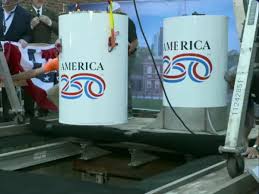
On July 4, 2026, the United States interred a 900-pound stainless steel time capsule in Philadelphia to commemorate its 250th Independence Day. Containing artifacts from all 50 states and the federal government, the vessel is engineered to preserve this snapshot of 2026 American life until its scheduled reopening in 2276.
PHILADELPHIA — On the occasion of America’s 250th Independence Day, the United States has officially interred "America’s Time Capsule" at the Independence National Historical Park in Philadelphia. The burial, which took place on July 4, 2026, marks the fulfillment of a congressional mandate established in 2016 to preserve a comprehensive record of the nation at the Semiquincentennial.
The 900-pound precision-milled stainless steel cylinder, designed to withstand the passage of two and a half centuries, will remain buried 10 feet underground until its scheduled reopening in 2276.
Preserving a Record for 2276
The project, spearheaded by the nonpartisan America250 commission, serves as a "national responsibility" to future generations. According to America250 Chair Rosie Rios, the capsule is intended to offer Americans of the 23rd century a glimpse into the "care, pride, and optimism" that defined the nation’s 250th anniversary.
The capsule’s construction involved technical collaboration with the National Institute of Standards and Technology (NIST) and the Library of Congress. To ensure the integrity of the contents, the vessel was sealed with a soft metal (indium) compression seal to create an airtight and watertight environment. It is further protected by an 1,100-pound stainless steel bell jar, designed to maintain a dry air pocket around the capsule.
A Grassroots Collection of American Life
The items contained within represent a collective effort, featuring contributions from all 50 states, the District of Columbia, five U.S. territories, and all three branches of the federal government.
The collection, which underwent a meticulous review by Library of Congress experts to ensure long-term preservation, includes:
Cultural Artifacts: Memorabilia reflecting everyday American life in 2026, including sports items and regional tokens like Maine’s piece of a North Atlantic right whale bone and a "seed pot" from Santa Clara Pueblo.
Technological Innovations: A fusion conductor segment from General Atomics and a DNA-based storage device from the Library of Congress containing digitized treasures.
Civic Records: Handwritten letters from governors, official state resolutions, and modern documents reflecting current societal challenges and aspirations.
Future Predictions: Contributions such as California’s AI-generated predictions for the state in 250 years.
Official Statements and Oversight
The National Park Service, in partnership with the Independence Historical Trust, is responsible for the capsule's placement and has incorporated its eventual recovery into official park management succession plans. A capstone marker has been placed above the burial site to identify its location for future generations.
"Greetings from the living, breathing hearts and hands of 2026," wrote Michael Berilla, who led the fabrication team at NIST, in a letter included in the capsule. "We will have long since returned to dust, but our devotion, pride, and unwavering hope for what our world could become are alive right here inside this steel."
Key Facts at a Glance
Interment Date: July 4, 2026.
Opening Date: July 4, 2276.
Weight: 900-pound stainless steel cylinder, with an 1,100-pound protective bell jar.
Location: Independence National Historical Park, Philadelphia.
Contents: Over 200 items, including letters, artifacts, and records from all 50 states, D.C., and five U.S. territories.
FAQ
Why a cylinder instead of a box?
Engineers chose a cylindrical shape because square edges in traditional time capsules are more prone to cracking and structural failure over long periods.
How will people find it in 2276?
The National Park Service has documented the capsule’s location within its long-term management and succession records, and a permanent capstone marks the burial site.
Were any items rejected?
Yes. To ensure preservation, items that might degrade or rust—such as Maryland’s original submission of Old Bay seasoning—were excluded or required resubmission on archival-safe materials.
Source: