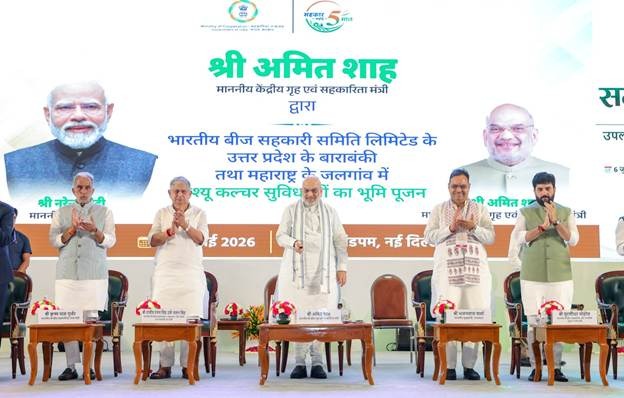
Union Home Minister Amit Shah celebrated the 5th anniversary of the Ministry of Cooperation by launching a suite of digital and physical projects. Key announcements included a new cooperative life insurance company, the digitization of 50,000 credit societies, and the expansion of the Bharat Taxi ride-hailing service to 500 cities.
Union Home and Cooperation Minister Amit Shah marked the Ministry of Cooperation's fifth anniversary by announcing a new life insurance venture and major infrastructure expansions.
NEW DELHI — Union Home and Cooperation Minister Amit Shah addressed the 5th Foundation Day celebration of the Ministry of Cooperation at Bharat Mandapam on Monday, July 6, 2026. During the event, Minister Shah outlined a roadmap for the future of India’s cooperative movement, unveiling a series of digital and physical infrastructure projects designed to modernize the sector and align it with the national vision of "Sahakar Se Samriddhi" (Prosperity through Cooperation).
The Ministry of Cooperation, established on July 6, 2021, has spent the past half-decade focused on institutional strengthening, technology adoption, and grassroots empowerment. The anniversary celebration served as a platform to review these milestones and launch the next phase of the government’s cooperative reform agenda.
Expanding the Cooperative Footprint
A central theme of the Minister’s address was the expansion of the cooperative model into new domains. Minister Shah announced the government's intent to establish a dedicated cooperative life insurance company, modeled after the successful "Bharat Taxi" initiative.
"The ministry has given a new lifeline to India's cooperative movement," Minister Shah stated during the event. He noted that the cooperative sector is no longer restricted to traditional areas like dairy, sugar, and fertilizers, and is now actively diversifying into ride-hailing, infrastructure, and insurance services. The "Bharat Taxi" platform, a cooperative-based cab service, is slated for expansion into 500 cities over the next two years.
Digital and Infrastructure Milestones
The Ministry of Cooperation utilized the 5th Foundation Day to launch several high-impact initiatives:
Grain Storage Expansion: Minister Shah oversaw the transfer of 135 grain storage godowns and inaugurated 85 additional facilities. He also laid the foundation stone for 47 new godowns under the "World’s Largest Grain Storage Scheme."
Digital Transformation: A major highlight was the transformation of 50,000 Primary Agricultural Credit Societies (PACS) into "e-PACS," a move intended to bring digital banking and services to the grassroots level.
Advanced Platforms: The Minister unveiled "Sahakar Sahyogi," a conversational AI-powered platform for Urban Cooperative Banks, and "Sahakar CBS," a centralized core banking platform.
Education and Afforestation: The event featured the Bhoomi Pujan for "Sahakar Van," a 64-acre cooperative afforestation project led by Amul and the National Cooperative Consumers' Federation of India (NCCF). Additionally, groundwork was initiated for the Tribhuvan Sahkari University in Anand, Gujarat, which will focus on human resource development within the sector.
Official Sources and Governance
According to official Ministry of Cooperation announcements, the event was attended by Union Minister of Fisheries, Animal Husbandry and Dairying Rajiv Ranjan Singh, Rajasthan Chief Minister Bhajan Lal Sharma, and various senior government officials. The Ministry emphasized that these initiatives were developed to ensure that over 8.5 lakh cooperative institutions in India—representing more than 30 crore members—have access to professional management and modern technological tools.
Regarding concerns over federal oversight, Minister Shah clarified that the Union Ministry’s role is supportive rather than interventionist. "The Union Ministry is not for interfering in the State subject," he remarked, emphasizing that the focus remains on collaborative growth and policy harmonization.
Why It Matters
The modernization of the cooperative sector is a critical component of India’s economic strategy toward 2047. By professionalizing these entities and integrating them into the digital economy, the government aims to reduce systemic inefficiencies in rural credit, agricultural marketing, and insurance distribution. For the millions of farmers and members associated with these societies, the digitalization of PACS and the launch of new cooperative insurance services represent a significant shift toward financial inclusion and risk mitigation.
Key Facts at a Glance
Foundation: The Ministry of Cooperation was established on July 6, 2021.
Sector Reach: India currently hosts over 8.5 lakh cooperative institutions with a membership base exceeding 30 crore.
Digital Push: 50,000 Primary Agricultural Credit Societies (PACS) are being converted into "e-PACS" to modernize grassroots financial operations.
New Ventures: Plans are underway for a cooperative life insurance company and the expansion of the "Bharat Taxi" service to 500 cities.
Frequently Asked Questions
What is the objective of the Ministry of Cooperation?
The Ministry aims to provide a renewed impetus to the cooperative sector, focusing on institutional strength, transparency, and realizing the goal of "Cooperation to Prosperity."
What are e-PACS?
e-PACS are Primary Agricultural Credit Societies that have been digitized to offer modern banking services, similar to core banking solutions, to their members in rural areas.
Will the new cooperative insurance company affect existing private insurers?
The initiative is designed to provide insurance access to cooperative members, particularly in rural and semi-urban areas, leveraging the existing network of cooperative societies for distribution.
Source: Ministry of Cooperation (Government of India), The Hindu, ANI News, India Education Diary