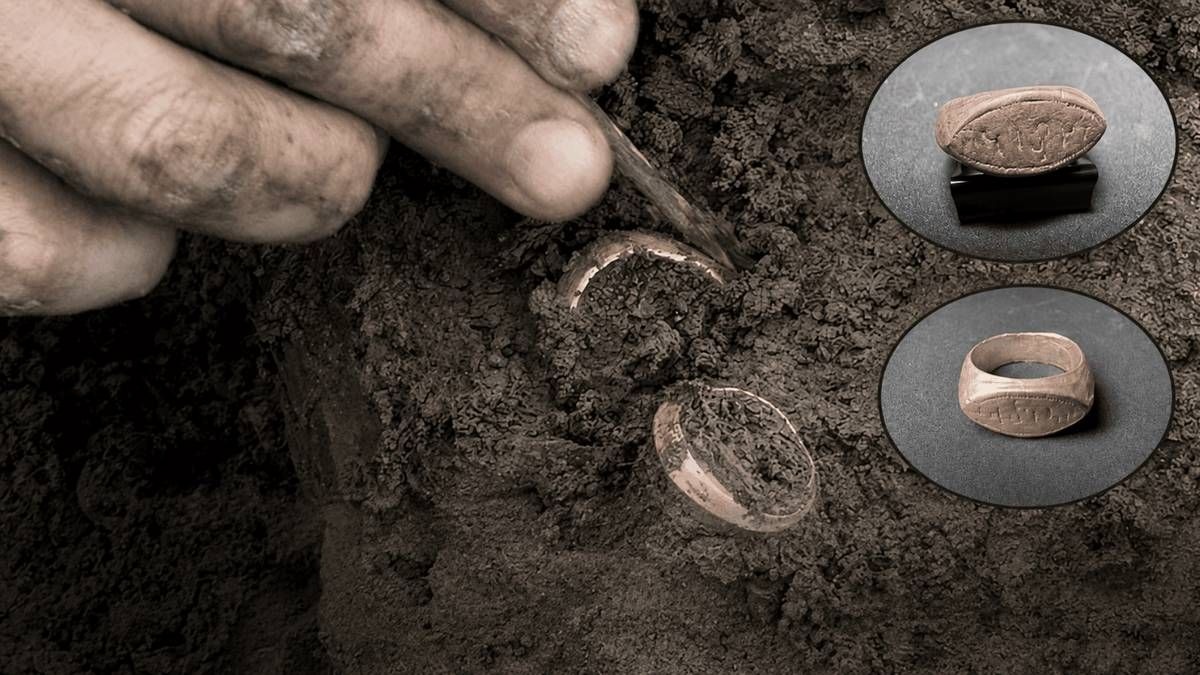
Thai archaeologists have discovered two 2,100-year-old Indian gold rings at the Don Yai Thong site in Phetchaburi. One ring bears an ancient Brahmi inscription belonging to an Indian merchant. The discovery provides critical physical evidence of extensive, early maritime trade links between the Indian subcontinent and ancient Thailand.
PHETCHABURI — In a major breakthrough for regional archaeology, Thai researchers have unearthed two ancient Indian gold rings estimated to be between 1,900 and 2,100 years old. The rare artifacts, one of which features a highly distinct inscription in ancient Indian Brahmi script, were discovered at the Don Yai Thong archaeological site in the Ban Lat district of central Phetchaburi province.
The discovery was announced following an urgent salvage operation launched on July 2, 2026, by the government to secure delicate historic materials threatened by seasonal monsoon rains and rising groundwater levels. The findings provide tangible, early historical evidence of vibrant maritime trade networks connecting the Indian subcontinent with the legendary "Suvarnabhumi" region the classical name attributed to present-day Thailand and broader Southeast Asia.
Brahmi Script Links Artifact to Indian Merchant Caste
According to official briefings provided by Thailand's Fine Arts Department (FAD), the two gold rings were found buried alongside a human skeleton designated as "Skeleton No. 4". While the first ring is a simple band with no decorative embellishments, the second is an elite signet ring engraved with ancient text on its face.
Epigraphists from Silpakorn University and government language specialists have deciphered the inscription as reading "Pusarakitasa" (or "Pusrakhitasa"), a Sanskrit-derived name meaning "belonging to Pusarakita" or "one who is protected by the Pushya star".
Dr. Uthen Wongsathit, Dean of the Faculty of Archaeology at Silpakorn University, indicated that the style of the Brahmi script corresponds precisely to the 5th to 7th Buddhist centuries (roughly 100 BCE to 100 CE). Experts deduce that the owner likely belonged to the Vaishya caste, which comprised the prominent merchant and trading guilds of ancient India.
Monsoonal Threats Spur Urgent Salvage Operations
The Fine Arts Department accelerated excavations this week due to environmental hazards threatening the integrity of the un-excavated zones. Alongside the gold jewelry, the site holds vulnerable bronze vessels and fragile human skeletal remains, including the intact grave of a young child buried inside a bronze container.
To avoid structural damage from soil salinity and moisture, recovery teams are extracting full, undisturbed blocks of earth containing the remains using heavy machinery. These earth blocks are being systematically transported to specialized scientific conservation laboratories in Pathum Thani for controlled microscopic extraction.
Official Sources Section
The direct scientific analysis, translation details, and recovery protocols have been corroborated via official statements released by Phanombut Chantarachoti, the Director-General of the Fine Arts Department of Thailand. Chronological and regional contextual mapping data have been integrated through database files maintained by the Ministry of Culture of Thailand and the archaeology faculty records at Silpakorn University.
Quote Section
Regarding the emergency preservation measures, government leaders detailed the next steps for the historic assets.
"As the site is heavily threatened by fluctuating underground water tables and seasonal rainfall, our teams have accelerated the artifact collection process to protect them from corrosion," stated Phanombut Chantarachoti, Director-General of the Fine Arts Department. "A public exhibition of the artifacts unearthed at the Don Yai Thong site will be held in the near future before they are permanently moved for advanced academic research".
Why It Matters
The discovery carries major geopolitical and historical implications for historians studying ancient global trade routes. While similar Brahmi seals have previously been found across coastal southern Thailand—such as in Krabi and Chumphon—discovering these premium items further north in central Phetchaburi proves that ancient Indian maritime merchant networks extended much deeper into the Thai mainland than previously documented. It redefines the map of the ancient maritime Silk Road, demonstrating that Phetchaburi was an essential inland trading hub over two millennia ago.
Key Facts at a Glance
Age of Artifacts: Scientifically dated between 1,900 and 2,100 years old, tracking back to the early historic era.
Linguistic Value: One ornament features a distinct Brahmi script inscription reading "Pusarakitasa," signifying personal ownership by an elite merchant.
Location: Uncovered at the Don Yai Thong archaeological dig site, located in the Ban Lat district of Phetchaburi province.
Current Status: Safely transferred to the Phra Nakhon Khiri National Museum for stabilization and cleaning.
Frequently Asked Questions (FAQ)
What script is written on the ancient Indian gold ring?
The ring is engraved with ancient Brahmi script, a writing system originating in ancient India that served as the ancestor for many modern South and Southeast Asian scripts.
Who is believed to have owned these rings?
Archaeologists believe the signet ring belonged to an affluent traveling merchant from the Indian Vaishya (merchant) caste who traded along early maritime routes.
Where can the public view these newly discovered artifacts?
The two gold rings are temporarily housed at the Phra Nakhon Khiri National Museum. The Fine Arts Department has confirmed plans to host a dedicated public exhibition following the conclusion of regional conservation efforts.
Source: Fine Arts Department of Thailand Official Portal, Silpakorn University Faculty of Archaeology, Thai PBS World Archives.