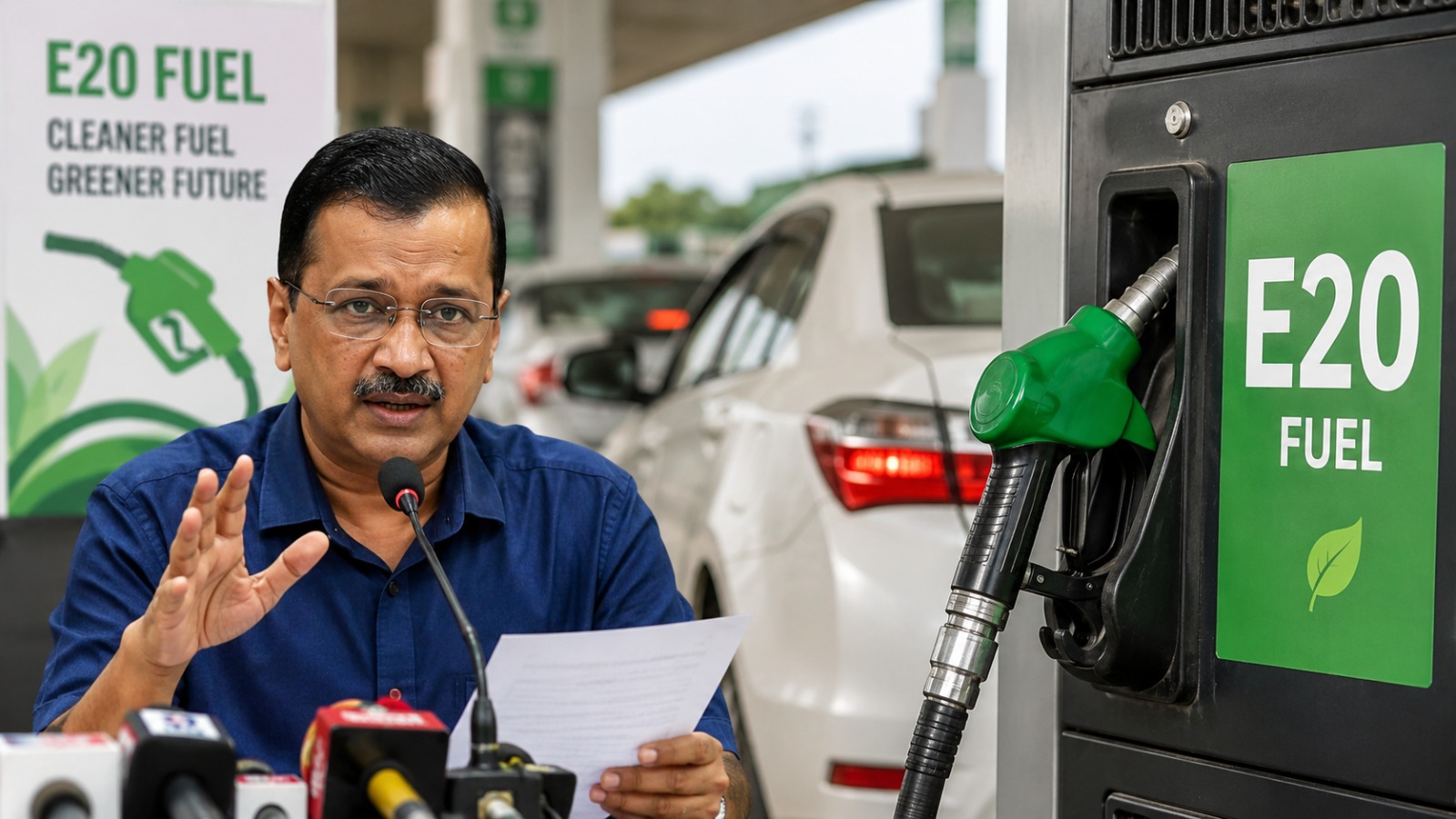
AAP chief Arvind Kejriwal conducted an unannounced inspection at a Delhi petrol station to assess motorist complaints regarding E20 fuel. Citing widespread reports of engine malfunctions and reduced mileage, Kejriwal labeled government safety claims as "white lies" and demanded the reintroduction of optional E0 and E10 fuel variants.
NEW DELHI, INDIA — Aam Aadmi Party (AAP) national convenor Arvind Kejriwal conducted an unannounced public inspection at a prominent petrol pump and vehicle service station in the national capital on Saturday. Adopting an informal, hands-on approach to gather ground-level feedback, Kejriwal interacted with local vehicle owners, interviewed service station workers, and personally examined vehicle engines. The inspection was launched to evaluate consumer challenges stemming from the central government's mandatory rollout of 20 percent ethanol-blended petrol, commonly known as E20 fuel. According to Kejriwal, widespread complaints from daily motorists concerning immediate drops in fuel efficiency and mechanical malfunctions directly contradict the official safety assurances issued by central ministries.
Escalating Political Tension Over Ethanol Blending Targets
The surprise public visit by the former Delhi Chief Minister amplifies an ongoing regulatory dispute between the ruling AAP and the central government over national fuel standards. The Ministry of Petroleum and Natural Gas has accelerated the nationwide distribution of E20 fuel as part of a strategic policy framework designed to reduce India's heavy dependence on crude oil imports, cut vehicular carbon emissions, and bolster the domestic agricultural economy.
However, opposition leaders have heavily challenged the implementation timeline. Kejriwal alleged that millions of older vehicles currently operating across the country are not structurally optimized to withstand higher ethanol concentrations, placing an unfair financial burden on lower-income motorists who face accelerated engine wear and component corrosion.
Technical Discrepancies and Economic Strains on Motorists
The structural differences between traditional petrol and modern ethanol blends have created significant friction between consumer expectations and corporate manufacturing metrics:
| Technical Parameter | Standard E10 / E0 Petrol | Modern E20 Fuel Blend |
| Ethanol Composition | 0% to 10% maximum volume | Exactly 20% ethanol volume |
| Energy Density | Baseline high thermal output | Lower thermal output; minor mileage decrease |
| Corrosive Potential | Non-reactive with standard rubber | Higher moisture absorption; alters older seals |
| Consumer Choice | Uniformly available across stations | Mandatory distribution at state pump networks |
During the inspections, several service technicians briefed Kejriwal on a notable increase in fuel pump blockages and filter replacements since the high-blend rollout. Academic studies previously acknowledged that while E20 fuel features a superior octane rating and faster combustion, it inherently reduces fuel economy by approximately 3 to 5 percent in non-optimized engines—a metric that motorists claim is significantly higher in real-world urban traffic conditions.
Official Sources Section
The underlying technical assertions, official ministerial stances, and political challenges highlighted during the inspection are based on formal statements from the Ministry of Petroleum and Natural Gas, public advisory rebuttals by the Society of Indian Automobile Manufacturers (SIAM), and media briefings organized at the Aam Aadmi Party national headquarters.
Quote Section
Detailing his immediate field observations after concluding the inspection at the vehicle service station, AAP National Convenor Arvind Kejriwal stated:
"The government’s assertions regarding E20 fuel are absolute white lies, and the ground reality is completely different. The mileage of almost all vehicles has decreased, and many vehicles have malfunction complaints. People are deeply upset with ethanol-blended petrol. With folded hands, I request the Prime Minister to accept the people's demand and make E20, E10, and E0 petrol simultaneously available at fuel stations so that the public can choose according to their preference."
Why It Matters
For daily commuters and logistics operators, the current mandate means navigating unexpected operational costs from decreased fuel economy and potential long-term maintenance liabilities. For the automotive manufacturing sector, the dispute creates consumer uncertainty regarding vehicle warranties and compliance for the estimated 30 crore older vehicles currently on Indian roads. For energy policymakers, the resistance highlights the challenge of balancing macro-environmental goals, like carbon reduction, with practical consumer protection at the retail pump.
Key Facts at a Glance
Direct Public Inspection: Kejriwal personally audited Delhi fuel pumps and service garages to collect real-world driver feedback.
Widespread Mileage Drop: Motorists reported distinct drops in fuel efficiency alongside an increase in engine calibration issues.
Demand for Consumer Choice: The AAP is formally urging the Centre to offer E0, E10, and E20 choices at separate pricing points.
Government Stance: The Ministry maintains that E20 is heavily tested, safe for compatible models, and essential for cutting oil imports.
FAQ Section
What exactly is E20 fuel?
E20 is a automotive fuel blend consisting of 80 percent conventional unleaded petrol and 20 percent plant-based ethanol. It is being deployed to cut greenhouse gases and reduce foreign oil dependency.
Why are older vehicles experiencing issues with E20?
Vehicles manufactured prior to the broad rollout of E20-compliant engines in 2023 were built for lower ethanol concentrations. Higher ethanol levels can absorb moisture and accelerate wear on standard plastic and rubber fuel system parts.
What is the primary policy change being requested?
Arvind Kejriwal and the Aam Aadmi Party are requesting that the central government end the singular mandate and allow fuel stations to sell multiple fuel variants (E0, E10, and E20) so motorists can select the correct blend for their engine type.
Source: