Prime Minister Narendra Modi announced a strategic sports alliance with New Zealand to develop India's rugby ecosystem. The newly signed India-New Zealand Joint Action Plan on Sport will bring elite coaching, sports science, and training technology to India, building on a successful pilot project launched in Bhubaneswar.
AUCKLAND, NEW ZEALAND — Prime Minister Narendra Modi officially announced that India intends to establish a long-term technical partnership to learn rugby from New Zealand. Speaking before a packed Indian diaspora gathering in Auckland during the final leg of a three-nation diplomatic tour, Modi unveiled the newly ratified India-New Zealand Joint Action Plan on Sport. The comprehensive framework is designed to broaden athletic exchange beyond traditional cricket ties, drawing directly on New Zealand’s elite high-performance coaching ecosystems, sports science frameworks, and advanced training technologies to elevate competitive sports throughout India.
Direct Technical Transfer Aims to Build Grassroots Rugby
The diplomatic decision to incorporate rugby development into India's long-term athletic roadmap follows successful pilot testing between the two nations' central sports bodies. Addressing thousands of attendees alongside New Zealand Prime Minister Christopher Luxon, Modi detailed the necessity of importing high-performance expertise to construct a sustainable youth rugby foundation.
According to external affairs documents, the framework prioritizes elite coaching deployment, grassroots talent scouting, and advanced data-driven training methods. The operational shift seeks to transform the sport from a marginal activity into a major domestic discipline, expanding India’s international sports footprint ahead of future Olympic and Asian Games cycles.
Joint Action Plan Outlines Clear Implementation Steps
The bilateral sports initiative moves away from generalized athletic goodwill, establishing a series of mandatory, highly structured milestones for sports ministries and national federations:
1.Ratification of Joint Action Plan:Bilateral Framework Formalization.Both governments formally enact the India-New Zealand Joint Action Plan on Sport to serve as the legal framework for funding, visa facilitation, and institutional sports science exchanges.
2.Coaching and Scouting Integration:Expert Technical Deployment.New Zealand Rugby (NZR) sends elite technical directors and high-performance coaches to India to train local instructors on standard safety protocols and player pathway design.
3.Sports Science & Tech Adoption:Technological Infrastructure Upgrades.Indian training hubs deploy advanced tracking equipment and sports performance software, leveraging New Zealand's commercial sports technology sector.
4.Grassroots Academy Rollout:Regional Hub Expansion.Establish regional high-performance academies using successful institutional blueprints, like the Kalinga Stadium model, to expand youth talent scouting.
Historical Context and Odisha's Development Model
The sports diplomacy push marks exactly 100 years of documented sporting relations between the two countries, which began when the Indian field hockey team toured New Zealand a century ago under the leadership of legend Major Dhyan Chand.
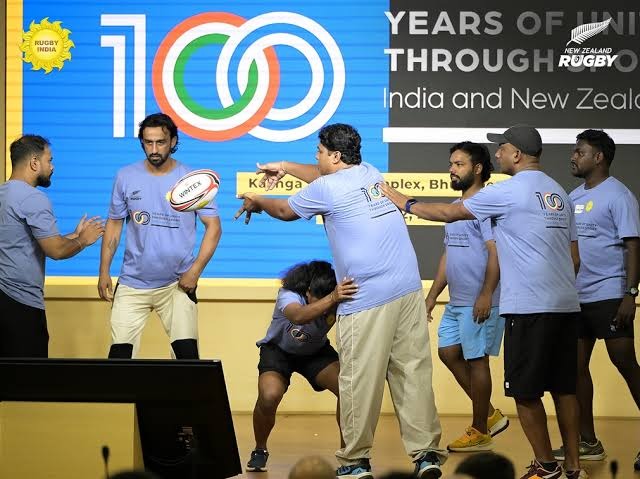
The foundations for the new rugby pipeline were laid earlier this year at the Kalinga Stadium in Bhubaneswar, Odisha. In close coordination with the local government, Rugby India and New Zealand Rugby conducted a high-performance training project targeting regional youth coaches. Odisha Chief Minister Mohan Charan Majhi noted that the Prime Minister's public endorsement validates the state's long-term capital investments in international sports infrastructure.
Official Sources Section
The details regarding the strategic sports alliance, historical data, and technical requirements have been cross-verified through official joint statements issued by the Ministry of External Affairs, India, public briefings from the Office of the Prime Minister of New Zealand, and statements recorded by the Press Trust of India (PTI).
Quote Section
Emphasizing the core philosophy driving the expanded partnership, Prime Minister Narendra Modi stated:
"India wants to learn from New Zealand in rugby. For this, we need coaches and experts. New Zealand can help us significantly in this regard. I consider the recent coaching programme involving New Zealand Rugby and Rugby India in Bhubaneswar to be a great start. I am confident that we can achieve a great deal together in the field of sports technology. The futures of India and New Zealand are intertwined."
Why It Matters
For young athletes and local rugby clubs, this pact opens direct pathways to world-class coaching methods and technical training materials. For domestic sports companies and academic institutions, the push into sports technology presents new opportunities for joint ventures and technical research with international firms. Broadly, for sports fans and the 1.4 billion population of India, it marks a deliberate move toward diversifying the country’s sports culture, building global competitiveness in fields historically dominated by Western and Pacific nations.
Key Facts at a Glance
New Strategic Alliance: The India-New Zealand Joint Action Plan on Sport formally expands bilateral athletic ties far beyond cricket.
Centenary Landmark: The signing marks 100 years of sporting contact, dating back to Major Dhyan Chand's 1926 hockey tour.
Bhubaneswar Blueprint: A pilot coaching project held at Kalinga Stadium serves as the operational baseline for future academy expansions.
Technology Focus: The agreement includes explicit provisions for sports science, player tracking technology, and infrastructure development.
FAQ Section
Why did India choose New Zealand for rugby development?
New Zealand possesses one of the world's most successful rugby ecosystems. By partnering directly with their sporting bodies, India can bypass trial-and-error phases in grassroots development, implementation safety, and sports technology.
Which cities in India will host the initial rugby programs?
Bhubaneswar acted as the initial testing ground for the joint coaching seminars. The Ministry of Youth Affairs and Sports plans to scale the academy model to other major urban sports complexes under the Joint Action Plan framework.
Does the sports pact cover disciplines other than rugby?
Yes. While rugby is a major focus, the Joint Action Plan covers high-performance athletic systems, hockey development, coaching education, and sports science innovations across multiple disciplines.
Source: