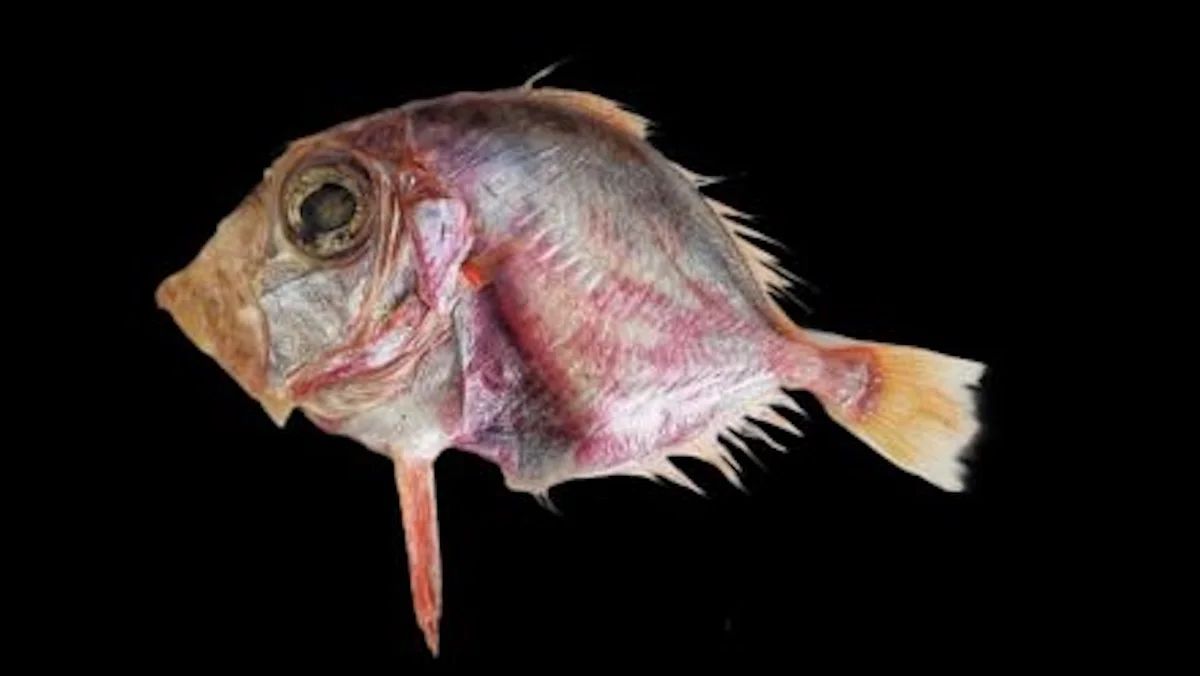
Scientists at ICAR-CMFRI have identified a new deep-sea fish, Cyttopsis indica (Indian dory), in the Arabian Sea. Found at 350–500 meters off the Kerala coast, this discovery corrects a long-standing taxonomic error, confirming the species is genetically distinct from its Atlantic counterpart through advanced molecular and morphological analysis.
Scientists have identified the "Indian Dory," correcting a long-standing taxonomic error and highlighting the biodiversity of India’s deep waters.
KOCHI — Marine researchers at the ICAR-Central Marine Fisheries Research Institute (ICAR-CMFRI) have identified a new species of deep-sea fish in the Arabian Sea, a discovery that resolves a decades-old scientific misidentification. The species, officially named Cyttopsis indica, or the Indian dory, was discovered along the continental slope of the eastern Lakshadweep Sea at depths ranging from 350 to 500 meters.
The identification of this fish, published in the Indian Journal of Fisheries, marks a significant milestone in marine taxonomy. For years, specimens of this fish found in the Indian Ocean were incorrectly classified as Cyttopsis rosea, a species now understood to be confined to the Atlantic Ocean.
Resolving a Taxonomic Mystery
The discovery process involved an intensive analysis of six specimens collected from deep-sea trawl landings at the Sakthikulangara fishing harbour in Kollam, Kerala. Led by scientist Dr. Ratheesh Kumar R., the research team employed a dual approach, combining traditional morphological examination with advanced molecular DNA sequencing.
"The DNA analysis revealed a stark genetic divergence from all other known species in its genus," according to the CMFRI research summary. This genetic evidence confirmed that Cyttopsis indica is a distinct species, possessing unique meristic and morphometric characteristics, such as a specific number of anal fin spines and lateral line scales, which differentiate it from its Atlantic counterparts.
Why It Matters
This discovery is vital for a more accurate understanding of marine biodiversity off India’s southwest coast. By correcting the taxonomic record, researchers can better map the distribution and ecological roles of dory species, which are part of the primitive Zeiformes order.
For the scientific community, the Indian dory discovery underscores the importance of modern molecular tools in re-evaluating historical data. As deep-sea exploration increases, such findings provide essential baseline data for marine managers and policymakers tasked with preserving ecosystems that remain largely unexplored and vulnerable to environmental change.
Key Facts at a Glance
New Species: Cyttopsis indica, commonly known as the Indian dory.
Habitat: Found at depths of 350–500 meters along the continental slope of the eastern Lakshadweep Sea.
Methodology: Confirmed through a combination of traditional taxonomy and COI gene sequence-based DNA analysis.
Taxonomic Correction: Replaces the previous, erroneous belief that the Indian Ocean species was the Atlantic Cyttopsis rosea.
FAQ
What makes the Indian dory different from other dory species?
Cyttopsis indica exhibits unique physical traits, such as a shorter post-orbital length and a specific configuration of anal fin spines and lateral line scales, along with a distinct genetic profile.
Why was the fish misidentified for so long?
Previously, researchers lacked the high-resolution molecular data needed to distinguish it from the Atlantic Cyttopsis rosea, leading to the assumption that a single species existed across both oceans.
Where can the Indian dory be found?
It inhabits the deep-sea continental slope of the eastern Lakshadweep Sea, off the coast of southern Kerala.
Source: ICAR-Central Marine Fisheries Research Institute (CMFRI), Indian Journal of Fisheries, The Times of India