Union Health Minister J.P. Nadda announced that the Ayushman Bharat Digital Mission has become a global leader in health infrastructure, issuing over 93.95 crore ABHA IDs. The ecosystem has linked 105 crore digital health records and registered 5.33 lakh health facilities to drive digital healthcare nationwide.
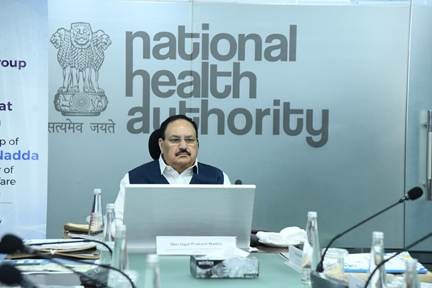
NEW DELHI, India — Union Health Minister Jagat Prakash Nadda announced on Friday, July 10, 2026, that the Ayushman Bharat Digital Mission (ABDM) has established itself as one of the world's largest digital health ecosystems. Speaking at the third high-level meeting of the Mission Steering Group (MSG) in New Delhi, Nadda confirmed that the state-backed framework has successfully issued more than 93.95 crore Ayushman Bharat Health Account (ABHA) identification numbers.
This milestone reflects India’s rapid implementation of unified digital public infrastructure to modernize clinical data sharing, reduce institutional wait times, and guarantee consent-based access to electronic medical files across the country.
National Health Registries Hit Historical Benchmarks
Operational audits provided by the Ministry of Health and Family Welfare (MoHFW) detail deep public sector adoption across every tier of the medical ecosystem. The national digital registries have successfully verified 9.85 lakh healthcare professionals and registered 5.33 lakh dedicated hospitals, diagnostic centers, and clinics under the single network dashboard. Alongside the creation of the 93.95 crore ABHA identity baselines, government data verification panels confirmed that more than 105 crore individual health records have been digitally linked to patient files.
To support execution at ground level, the mission has scaled up technical compatibility by transitioning 2.72 lakh healthcare facilities to official ABDM-enabled digital management software. A key driver behind the drop in public hospital wait times has been the deployment of the digital 'Scan & Register' facility, which has generated approximately 24 crore automated tokens to bypass traditional outpatient department (OPD) registration lines.
Multi-Ministerial Steering Framework and Tech Maps
The high-level policy review session in New Delhi brought together senior political leaders, including Tripura Chief Minister Manik Saha, Madhya Pradesh Deputy Chief Minister Rajendra Shukla, and Ministers of State Prataprao Jadhav and Anupriya Patel. Technical and governance strategy discussions were supported by research executives from the National Health Authority (NHA) and public policy members from NITI Aayog.
The updated developmental roadmap for the mission prioritizes the deployment of predictive diagnostic modules powered by artificial intelligence (AI) systems. State committees are focusing on deep-tier integration via model district initiatives, alongside pushing out advanced configurations through updated iterations of the Aarogya Setu 2.0 consumer portal, ensuring unified linkages with secondary programs like the Central Government Health Scheme (CGHS) and the Employees' State Insurance Corporation (ESIC).
Impact on Citizens and Healthcare Providers
For regular citizens and hospital consumers, the creation of the unified ABHA platform reduces the historic burden of archiving physical medical prescriptions, lab reports, and paper discharge summaries across multiple hospital visits. The secure digital network allows individuals to share historical medical records instantly with authorized doctors through encrypted, time-limited digital tokens.
For domestic insurance groups and corporate hospital conglomerates, the ongoing digitization of health data paves the way for direct integration with the National Health Claims Exchange (NHCX). This structural ecosystem standardizes the processing of cashless medical insurance approvals, significantly cutting administrative operating costs and lowering the frequency of long discharge delays for corporate policyholders.
Official Sources Section
The underlying statistical data, institutional progress markers, and official policy maps detailed in this coverage are drawn directly from the formal summary releases compiled during the 3rd Mission Steering Group session, hosted on the online media portals of the Press Information Bureau (PIB).
Quote Section
According to statements released by the Union Health Ministry during the high-level meeting:
"While a robust digital health infrastructure has been created under ABDM, the next phase must focus on maximizing its adoption and utilization across the country. Strengthening the health sector is integral to realizing the vision of Viksit Bharat, and ABDM will serve as a critical pillar in that journey."
Why It Matters
Establishing a multi-layered digital public infrastructure in healthcare enables public safety monitoring and fast responses to localized health issues. For ordinary consumers, it transforms how medical files are managed, changing patient care from disconnected local treatments into a continuous, secure, and lifelong digital health profile.
Key Facts at a Glance
ABHA Identifiers: Reached 93.95 crore verified health accounts across India.
Linked History: Exceeded 105 crore individual digital health records linked under the national system.
Registry Footprint: Encompasses 5.33 lakh verified health centers and 9.85 lakh registered medical experts.
Line Reduction: Generated 24 crore rapid 'Scan & Register' QR tokens to cut OPD queue times.
FAQ Section
What exactly is an ABHA number and how does it help a citizen?
An Ayushman Bharat Health Account (ABHA) number is a unique 14-digit identifier that allows citizens to link, store, and share their medical histories digitally and securely across authorized clinics nationwide.
Can private hospitals access my medical records without my permission?
No. The operational framework built by the National Health Authority uses a strict consent-based protocol, meaning medical history can only be viewed after the patient explicitly approves a digital access request.
What is the 'Scan & Register' service used for at public hospitals?
It allows patients to scan a facility's QR code using their smartphones to instantly share their basic ABHA profile details, bypassing manual data entry lines for OPD tokens.
How are emerging technologies like Artificial Intelligence being used by the mission?
The future technical map aims to integrate AI tools into the network to support diagnostic decision-making, manage public health trends, and improve hospital resource planning.
Source: Official steering review papers published on July 10, 2026, by the Ministry of Health and Family Welfare through the documentation offices of the Press Information Bureau.