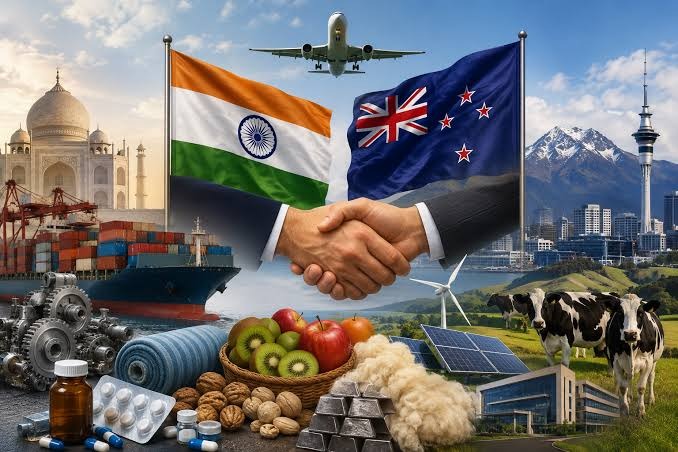
India and New Zealand have expanded their strategic cooperation across defense, science, and space sectors, coinciding with Prime Minister Modi's historic state visit to Auckland. Building on their 2026 Free Trade Agreement, both democracies are accelerating joint maritime security drills, polar research, and professional migration pathways.
AUCKLAND, New Zealand — India and New Zealand have significantly expanded their strategic engagement, transforming traditional ties into a broad-based partnership spanning defense, scientific innovation, space exploration, and bilateral trade. The announcement coincided with Prime Minister Narendra Modi’s high-profile arrival in Auckland on Friday, July 10, 2026, marking the final leg of his three-nation tour and the first state visit by an Indian Prime Minister to the island nation in nearly four decades.
This diplomatic momentum follows the landmark Free Trade Agreement (FTA) signed in April 2026, positioning both nations to align their economic and security interests within an increasingly complex Indo-Pacific landscape.
Defense Integration and Maritime Security Take Center Stage
The rapid acceleration of India-New Zealand bilateral ties is anchored by a formal Defense Cooperation Agreement (DCA), which was established during New Zealand Prime Minister Christopher Luxon’s preceding visit to New Delhi. According to updates from India's Ministry of External Affairs (MEA), naval cooperation has emerged as the primary driver of regional security alignment.
Recent operational highlights include successful port calls by Indian Navy warships INS Sahyadri and INS Kolkata in Wellington and Auckland, alongside strategic port visits by the Indian Navy sailing vessel INSV Tarini.
High-level military leadership exchanges have solidified this partnership. Following reciprocal visits by the Chief of the Royal New Zealand Navy and India's Chief of Naval Staff, the two democracies have expanded information-sharing channels. Border management has similarly evolved under a newly implemented Customs Cooperative Arrangement and a Mutual Recognition Agreement for Authorised Economic Operators, signed between India's Central Board of Indirect Taxes and Customs (CBIC) and the New Zealand Customs Service to deter transnational crime.
Joint Scientific Initiatives and Space Collaboration
Beyond traditional security, India and New Zealand are expanding scientific cooperation through structured knowledge-sharing programs. A primary area of scientific synergy is polar research, with Indian scientists actively participating in specialized Antarctic research expeditions alongside Kiwi teams.
Bilateral space exploration has also seen a significant upgrade following an official Indian Space Research Organisation (ISRO) delegation deployment to New Zealand. The institutional exchange focuses on:
Co-developing satellite-based maritime domain awareness assets.
Exchanging digital governance frameworks to optimize public sector tech delivery.
Enhancing agricultural science collaboration, particularly in food safety, plant protection audits, and advanced dairy and sheep farming methodologies.
Economic Impact and Service Sector Mobility
The commercial backbone of the expanding relationship remains tied to the 2026 Free Trade Agreement, which projected a target of up to $20 billion in new investment flows over the next 15 years. Under the structural guidelines of the trade pact, New Zealand grants 100% duty-free access to all Indian merchandise exports, providing immediate market competitive advantages to India’s labor-intensive textile, pharmaceutical, and engineering sectors.
For professionals and the diaspora, the ongoing negotiations for a dedicated Migration and Mobility Partnership Agreement aim to streamline cross-border movement. New Zealand has opened up 118 service sectors, offering specialized post-study work pathways for STEM graduates and introducing a temporary employment visa allocation for skilled professionals.
Official Sources Section
The policy directions, operational defense frameworks, and multi-sector cooperative targets described in this article are sourced directly from formal statements, high-level diplomatic schedules, and bilateral agreement registries maintained by India's Ministry of External Affairs (MEA) and the Prime Minister’s Office (PMO).
Quote Section
According to official brief transcripts provided by regional diplomatic missions ahead of the bilateral meetings:
"Our expanding strategic cooperation with New Zealand reflects a mutual commitment to a stable, rules-based Indo-Pacific. The transition from pure trade dialogues to active defense coordination and joint space research indicates the growing trust between our two democracies."
Why It Matters
For citizens, exporters, and technology institutions, this expanded alliance stabilizes supply chains and introduces high-income employment opportunities for technical professionals. By combining India's scale and engineering talent with New Zealand's localized innovation and maritime domain expertise, the partnership enhances regional economic stability during a period of global trade uncertainty.
Key Facts at a Glance
Defense Architecture: Operations are formally guided by a comprehensive Defense Cooperation Agreement (DCA).
Scientific Research: Indian researchers are actively participating in joint Antarctic exploration programs.
Space & Technology: Joint space framework tracks follow official technical exchanges between ISRO and Kiwi space agencies.
Bilateral Economics: Backed by the 2026 Free Trade Agreement, target investments aim to reach $20 billion over 15 years.
FAQ Section
What are the primary areas of defense cooperation between India and New Zealand?
Defense cooperation focuses heavily on maritime security, including regular naval warship port calls, joint high-level strategic dialogues, and information sharing to curb transnational organized crime.
How are the two nations collaborating in the scientific sector?
Key scientific projects include joint research expeditions in the Antarctic, digital governance research, satellite technology cooperation, and advanced agricultural quality-control audits.
What benefits does the recent trade pact provide to Indian professionals?
The agreement opens 118 service sectors in New Zealand and improves visa mobility pathways, particularly offering post-study work opportunities for STEM graduates and skilled industry experts.
Source: Official press statements published on July 10, 2026, by the Ministry of External Affairs and operational updates from NSE India regarding expanding corporate footprints.