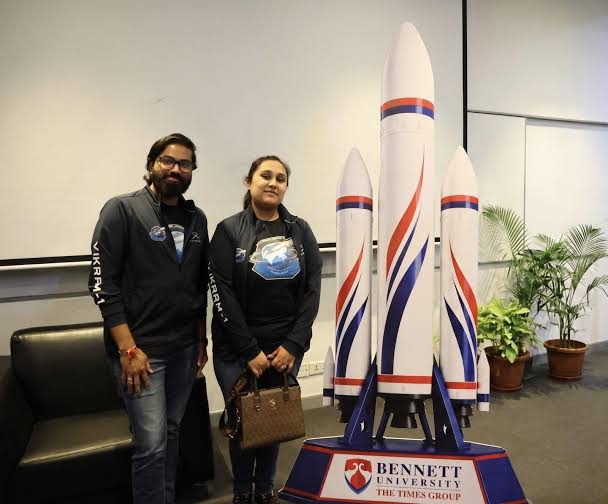
Bennett University has expanded its aerospace engineering programs and launched its SpaceTech Venture Cohort alongside the Space Founders Manual to support India's private space push. Inaugurated by astronaut Shubhanshu Shukla, the initiatives combine hands-on propulsion research, startup incubation, and IN-SPACe collaboration to cultivate the next generation of space entrepreneurs.
GREATER NOIDA — Bennett University has expanded its aerospace engineering curricula and launched dedicated space-sector incubation programs, cementing its institutional alignment with India's private space push, university administrators announced on Saturday, September 5, 2026. The comprehensive initiative—marked by the rollout of the SpaceTech Venture Cohort and the publication of the Space Founders Manual during the recent Deeksharambh orientation program—aims to transition undergraduate students from theoretical orbital mechanics into active contributors within the domestic commercial launch, satellite communications, and aerospace supply chain ecosystems. The development comes as national space authorities actively seek private sector collaboration to scale India's share in the multi-billion-dollar global space economy.
Expanding Aerospace Curricula to Meet Commercial Space Demands
India’s NewSpace sector has undergone structural transformation since national policy reforms opened launch infrastructure, satellite fabrication, and testing grounds to private non-governmental entities. Bennett University has adapted its Mechanical and Aerospace Engineering specialization under the School of Engineering and Applied Sciences to bridge the acute talent deficit facing private space startups and aerospace manufacturing vendors.
The university's academic framework integrates core mechanical principles with advanced domains including gas dynamics, computational simulation, aerostructures, and jet propulsion. Students operate within specialized wind-tunnel testing facilities, structural stress analysis laboratories, and advanced materials engineering workshops. Rather than isolating technical training from real-world application, the institution mandates practical project completions focused on lightweight composites, micro-propulsion subsystems, and high-altitude aerodynamic stability, preparing graduates for technical roles across private launch vehicle manufacturers and defense contractors.
Interdisciplinary Incubation and the SpaceTech Venture Cohort
To accelerate commercialization, the university formally instituted the SpaceTech Venture Cohort, breaking traditional silos that historically restricted space innovation to academic astrophysicists. The incubator recruits cross-disciplinary teams spanning software development, industrial design, life sciences, and regulatory policy to develop commercial applications for low-Earth orbit missions and satellite communications.
During the launch, the university unveiled the Space Founders Manual, an operational playbook designed to assist student founders in navigating venture funding, intellectual property registration, and space regulatory compliance. The cohort collaborates alongside university-backed entrepreneurship cells, providing seed capital access, technical mentorship from seasoned aerospace professionals, and prototype testing resources to student-led teams building market-ready aerospace products.
Parallel to mechanical research, the university has also partnered with the Indian National Space Promotion and Authorisation Centre (IN-SPACe) through its Times School of Media to offer certified training in Space Sector Communication and Public Engagement. Recognized under the National Council for Vocational Education and Training (NCVET) framework, the specialized program trains professionals to articulate policy communication, crisis response, and public engagement for the evolving space tech sector.
Impact on Industry, Students, and the Domestic Economy
The convergence of academic research and private space enterprise produces measurable impacts across multiple industrial and educational fronts:
For Private Aerospace Startups: Fast-tracks the recruitment of project-ready aerospace engineers, reducing corporate training overhead and accelerating deployment cycles for private launch vehicles.
For Engineering Students: Transitions academic learning into hands-on space industry experience, improving employability in computational fluid dynamics, satellite subsystems, and advanced manufacturing.
For National Space Ecosystem: Broadens institutional capacity outside traditional state agencies, distributing innovation across academic hubs to support India's private space push.
For Venture Investors: Provides early-stage venture capital funds with a vetted pipeline of deep-tech student founders working on commercial space technology.
Official Sources
According to program documentation from Bennett University and joint curricular directives issued by the Indian National Space Promotion and Authorisation Centre (IN-SPACe), public-private academic tie-ups are designed to align institutional training with national manufacturing benchmarks. National space initiatives are administered in alignment with directives issued by the Indian Space Research Organisation (ISRO) and the Department of Space.
Official Statements
Addressing incoming students during the inauguration of the space cohort, Indian astronaut and Indian Air Force Group Captain Shubhanshu Shukla stressed the practical resilience required in modern aerospace endeavors:
"Failure is not the end of the road, but one of the best mediums to learn and reinvent yourself. Believe me, we also made mistakes in space, and many missions faced problems. When things get tough, you must rely on your preparation and hard work."
Special Guest and Khel Ratna awardee Ronjan Sodhi underscored the focus needed in the sector: "Whether you are aiming for a podium finish or launching a startup into orbit, the foundational values of razor-sharp focus and unwavering perseverance are exactly the same."
Commenting on joint institutional frameworks, Dr. Vinod Kumar, Director of the Promotion Directorate at IN-SPACe, stated: "This reflects IN-SPACe's commitment to building skilled human capital that can bridge the gap between space science and society. Recognition under the NCVET framework ensures that the competencies developed through this programme are benchmarked to national standards."
Why It Matters
Capacity Building: India’s private space push requires thousands of specialized engineers and operational professionals annually to sustain private rocket and satellite launches.
Venture Creation: Moving beyond theoretical coursework enables engineering campuses to incubate viable commercial startups that attract early-stage risk capital.
Ecosystem Diversity: Expanding space studies into policy, communications, and business broadens the workforce beyond core rocketry into an integrated commercial industry.
Key Facts at a Glance
Institution: Bennett University, located in Greater Noida, Uttar Pradesh.
Core Initiatives: Launch of the SpaceTech Venture Cohort, unveiling of the Space Founders Manual, and advanced laboratory training in propulsion and aerostructures.
Key Dignitaries: Inaugurated by astronaut Group Captain Shubhanshu Shukla and Khel Ratna awardee Ronjan Sodhi.
National Alignment: Programs coordinated with national accreditation bodies and regulatory frameworks established by IN-SPACe.
Frequently Asked Questions
What is Bennett University's SpaceTech Venture Cohort?
The SpaceTech Venture Cohort is an interdisciplinary incubation program designed to help university students develop scalable commercial startups in satellite software, payload development, and space applications.
How does Bennett University contribute to India's private space push?
The university provides specialized undergraduate training in aerospace engineering, operates hands-on wind tunnel and propulsion labs, and partners with government bodies like IN-SPACe to develop cross-disciplinary talent.
What is the role of IN-SPACe in university-level space programs?
IN-SPACe collaborates with academic institutions to benchmark educational and communication curricula against national industry standards, fostering skilled human capital for the private space economy.
Who unveiled the Space Founders Manual at Bennett University?
Group Captain Shubhanshu Shukla, an Indian astronaut who contributed to scientific research aboard the International Space Station, formally unveiled the manual during the university's Deeksharambh orientation ceremony.
Source: Official program announcements from Bennett University, regulatory circulars and releases from the Indian National Space Promotion and Authorisation Centre (IN-SPACe), and academic policy frameworks from the Indian Space Research Organisation (ISRO).