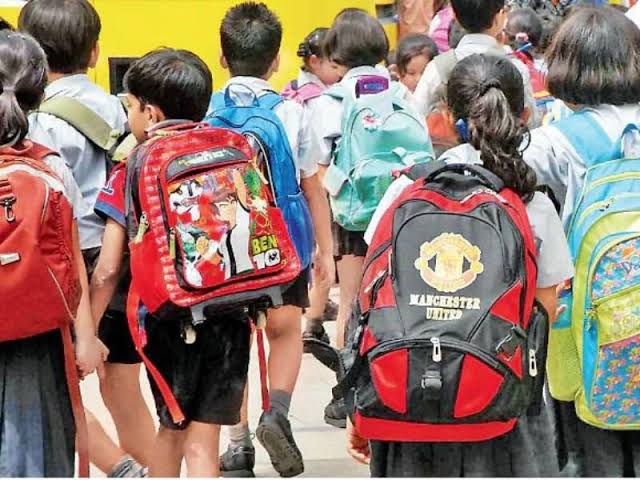
The Maharashtra government has mandated that school bags must not exceed 10% of a student’s body weight across all government, aided, and private schools. Introducing 10 annual bagless days for experiential learning, the directive enforces timetable restructuring and regular audits, penalizing non-compliant institutions with grant reductions or license derecognition.
MUMBAI — The Maharashtra School Education and Sports Department has issued a comprehensive directive mandating that the weight of a student's school bag must not exceed 10% of their body weight across all primary, secondary, and higher secondary institutions. Promulgated by the State School Education Commissioner following guidelines released by the Union Ministry of Education, the statutory notification also instructs educational institutions to introduce 10 mandatory "bagless days" each academic year to foster experiential learning and relieve physical musculoskeletal strain on pupils. The directive applies uniformly across public, municipal, state-aided, and private unaided schools throughout Maharashtra.
Timetable Restructuring and Mandatory Physical Audits
Under the statutory framework, school administrations are instructed to redesign daily academic timetables so students are only required to transport books, notebooks, and reference materials essential for that specific instruction day. Educational institutions have been directed to eliminate unnecessary supplementary workbooks and prohibit requests for students to bring non-essential stationary or reference guides on standard days.
School managements must establish dedicated on-campus infrastructure to facilitate bag-weight reduction, including digital weighing scales at entrance gates, personal book lockers where feasible, and safe drinking water stations to eliminate the need for pupils to carry heavy fluid flasks from home. District education officers (DEOs) and block inspectors have been authorized to conduct surprise random weight audits in classrooms.
Failure to adhere to the prescribed threshold carries administrative penalties. Schools repeatedly violating the 10% weight limit face statutory reductions or freezes in state grants-in-aid, and in persistent or egregious cases, total derecognition of their operational license.
Institutionalizing 10 Bagless Days Under National Frameworks
In accordance with the National Education Policy (NEP) and the national School Bag Policy 2020, the notification directs schools to designate at least 10 bagless days during the academic calendar. During these scheduled sessions, students in grades 6 through 8 will engage exclusively in vocational crafts, arts, physical culture, field explorations, and interactive community projects without backpacks.
These experiential days are designed to integrate vocational exposures—such as local carpentry, potting, electric circuit assembly, ecological mapping, and regional heritage preservation—directly into foundational schooling without adding curricular textbook loads.
Pedagogical and Health Impacts Across Stakeholders
The structural enforcement of the bag weight cap and bagless modules introduces measurable shifts for educational and medical stakeholders:
For Students: Mitigates early-onset musculoskeletal disorders, including chronic lumbar fatigue, postural misalignment, scoliosis risks, and cervical spine compression caused by overloaded backpacks.
For Parents: Relieves daily anxiety over physical strain, encouraging parents to inspect school timetables before packing and preventing unnecessary expenditure on heavy hardbound supplies.
For School Administrations: Necessitates logistical adjustments, including internal locker provisions, semesterized textbook volumes, and scheduled homework rotations across academic departments.
For Teachers: Requires collaborative planning among subject faculty to prevent overlapping homework requirements that demand simultaneous carriage of multiple heavy workbooks.
Official Sources
According to formal administrative orders released by the School Education and Sports Department, Government of Maharashtra and directives issued under the national School Bag Policy 2020 by the Department of School Education and Literacy, Ministry of Education, the circular aligns state schools with statutory standards to curb physical burdens on children. Compliance monitoring will be handled in coordination with the Maharashtra State Council of Educational Research and Training (SCERT).
Official Statements
"According to senior officials in the School Education Department, repeated surveys revealed that primary and middle school students regularly carried loads equaling 20% to 30% of their body weight, creating long-term orthopedic complications that required strict administrative intervention."
Education commissionerate officials noted: "Schools must actively plan their daily timetables and classroom activities to ensure that unnecessary academic materials remain outside the bag, with regular weighing audits conducted at the administrative level to guarantee institutional compliance."
Why It Matters
Pediatric Health Protection: Directly shields developing children from chronic spine compression, muscular strain, and fatigue.
Experiential Pedagogical Shift: Bagless days shift the classroom focus from rote textbook memorization to vocational training and skill-based learning.
Regulatory Accountability: Imposes punitive actions—including grant freezes and derecognition—on non-compliant private and aided schools, ensuring statutory implementation rather than voluntary adherence.
Key Facts at a Glance
Weight Restriction: School bag weight is strictly capped at a maximum of 10% of the student's body weight.
Bagless Days: Mandatory 10 bagless days per academic year for vocational and experiential learning.
Applicability: Enforced across all government, government-aided, municipal, and private unaided schools in Maharashtra.
Penalties: Defaulting schools face financial reductions in state grants or potential cancellation of recognition.
Frequently Asked Questions
What is the maximum permissible weight for a school bag in Maharashtra?
The total weight of a student's backpack, including all books, stationery, and lunchboxes, must not exceed 10% of their actual body weight.
What happens during the 10 bagless days?
During these days, students attend school without regular textbooks or bags to participate in hands-on vocational modules, local crafts, arts, physical activities, and field visits.
Which schools must comply with the new directive?
The directive applies to all primary, secondary, and higher secondary schools operating in Maharashtra, including state government, aided, and private unaided institutions.
What action will the government take against schools that violate the rule?
Institutions that fail to enforce the weight limits following inspection audits may face penalties affecting state funding or face derecognition by the education department.
Source: Official notifications from the School Education and Sports Department, Government of Maharashtra, regulatory circulars from the Ministry of Education, Government of India, and academic framework advisories from the Maharashtra State Council of Educational Research and Training (SCERT).