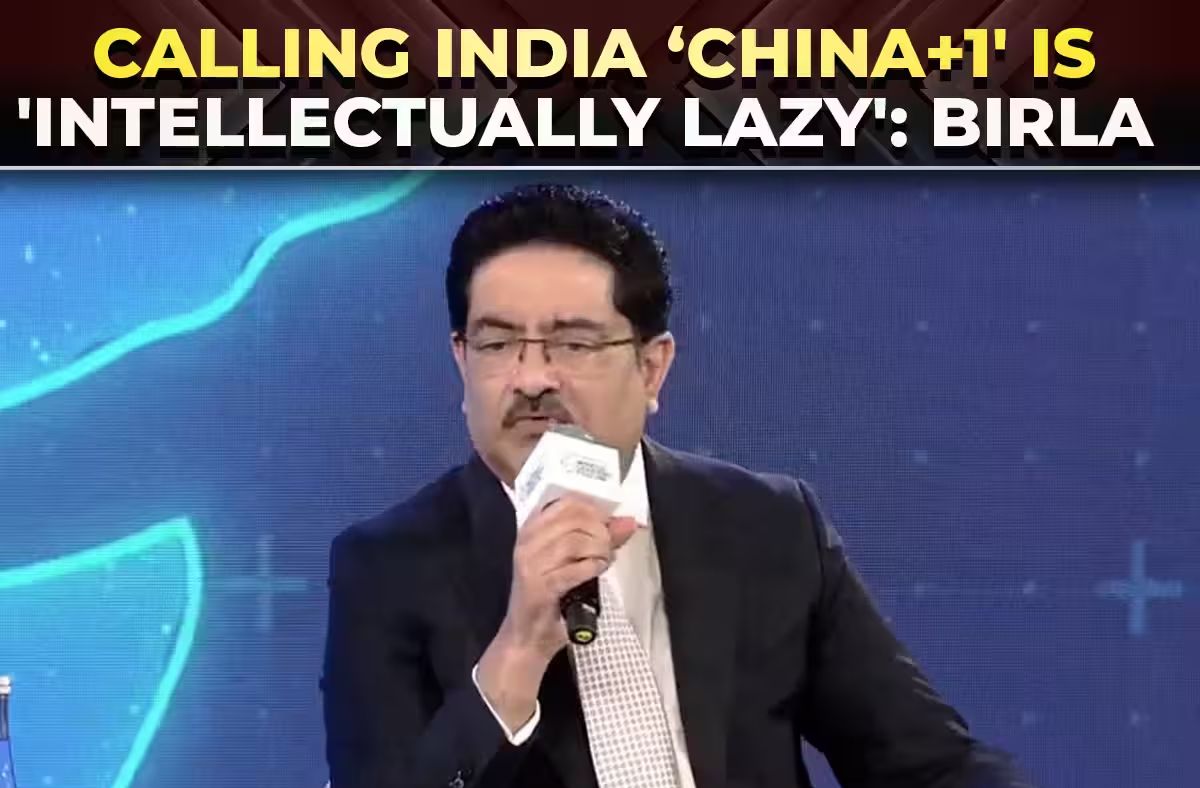
Speaking at the ET World Leaders Forum in Mumbai, Aditya Birla Group Chairman Kumar Mangalam Birla criticized the term "China plus one" as intellectually lazy. He urged international markets to recognize India as a standalone global growth engine under a new "world plus one" framework driven by strong corporate conviction.
Backed by high-level industry addresses in Mumbai, corporate leaders argue that viewing India merely as an alternative to China underestimates its standalone economic scale.
Redefining India's Position in the Changing Global Order
The international business community is reevaluating how emerging manufacturing hubs and supply chain networks are categorized. According to official proceedings and keynote addresses at The Economic Times World Leaders Forum in Mumbai on August 21, 2026, Aditya Birla Group Chairman Kumar Mangalam Birla challenged conventional economic nomenclature.
Addressing senior policymakers and global business leaders, Birla stated that describing India as a "China plus one" destination is an "intellectually lazy" shorthand that fails to capture the nation's true economic depth, domestic market scale, and historical track record. Instead, he proposed that multinational corporations and international investors should view India through the lens of "World Plus One"—positioning the country as a primary global growth engine rather than a secondary regional backup.
Corporate Conviction, Capital Discipline, and Domestic Inflows
Elaborating on current investment cycles, Birla noted that large industrial groups are ramping up capital expenditures, signaling a robust revival in corporate investment activity. He emphasized the importance of distinguishing between standard corporate capital discipline and underlying confidence in the Indian economy. According to leadership assessments shared at the forum, institutional conviction regarding India's long-term prospects remains at an all-time high.
At the same time, the discussion highlighted a structural shift in market liquidity. With domestic investors exhibiting a deeper understanding of local economic drivers, India's financial ecosystem is growing less dependent on overseas capital volatility. While foreign institutional investors face complex pressures from currency movements and global geopolitics, robust domestic retail participation continues to provide a stable cushion for capital markets and initial public offering (IPO) pipelines.
Why It Matters
The practical implications of shifting from a "China plus one" mindset to a "World Plus One" framework affect global supply chain strategies, foreign direct investment (FDI) inflows, and domestic industrial planning. By treating India as a standalone economic powerhouse with independent consumer demand and robust digital infrastructure, global enterprises can better align their long-term manufacturing and expansion roadmaps with the country's rising output capabilities.
Key Facts at a Glance
Forum Context: Announced during the ET World Leaders Forum in Mumbai on August 21, 2026.
Core Thesis: Characterizing India as "China plus one" underestimates its independent capacity and scale.
New Framework: Proposing "World Plus One" to position India as a primary global growth engine.
Market Resilience: Growing reliance on deep domestic liquidity alongside returning foreign capital.
FAQ Section
Why did Kumar Mangalam Birla criticize the "China plus one" label?
Birla argued that the term is an intellectually lazy shorthand that reduces India to a secondary alternative rather than acknowledging its independent scale, track record, and potential as a global growth engine.
What does the "World Plus One" concept signify for international businesses?
It encourages global corporations to integrate India into their core strategies as a standalone primary driver of manufacturing, innovation, and economic expansion.
How are domestic investors influencing India's capital markets?
Consistent inflows from domestic retail and institutional investors have deepened market liquidity, reducing short-term reliance on overseas capital flows.
Where can readers review full transcripts of the ET World Leaders Forum?
Detailed coverage, video recordings, and executive interviews are published regularly on The Economic Times Portal.
Source: The Economic Times Corporate Trends, ET TV News Videos