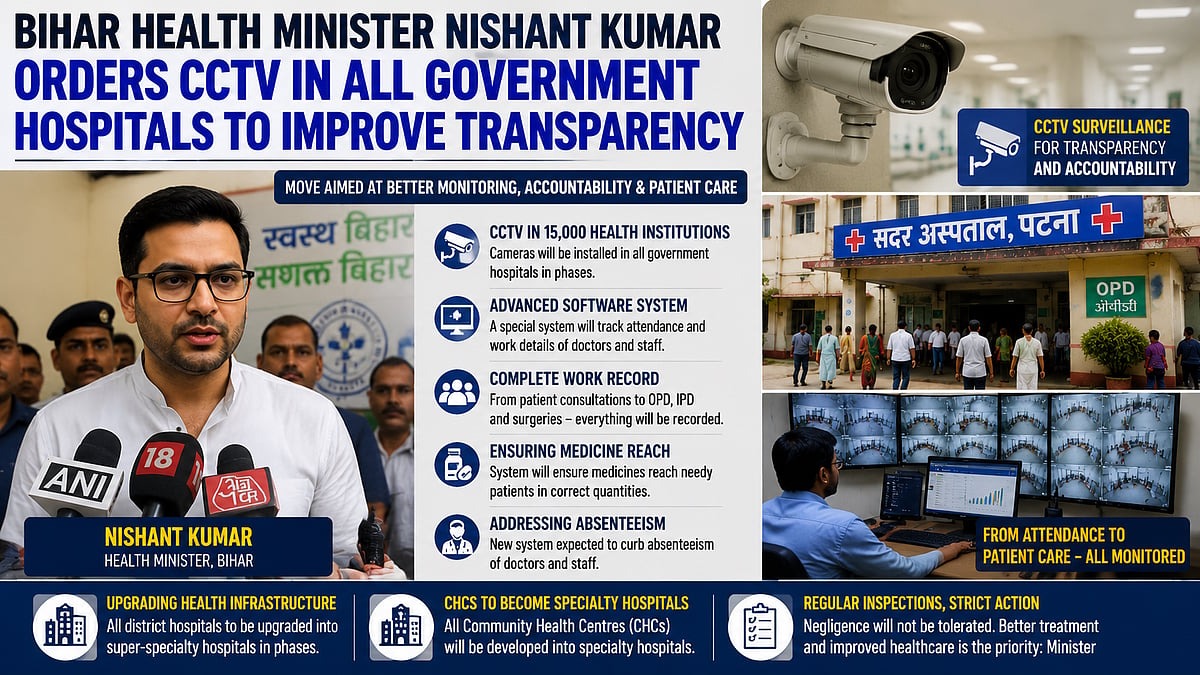
Bihar Health Minister Nishant Kumar has ordered the mandatory installation of CCTV networks across all government hospitals to improve transparency and monitor staff performance. The digital initiative tracks employee attendance, secures emergency wards, and streamlines patient distribution networks, establishing real-time administrative accountability across the state's public healthcare infrastructure.
PATNA — Bihar Health Minister Nishant Kumar has officially ordered the immediate installation of closed-circuit television (CCTV) systems across all state-run healthcare facilities, ranging from primary health centers to large medical college hospitals. The comprehensive digital mandate, announced during a high-level performance review meeting in Patna, aims to systematically improve transparency and monitor staff performance in real time. The enforcement directive addresses long-standing citizen complaints regarding medical absenteeism, security vulnerabilities, and irregular patient care delivery across Bihar’s public healthcare network.
Directives Aimed at Curbing Staff Absenteeism
According to an official notification from the Bihar State Health Society, the widespread CCTV installation program must be executed under a strict, phased timeline.
The ministerial order specifically dictates that high-definition network cameras must be placed at all major entry points, outpatient department (OPD) counters, emergency wards, medicine distribution desks, and main administrative corridors. By targeting these specific functional nodes, the health department plans to establish an unalterable digital audit trail to track exactly when doctors, nursing teams, and auxiliary staff arrive at their assigned stations. The recorded video data will serve as an objective reference points to verify standard biometric attendance logs, effectively penalizing unauthorized staff absences.
Operational Monitoring and Patient Security Integration
The deployment strategy expands beyond simply monitoring employee attendance. Under the administrative rules framed by the State Health Department, centralized digital control centers will be established at both district and state levels. The structural expansion is designed to address multiple systemic vulnerabilities:
Real-Time Workload Tracking: District magistrates and health directors can directly view crowding levels at OPD ticketing counters and move resources to reduce patient wait times.
Infrastructure Accountability: Monitoring the physical availability of essential supplies, verifying that round-the-clock emergency desks are functional, and tracking internal cleanliness protocols.
Safety Barriers: Providing a secure physical environment for on-duty doctors and female nursing staff, mitigating the risk of workplace harassment or spontaneous public unrest.
The operational overhaul is expected to bring immediate structural improvements for millions of rural and semi-urban patients who rely completely on state-funded clinical infrastructure. Furthermore, medical equipment vendors and security enterprise firms expect a substantial rise in technology deployment contracts within the state over the next two fiscal quarters.
Enforcement Framework
The newly formed health department inspection committees have been given the legal authority to conduct surprise physical audits. Any state facility found operating with deactivated or intentionally obstructed camera networks will face immediate disciplinary cuts to their regional administrative budgets.
Macro Context: Digital Overhaul of Public Welfare Systems
Independent healthcare analysts point out that Bihar's mandatory digital push mirrors broader governance strategies deployed across other major Indian states, such as Uttar Pradesh and Madhya Pradesh. Public health systems have frequently faced scrutiny due to poor maintenance, local medication theft, and unauthorized medical brokers operating on public property.
By standardizing continuous video surveillance, the state government intends to shift from an adversarial, post-incident investigative model to a preventative, data-driven management framework. This technological integration aligns with ongoing structural transitions toward transparent e-governance platforms supported by the central Ministry of Health and Family Welfare.
Official Executive Mandates and Accountability Clauses
The logistical roll-out of the surveillance grid will be managed under direct monitoring frameworks supervised by senior state IAS officers.
State Secretariat Directives
According to the administrative directives compiled by the Health Secretariat at the Vikas Bhawan in Patna, funding allocations for the camera infrastructure will be drawn from the state's dedicated emergency health asset modernization funds.
Management Enforcement Summary
In a post-review briefing, senior department administrative leads clarified that:
"The objective behind this comprehensive surveillance initiative is not to create an environment of institutional mistrust, but to establish verified, empirical benchmarks for operational accountability. Honest healthcare professionals will gain a secure working environment, while negligent activities will face rapid, documented administrative corrections."
Why It Matters
For citizens and low-income patients, this policy ensures that doctors and essential medicines remain accessible during mandated clinic hours without arbitrary interruptions. For state administrators and institutional investors tracking public infrastructure efficiency, the continuous data flow provides a reliable mechanism to assess real capital usage and evaluate employee performance metrics across rural medical districts.
Key Facts at a Glance
Policy Mandate: Health Minister Nishant Kumar has officially ordered comprehensive CCTV installation across all government hospitals in Bihar.
Primary Objective: The technological rollout focuses heavily on maximizing institutional transparency while accurately monitoring medical staff performance.
Surveillance Scope: Network cameras will cover all emergency rooms, OPD units, medicine counters, and main entry corridors.
Administrative Oversight: Decentralized regional monitoring hubs will connect directly to a centralized state dashboard to prevent localized manipulation of data.
Frequently Asked Questions (FAQ)
Which specific hospitals are included under Bihar's new CCTV installation mandate?
The order applies to all levels of state-run healthcare infrastructure, including village Primary Health Centers (PHCs), Community Health Centers (CHCs), District Hospitals, and premium State Medical College Hospitals.
Will the new camera installations violate patient privacy regulations?
No, the administrative guidelines strictly prohibit camera placements inside private examination rooms, changing spaces, or active inpatient intensive care unit beds to ensure full compliance with patient privacy laws.
How will the recorded video footage be used to monitor staff performance?
The digital recordings will be systematically cross-verified against electronic biometric logs to confirm physical presence and analyze how efficiently staff manage high-volume patient periods.
Sources: