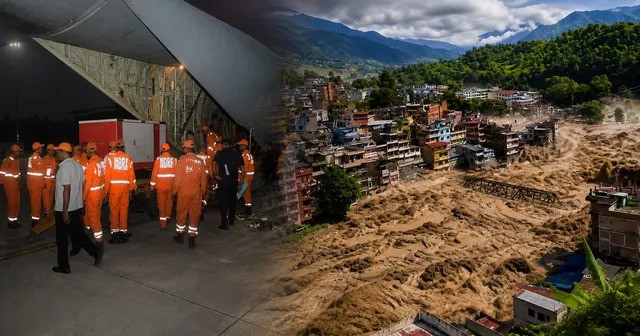
India has deployed an 11-member specialized rescue team to Nepal to assist local authorities following devastating flash floods that killed over 600 people and left thousands missing. The team will support complex operations alongside ongoing bilateral humanitarian relief efforts.
An 11-member specialized rescue team from India arrived in Nepal to support local authorities as the death toll from catastrophic flash floods surpassed 600.
KATHMANDU — An 11-member Indian disaster response team, including medical personnel and tunnel rescue experts, arrived in Nepal on Saturday to assist local authorities following devastating flash floods that killed more than 600 people and left nearly 2,000 missing. The disaster, triggered by a massive glacial collapse along the Nepal-Tibet border affecting regions such as Rasuwa, sent a destructive wall of water, mud, and debris through the Bhotekoshi and Trishuli river valleys on Wednesday. Following formal requests from the Nepalese government for technical support in complex operations, New Delhi deployed the specialized team alongside extensive aerial relief consignments to bolster ongoing search-and-recovery missions in severely damaged terrain.
Specialized Rescue and Tunnel Operations
The deployment comprises technical specialists equipped to manage complex subterranean and structural recovery tasks. According to local reports, rescue efforts have faced severe impediments due to compromised infrastructure, including washed-out roads and collapsed bridges across mountain districts. The specialized Indian personnel are coordinating directly with the Nepal Army to target hard-to-reach locations, including flooded hydropower project tunnels where workers and local residents remained trapped. Concurrently, heavy equipment requests, including portable Bailey bridges, are being facilitated to restore critical supply routes between isolated settlements and major hubs like Kathmandu.
Humanitarian Aid and Regional Impact
The flash floods have devastated vital physical assets, including hydroelectric facilities, communication lines, and residential settlements, leaving local hospitals struggling with morgue capacities amidst an influx of casualties. Beyond the specialized response team, India has flown in tens of tonnes of humanitarian aid, encompassing medical supplies, dry rations, and tents. For businesses, travelers, and citizens, the disruption of key trade corridors along the mountain highways has halted regional logistics, while consular offices work to track and evacuate stranded foreign nationals, including Indian pilgrims and tourists.
Official Sources Section
According to official announcements from the Indian Embassy in Kathmandu and briefings released by Nepal's Ministry of Foreign Affairs and national disaster management authorities, the deployment follows direct high-level coordination between New Delhi and Kathmandu.
"The team includes medical personnel and tunnel rescue experts. It was sent after a request from the Nepal government, according to Indian embassy sources," organizers stated.
Government statements confirmed that while domestic security forces are leading primary operations, international technical assistance is being integrated into complex structural zones.
Why It Matters
The deployment of India's specialized rescue team carries immediate practical implications for humanitarian relief and regional stability. With thousands still unaccounted for and continuous threats of secondary flooding from blocked debris dams, advanced technical support accelerates the recovery of trapped survivors. For bilateral relations, the rapid response reinforces mutual disaster resilience and underscores New Delhi's operational capacity as a primary regional first responder.
Key Facts at a Glance
Rescue Team Deployment: An 11-member Indian team including medical and tunnel rescue experts arrived in Nepal.
Casualties: Death toll surpasses 600 people, with nearly 2,000 individuals reported missing.
Disaster Trigger: Catastrophic flash floods and glacial collapse along the Nepal-Tibet border region.
Humanitarian Aid: India previously dispatched over 60 tonnes of relief material, including medicines and food packets.
Frequently Asked Questions
Why was the Indian rescue team sent to Nepal? The team was deployed at the request of the Nepalese government to assist with complex technical operations, including tunnel rescues in flood-affected regions.
What caused the catastrophic floods in Nepal? The disaster was triggered by a massive glacial collapse along the Nepal-Tibet border, sending a destructive torrent of water and debris down mountain river systems.
How many people have been affected by the disaster? Over 600 people have been confirmed dead, and nearly 2,000 remain missing following widespread destruction in districts like Rasuwa.
What other assistance has India provided? In addition to personnel, India has airlifted tens of tonnes of humanitarian assistance, including emergency food packets, medical supplies, and disaster relief equipment.
Source: The Economic Times, The Hindu, The Pioneer, Ministry of External Affairs, India