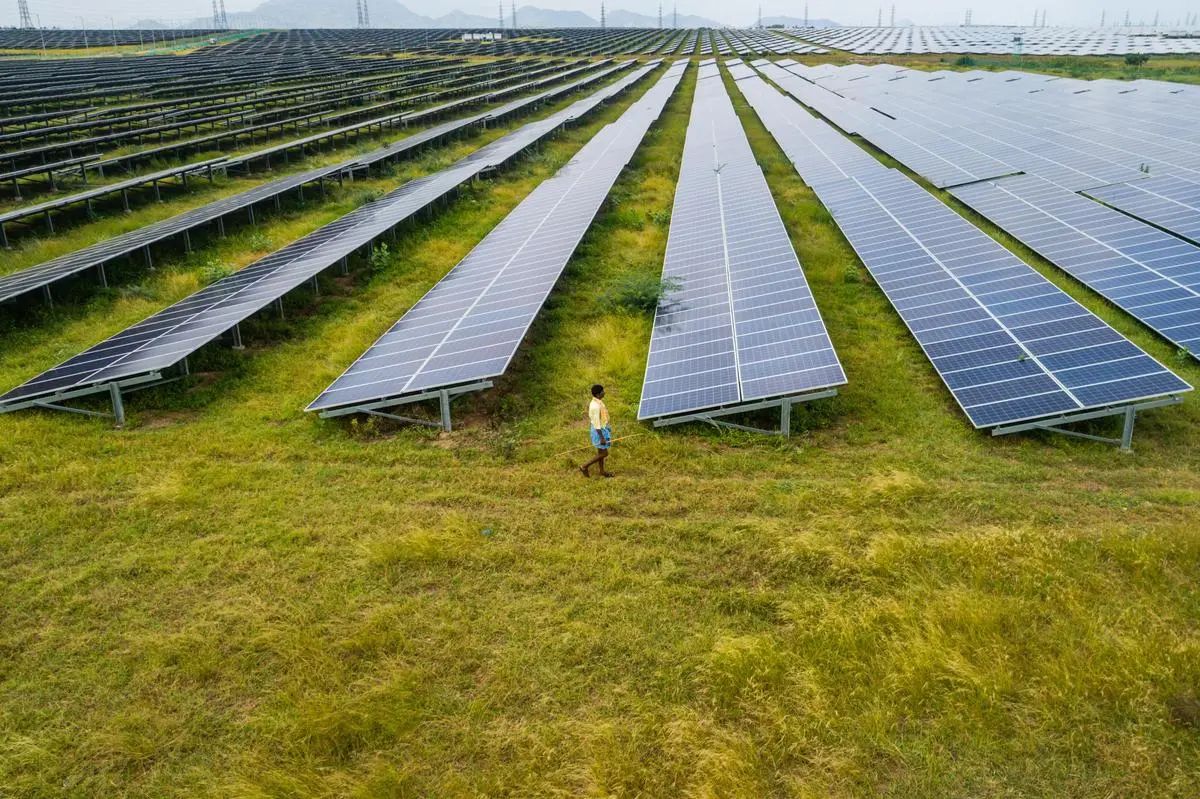
The Union Ministry of New and Renewable Energy is designing a new policy framework to support domestic polysilicon manufacturing. Aiming for at least 30 gigawatts of capacity by 2030, the initiative seeks to eliminate heavy import reliance, secure vital upstream solar supply chains, and bolster long-term manufacturing resilience across India.
Backed by official ministry announcements in New Delhi, the government is drafting a dedicated support scheme to establish at least 30 gigawatts of domestic polysilicon manufacturing capacity by 2030.
Addressing Upstream Gaps in India's Clean Energy Sector
India's rapid expansion in renewable energy infrastructure is set to undergo a major industrial shift. Speaking on the sidelines of the Bloomberg New Energy Finance Summit in New Delhi, Ministry of New and Renewable Energy (MNRE) Secretary Santosh Kumar Sarangi announced that the central government is actively designing a specialized support scheme to promote domestic manufacturing of polysilicon.
While India has successfully scaled up downstream solar photovoltaic module manufacturing to over 200 gigawatts and cell production to roughly 30 gigawatts, domestic production of polysilicon—the foundational raw material required for solar ingots and wafers—has remained virtually non-existent. The new administrative framework aims to resolve this bottleneck, ensuring that the country's clean energy transition is supported by an integrated, self-reliant domestic supply chain.
Investment Metrics and Strategic Capacity Goals
Establishing a robust domestic polysilicon ecosystem requires significant capital expenditure and advanced chemical refining expertise. According to ministry estimates released in August 2026, setting up a single gigawatt of polysilicon production alongside metallurgical-grade silicon demands an estimated investment of approximately Rs 850 crore per gigawatt.
To meet projected national demand under broader decarbonization goals, the government is targeting a minimum capacity addition of 30 gigawatts of polysilicon manufacturing by 2030, representing an estimated investment potential of ₹25,000 crore. Because existing production-linked incentive (PLI) structures allocated limited capacity for this upstream component, officials confirmed that a separate, dedicated policy mechanism is necessary to adequately incentivize manufacturers.
Why It Matters
The practical implications of localizing polysilicon production extend directly to industrial self-reliance, national security, and long-term solar project economics. By fostering domestic refining capabilities, India can insulate its massive renewable energy ambitions from overseas supply chain vulnerabilities, reduce import dependency on dominant international markets, and strengthen industrial growth across both solar energy and semiconductor sectors.
Key Facts at a Glance
Target Capacity: At least 30 gigawatts of domestic polysilicon manufacturing by 2030.
Capital Requirement: Estimated investment of approximately Rs 850 crore per gigawatt.
Strategic Objective: Closing the upstream gap in India's solar PV value chain and reducing import dependence.
Policy Vehicle: A dedicated support mechanism separate from broader downstream solar PLI programs.
FAQ Section
Why is the government introducing a new scheme for polysilicon?
While India has built massive capacity for assembling solar cells and modules, it currently relies entirely on imports for polysilicon, the foundational raw material needed for solar ingots and wafers.
What is the target capacity set by the Ministry for 2030?
The Ministry of New and Renewable Energy is aiming for at least 30 gigawatts of domestic polysilicon manufacturing capacity by the end of the decade.
How much capital is required to set up polysilicon manufacturing facilities?
Industry estimates indicate that setting up 1 gigawatt of polysilicon production alongside metallurgical-grade silicon requires an investment of approximately Rs 850 crore.
Where can stakeholders track official policy updates and scheme guidelines?
Official policy announcements and ministry progress reports are published regularly through financial news desks and government portals such as The Economic Times and Mint.
Source: Mint, ANI News, The Economic Times