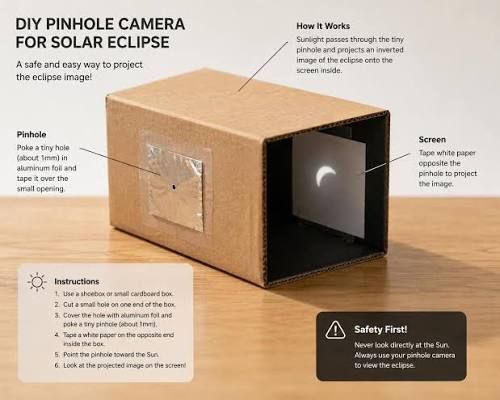
As astronomy enthusiasts prepare for the August 12, 2026 solar eclipse, scientists and safety officials emphasize the importance of indirect viewing techniques. Utilizing a standard cereal box, aluminum foil, and a pin, observers can construct an effective pinhole projector to watch partial phases safely without risking permanent retinal damage.
Amid widespread public excitement for upcoming celestial alignments, science communicators share accessible instructions for building reliable, indirect projection tools using everyday household materials.
As millions of stargazers and astronomy enthusiasts prepare to observe the celestial alignments of August 2026, public health agencies and astronomical societies have issued essential safety guidelines regarding eye protection. Because direct observation of unshielded solar radiation can cause permanent retinal injury, experts recommend indirect projection methods for individuals without certified ISO-compliant solar filters. To bridge this accessibility gap, educational institutions and science organizations have highlighted the construction of a traditional cereal box eclipse viewer—an inexpensive, highly effective pinhole projector that allows observers to watch celestial progression safely.
Materials Needed and Step-by-Step Construction
Building a functional pinhole projection box requires common household items that can be assembled within minutes. According to science outreach coordinators, the design relies on casting a focused image of the sun onto an internal white screen rather than looking upward directly.
Essential materials and assembly steps include:
Required Components: An empty cereal box, a sheet of plain white paper, a piece of aluminum foil, adhesive tape, a pair of scissors, and a sharp pin or needle.
Preparing the Screen: Cut a piece of white paper to fit snugly inside the bottom of the cereal box and secure it flat using tape to act as the internal projection screen.
Configuring the Top Apertures: Remove or tape down the top flaps of the box, cutting two separate rectangular openings on opposite outer edges of the lid while leaving the center divider intact.
Creating the Pinhole: Cover one of the top rectangular openings tightly with aluminum foil, securing the edges with tape, and use a pin to puncture a tiny, smooth hole in the exact center.
Operating the Projector and Crucial Safety Protocols
Proper operation of the finished device ensures complete eye safety throughout the duration of the event. Official astronomy guidelines dictate that users must stand with their backs entirely turned toward the sun, holding the box so that sunlight enters through the foil-covered pinhole. The projected image of the solar crescent will then appear on the white paper screen inside the opposite viewing window.
Experts reiterate strict safety warnings: conventional sunglasses, uncertified filters, and unfiltered optical equipment such as cameras or binoculars must never be used to look directly at the sun, as they fail to block harmful infrared and ultraviolet rays.
Why It Matters
Providing low-cost, accessible DIY alternatives empowers communities, students, and families to engage with major astronomical events without compromising personal safety. Safe viewing practices prevent accidental ocular injuries while fostering widespread public interest in space science.
Key Facts at a Glance
Device Type: Pinhole projection box (cereal box viewer).
Core Materials: Empty cereal box, aluminum foil, white paper, tape, and a pin.
Viewing Position: Observers must stand with their back to the sun, allowing light to pass through the pinhole onto the internal paper screen.
Safety Standard: Certified ISO 12312-2 filters or indirect projection methods are required during all partial eclipse phases.
FAQ Section
Why are ordinary sunglasses unsafe for viewing a solar eclipse?
Standard sunglasses transmit too much visible and invisible light, failing to protect the retina from severe thermal damage during direct solar observation.
How does a cereal box pinhole projector work?
Light from the sun passes through a tiny pinhole in aluminum foil, creating a small, safe optical projection of the sun's image onto a white paper screen inside the darkened box.
Can children use pinhole projection boxes safely?
Yes, because the viewer projects an image away from direct sightlines and requires the user to look away from the sun, it provides a safe educational option for children under supervision.
Where can readers find verified instructions and safety updates?
Detailed construction steps and scientific safety advisories are accessible directly via the Scout Life Project Portal and the National Solar Observatory Portal.
Source: Scout Life Science Archives, National Solar Observatory Portal, U.S. Army Directorate News, BBVA Sustainability Research Desk