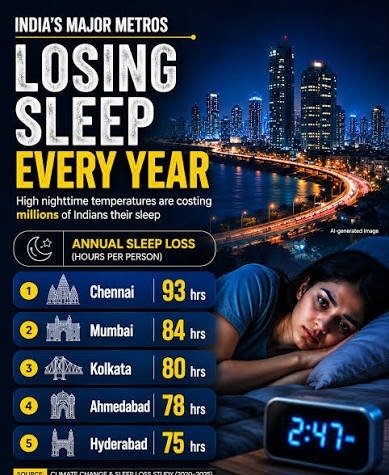
A global study by Climate Central reveals that climate change-induced nighttime heat is driving severe sleep loss across Indian cities. Chennai residents lose an average of 93 hours of sleep annually the highest among Indian metros as elevated overnight temperatures prevent physiological recovery, increasing long-term cardiovascular and mental health risks.
CHENNAI, July 25, 2026 — Rising nighttime temperatures caused by climate change have made Indian metropolitan areas major global hotspots for chronic sleep deprivation, with residents in Chennai losing an average of 93 hours of sleep every year. According to an extensive global report by climate research organization Climate Central, persistently elevated nighttime heat prevents the human body from cooling down after sunset, creating a silent public health emergency across dense urban centers.
The analysis, which examined sleep disruption metrics across more than 1,300 cities worldwide, revealed that urban populations in southern India face the heaviest heat-related sleep loss nationally. Coastal humidity paired with concrete heat retention keeps indoor temperatures well above health-safe thresholds throughout the night.
Heat Retention and Metros Impacted
The research highlights a significant thermal divergence: global nighttime temperatures are increasing at a faster pace than daytime maximums due to fossil-fuel-driven climate change. In dense urban environments, the Urban Heat Island (UHI) effect amplifies this phenomenon as concrete structures and asphalt roads absorb thermal energy during the day and release it continuously after dark.
Data collected across major Indian metropolitan hubs demonstrates widespread sleep disruption:
Chennai: Leads major Indian metros with 93 total hours of annual sleep lost per resident, of which five hours are directly attributable to human-induced climate change.
Mumbai: Records 84 hours of heat-induced sleep loss annually.
Kolkata: Logged 80 hours of lost sleep per year per inhabitant.
Bengaluru: Recorded 67 hours lost annually, with climate change accounting for 12 percent of that loss—the highest climate attribution footprint among Indian metros.
| Indian City | Total Annual Sleep Lost (Hours) | Climate Change Contribution | Primary Environmental Factor |
| Chennai | 93 Hours | ~5.0 Hours | Coastal humidity + concrete heat retention |
| Puducherry (UT) | 92 Hours | ~7.5 Hours | High ambient nighttime humidity |
| Mumbai | 84 Hours | ~5.8 Hours | Urban Heat Island density + maritime air mass |
| Kolkata | 80 Hours | ~5.2 Hours | High evening heat index |
| Bengaluru | 67 Hours | ~8.0 Hours | Rapid urbanization destroying natural cooling |
Physiological Impacts and Health Risks
Public health experts warn that chronic sleep loss caused by nighttime thermal stress leads to severe physiological consequences. Core body temperatures must drop by approximately 1°C to initiate and maintain deep, restorative REM sleep. When indoor ambient temperatures remain above 30°C, natural thermoregulation fails.
Medical research linked to the report indicates that sustained exposure to nighttime heat stress increases the risk of:
Cardiovascular Strain: Prolonged elevated heart rates during rest elevate the incidence of strokes, hypertension, and heart attacks.
Mental Health Disruption: Sleep deprivation accumulates into chronic fatigue, cognitive decline, anxiety, and reduced workplace productivity.
Impaired Immunity: Interrupted sleep cycles weaken immune responses, leaving vulnerable populations more susceptible to infections.
Low-income households, outdoor manual laborers, pregnant women, and the elderly suffer disproportionately because they lack access to air conditioning or continuous grid power.
Official Sources Section
According to official analytics and scientific declarations released by international climate research organizations and medical health alliances:
"Across more than 1,300 cities, climate change has at least doubled temperature-related sleep loss since the early 1970s, showing that the impacts of fossil fuel-driven warming extend beyond extreme weather to undermine one of the most fundamental requirements for human health," stated Dr. Kristina Dahl, Vice President for Science at Climate Central.
Further medical context was confirmed by the Global Climate and Health Alliance, emphasizing that elevated overnight temperatures prevent the human body from recovering from daytime heat stress, elevating urban mortality rates during heat waves.
Why It Matters
The findings demonstrate that climate change is actively damaging everyday human health through chronic physiological stress rather than solely through acute weather events:
For Urban Residents: Highlights the hidden health burden of nighttime heat, driving the need for better home ventilation, passive cooling, and thermal management.
For Health Authorities: Requires municipal health departments to incorporate indoor heat metrics and sleep disruption into regional climate adaptation plans.
For City Planners: Underscores the necessity of green building mandates, cool roofs, urban canopy restoration, and reflective building materials to counter urban heat traps.
Key Facts at a Glance
Top Sleep Loss: Chennai leads major Indian cities with 93 hours of annual sleep lost per resident due to nighttime heat.
National Hotspot: Southern states including Tamil Nadu, Kerala, Andhra Pradesh, and Karnataka face the highest cumulative sleep loss in India.
Climate Attribution: Human-driven warming accounts for over 10 percent of global heat-related sleep loss, doubling temperature-driven sleep disruption since the 1970s.
Health Hazard: Sustained indoor temperatures above 30°C prevent thermoregulation, increasing risks of cardiovascular disease, strokes, and cognitive decline.
Frequently Asked Questions (FAQ)
Why is nighttime heat more dangerous for sleep than daytime heat?
During sleep, the human body needs to drop its internal core temperature by about 1°C to enter restorative sleep stages. High overnight ambient temperatures prevent this natural cooling process, causing frequent waking, elevated heart rates, and chronic sleep deficits.
Which Indian city loses the most sleep due to climate change?
Chennai recorded the highest total sleep loss among major Indian metros at 93 hours per person annually. Meanwhile, Bengaluru recorded the highest relative climate change footprint, with human-caused warming accounting for 12 percent of its annual sleep loss.
How does the Urban Heat Island effect worsen nighttime sleep loss?
Dense urban areas with high concentrations of concrete, asphalt, and tall buildings trap heat during the daytime. After sunset, these materials slowly radiate heat back into the surrounding environment, keeping indoor and outdoor temperatures elevated long into the night.
What can cities do to reduce nighttime indoor heat retention?
Urban planners recommend installing cool or reflective roofs, planting urban tree canopies to absorb thermal energy, designing passive building ventilation, and limiting heat-trapping construction materials.
Source: Climate Central, Global Climate and Health Alliance, and the Ministry of Environment, Forest and Climate Change.