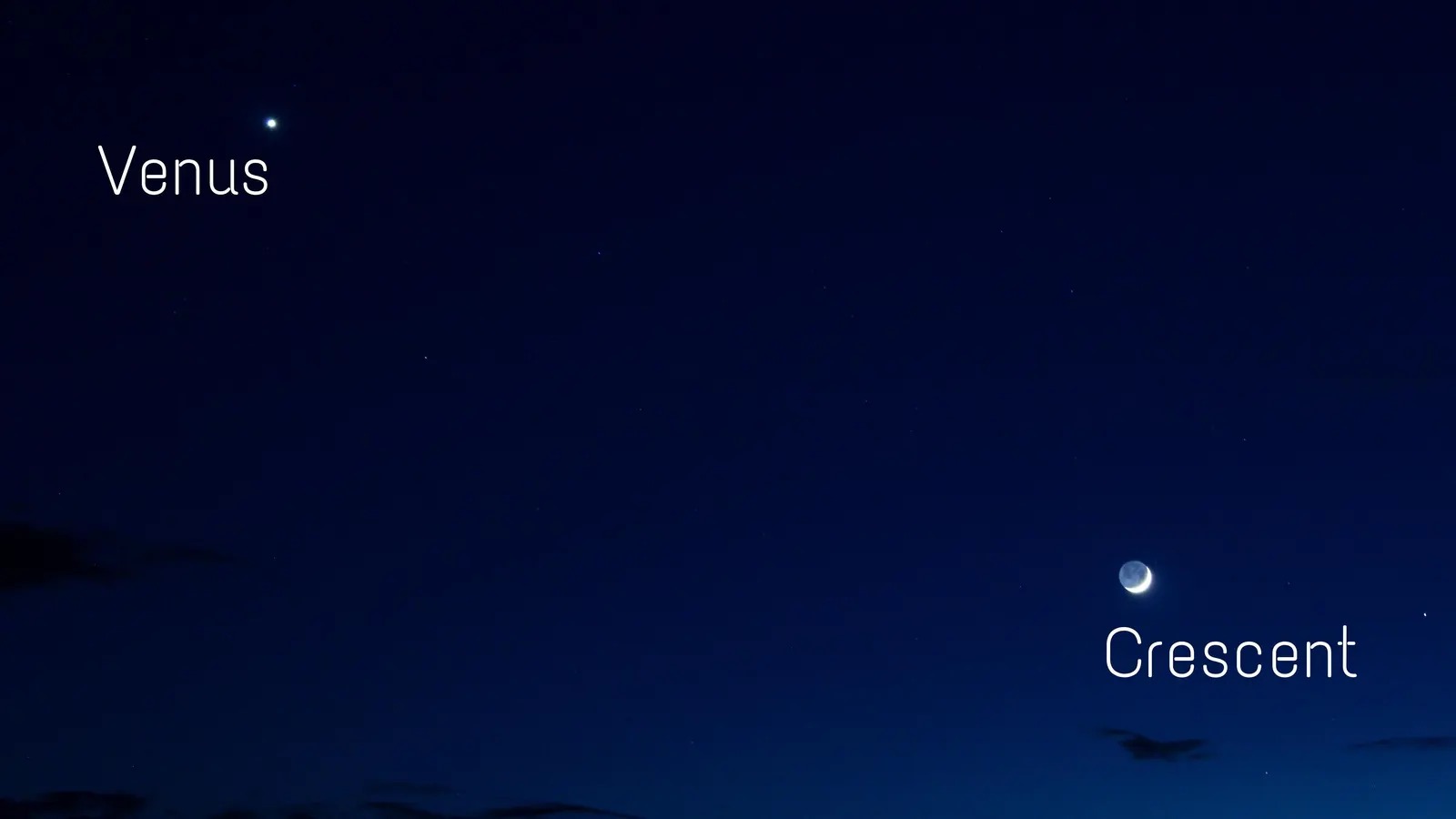
From 19 to 21 May 2026, Indian skywatchers will see a stunning celestial trio as the crescent Moon, Venus and Jupiter gather in the evening sky. The peak viewing night is 20 May, when the Moon will sit between dazzling Venus and bright Jupiter after sunset, creating one of the most photogenic sky events of the year.
On these evenings, you’ll be able to see the Moon and two brilliant “stars” – Venus and Jupiter close together with the naked eye. No telescope is needed, just clear weather and a reasonably open view of the western horizon. Astronomy forecasts show the Moon gliding past Venus on 19 May, sliding between Venus and Jupiter on 20 May, and moving nearer Jupiter on 21 May, while the planets head toward their tight conjunction on 9 June.
When And Where To Look In India
On 19–21 May, step outside about 30–60 minutes after sunset and face the west to west-southwest. On 19 May, look for a very thin crescent Moon near Venus, the brightest “star” low in the west. On 20 May, the Moon will appear between Venus and Jupiter, giving the classic Moon–Venus–Jupiter trio in a single frame. On 21 May, the Moon will be closer to Jupiter as the pair shifts higher and slightly eastward.
How To Watch Without A Telescope
All three objects are bright enough for naked-eye viewing even from Indian cities with moderate light pollution. Choose a terrace, rooftop or open ground with a clear western horizon and minimal obstruction from buildings and trees. Give your eyes 10–15 minutes to adjust to the dark. First find the crescent Moon; then look around it for the two bright, non-twinkling points of light – the lower one is usually Venus, the upper or slightly offset one is Jupiter. Binoculars will sharpen lunar detail and separate the planets from background stars, but they are optional.
Tips For Indian Skywatchers And Photographers
Check the local weather forecast; haze near the horizon can dim the view, so pick the clearest evening between 19 and 21 May. For smartphone photos, use night mode, rest the phone on a stable surface or tripod, and tap to focus on the Moon so Venus and Jupiter remain visible in the same shot. Astronomy apps like Stellarium or SkySafari can help you confirm the exact positions for your city and time.
Skywatcher Smart Highlights
- Best viewing window: 19–21 May 2026, about 30–60 minutes after sunset
- Peak trio night: 20 May, when the crescent Moon sits between Venus and Jupiter
- Look direction: West to west-southwest from rooftops or open grounds across India
- No telescope needed; binoculars and a tripod-mounted phone can enhance the experience
- Venus and Jupiter continue to draw closer toward a tight conjunction on 9 June 2026
Sources: SkyAtNightMagazine, MoneycontrolScience, NDTVScience, Astronomy.com, space-event calendars, social astronomy updates