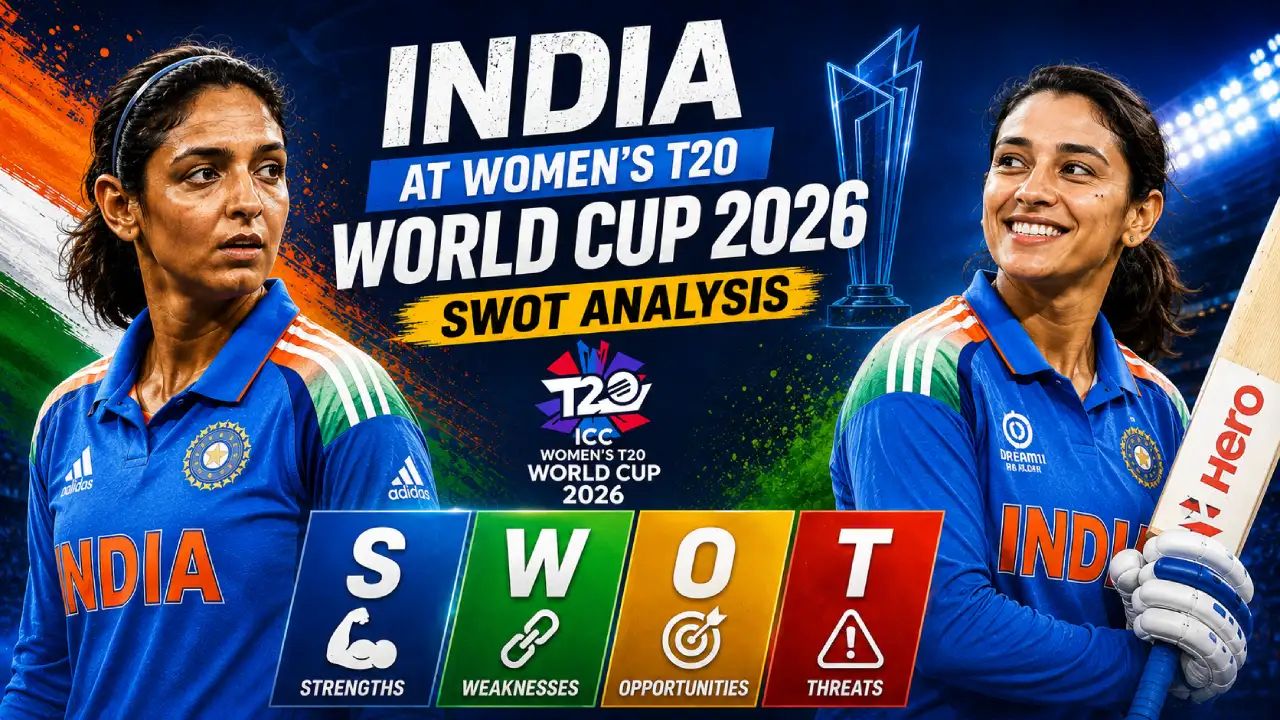
India's quest for a maiden title at the ICC Women's T20 World Cup 2026 in England faces headwinds. A SWOT analysis reveals that while a potent Mandhana-led top order stabilizes the team, recent series losses to England and South Africa expose middle-order flaws against elite seam bowling.
LONDON — The Board of Control for Cricket for India (BCCI) and the International Cricket Council (ICC) have finalized operations for the highly anticipated tenth edition of the ICC Women's T20 World Cup 2026. Scheduled to run from June 12 to July 5, 2026, across seven historic venues in England and Wales, the expanded 12-team tournament presents a formidable challenge for the India women's national cricket team. Led by veteran skipper Harmanpreet Kaur, India is seeking its maiden global T20 title. However, an authoritative Strengths, Weaknesses, Opportunities, and Threats (SWOT) analysis indicates that "Harmanpreet's Girls" face a complex, uphill path to the podium, punctuated by challenging English conditions and stiff Group A rivals, including six-time champions Australia and recent powerhouses South Africa.
Strengths: World-Class Top Order and Elite Spin All-Rounders
India’s primary tactical advantage lies in its explosive top-order batting unit and world-class spin-bowling all-rounders. The opening partnership of vice-captain Smriti Mandhana and the aggressive Shafali Verma remains one of the most feared pairs in international cricket, capable of maximizing the mandatory powerplay overs.
Complementing the top order is the exceptional tactical versatility of Deepti Sharma. Ranked among the premier all-rounders globally by the ICC, Sharma provides critical lower-order runs and defensive, economical off-spin. Alongside emerging slow-bowling talents like Shreyanka Patil and Radha Yadav, India possesses a highly technical spin department capable of suffocating opposing runs if pitches exhibit dry, turning characteristics later in the tournament.
Weaknesses: Middle-Order Instability and Recent Defeats
Despite individual brilliance, India's campaign is weighed down by structural inconsistencies. Chief among these is a highly volatile middle-order batting lineup. When Mandhana or Kaur fail to anchor the innings, the scoring rate frequently stagnates, placing immense pressure on lower-order power hitters like wicketkeeper-batsman Richa Ghosh.
Furthermore, India enters the tournament struggling for structural momentum. Official match data reveals a difficult preparatory phase on European and South African soil. In April 2026, India suffered a convincing 4–1 T20 international series defeat against South Africa. This was followed by a 2–1 T20 series loss away against England in early June. Just this week, on June 10, India lost its final official warm-up match against England by 5 runs at Sophia Gardens in Cardiff, highlighting ongoing vulnerabilities in chasing target metrics under pressure.
Opportunities: A Fresh Template and Enhanced Financial Incentives
The 2026 iteration offers India an ideal structural reset to shed its historic "choker" tag in ICC knockout matches. With the tournament expanding to 12 teams divided into two round-robin groups of six, India has ample opportunity to test line-up variations against lower-ranked group components like the Netherlands and Bangladesh before facing elite opposition.
Additionally, the governing council has injected unprecedented stakes into the tournament. The ICC has officially increased the total prize pool to $8.76 million—a 10% elevation from the 2024 edition. The tournament champions are guaranteed a minimum payout of $2.34 million, offering significant financial and professional validation for a squad aiming to inspire the next generation of domestic athletes.
Threats: Heavy Group A Architecture and English Seam Dynamics
The most immediate threat to India's progression is the highly condensed nature of Group A. To qualify for the semi-finals at The Oval, India must finish in the top two of a group containing:
Australia (defending multi-time champions)
South Africa (2024 finalists)
Pakistan (traditional high-stakes rivals)
Bangladesh
Netherlands
Furthermore, meteorological and soil conditions in England during June present a stark structural contrast to subcontinental wickets. Early-summer English pitches traditionally favor seam, swing, and pronounced bounce. Aside from right-arm medium-pacer Renuka Singh, India's seam-bowling department lacks established depth, leaving the squad exposed against elite pace attacks on green tops at venues like Lord's and Headingley.
Official Sources Section
According to official team filings managed by the BCCI and scheduling frameworks released by the ICC, India will officially open its Group A campaign against Pakistan on June 14, 2026, at the Edgbaston Cricket Ground in Birmingham. Subsequent group stage fixtures are slated for Headingley in Leeds, Old Trafford in Manchester, and Lord's in London.
Quote Section
"We have reviewed our recent bilateral outings in South Africa and England to identify the precise technical interventions required for our batting depth," stated national selection officials via an administrative release. "The squad is fully aware of the distinct nature of playing an extended round-robin in English conditions. Our focus remains on tactical consistency from the opening delivery at Edgbaston."
Why It Matters
For cricket consumers, corporate sponsors, and broadcasting investors across the subcontinent, India's performance carries immense commercial weight. A successful tournament run would exponentially boost domestic viewership metrics on streaming platforms like JioHotstar and linear channels like Star Sports. Conversely, an early group-stage exit would disrupt corporate ad-spend valuations and slow down the commercial momentum generated by the domestic Women's Premier League (WPL).
Key Facts at a Glance
Tournament Timeline: June 12 to July 5, 2026, across seven venues in England and Wales, concluding with the Final at Lord's Cricket Ground.
Expanded Competition: Features a record 12 international teams competing in 33 total tournament matches.
Prize Purse: Total pool allocated at $8.76 million, with the tournament winners securing $2.34 million.
India's Opening Fixture: India vs. Pakistan, Group A, scheduled for June 14, 2026, at Edgbaston, Birmingham.
FAQ Section
When does India play its first match at the Women's T20 World Cup 2026?
India plays its opening group stage match against Pakistan on June 14, 2026, at Edgbaston in Birmingham.
Which teams are in India's group for the tournament?
India is placed in Group A alongside six-time champions Australia, South Africa, Pakistan, Bangladesh, and the Netherlands.
Where can fans in India watch the live broadcast of the tournament?
Official broadcasting and distribution rights are shared across Star Sports network channels and digital streaming platforms including JioHotstar and Airtel Xstream Play.
Source: Official Tournament Operational Frameworks via ICC Cricket, National Selection Briefings via BCCI India.