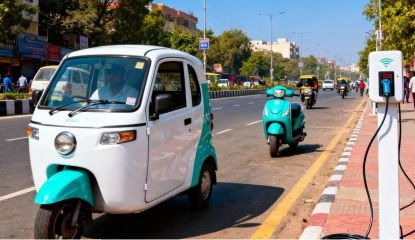
Auto-rickshaw unions in New Delhi have strongly criticized the newly approved Delhi EV Policy 2026–2030. While the regulation mandates an absolute transition to electric three-wheelers by January 2027, operators warn that a lack of targeted financing and an inadequate charging network will burden drivers with steep out-of-pocket costs.
NEW DELHI — Auto-rickshaw driver unions in the national capital have raised collective objections against the newly approved Delhi Electric Vehicle (EV) Policy 2026–2030, warning that the regulations will severely impact the livelihoods of thousands of low-income transport operators. Approved on Monday by the state cabinet under Chief Minister Rekha Gupta, the ₹15,000 crore mobility blueprint introduces a total registration ban on new internal combustion engine (ICE) and compressed natural gas (CNG) three-wheelers starting January 1, 2027. Representing the frontline workforce of Delhi's last-mile transit matrix, union leaders argue that forcing a rapid technological transition within less than eight months will trigger an acute financial crisis for individual drivers.
Financial Gaps and Declining Subsidy Architecture
The primary point of friction raised by the transport unions centers around the steep upfront procurement cost of electric three-wheelers compared to standard CNG equivalents. According to statement frameworks released by joint auto rickshaw federations in New Delhi, drivers face an additional financial burden of up to ₹80,000 per vehicle when migrating to zero-emission platforms.
While the Delhi government’s approved strategy offers a direct purchase subsidy of ₹50,000 for electric three-wheelers during the first year of implementation, the policy structure dictates that this fiscal support will systematically reduce over time. The subsidy is scheduled to drop to ₹40,000 in the second year and taper down to ₹30,000 in the third year.
Legal and financial analysts tracking the transition point out a core contradiction within the policy design: the government is mandating the strict enforcement of an absolute registration ban precisely as it scales back direct fiscal purchase assistance. Furthermore, the lack of targeted interest subventions, low-interest micro-loans, or sovereign credit guarantees creates a deep funding bottleneck for a demographic that largely operates outside traditional corporate banking loops.
Infrastructure Deficits and Operational Downtime
Beyond capital acquisition costs, drivers are voicing concerns over the city's operational readiness to support full-scale public transport electrification. Union representatives highlighted that a conventional CNG auto-rickshaw can replenish its fuel tank within five to ten minutes at existing retail pumps, enabling continuous double-shift operations.
Conversely, standard commercial electric three-wheelers require multi-hour charging durations, resulting in significant operational downtime that directly reduces daily wage potential. Although the policy outlines the deployment of 32,000 localized charging points across the National Capital Territory (NCT), unions maintain that the current geographical distribution of high-voltage rapid charging docks remains heavily concentrated in premium commercial districts rather than outer-ring industrial hubs and residential colonies where fleet operators reside.
The policy also introduces strict regulatory interventions for battery-powered transport:
Registration Ceilings: The transport department plans to formalize a definitive cap of 2.5 lakh vehicles on total e-rickshaw registrations to curb urban traffic bottlenecks.
Compliance Certification: All active three-wheelers will be legally required to secure an official E-rickshaw Compliance Certificate (ECC) verifying systemic fitness metrics.
Local Identity Mandates: Registrations will be restricted exclusively to permanent Delhi residents holding a singular, endorsed commercial driving license.
Official Sources Section
The official policy parameters, incentive outlays, and vehicle registration timelines are administered under the joint jurisdiction of the Delhi Transport Department and the Ministry of Road Transport and Highways. Sectoral infrastructure targets and funding metrics are coordinated via notifications published by the Press Information Bureau (PIB).
Quote Section
"For thousands of auto-rickshaw drivers, the city's new electric vehicle policy is not just about cleaner mobility; it could mean spending nearly ₹80,000 more to purchase a vehicle, while navigating an ecosystem that many believe is not yet ready," representatives from regional auto unions stated following the Cabinet briefing. "The draft policy asks the market to comply most rigorously just as it withdraws the most support. Without direct financing mechanisms, the mandate risks harming the drivers."
Why It Matters
Auto-rickshaws provide an essential, affordable public transit layer for millions of daily commuters navigating Delhi’s dense urban landscape. If the capital requirements for vehicle acquisition become too expensive for standard operators, it could cause a sharp contraction in the active driver pool, leading to higher passenger fares and longer wait times. For the automotive industry, the policy forces high manufacturing volumes toward pure electric drivetrains while excluding conventional hybrid technologies from receiving municipal tax relief.
Key Facts at a Glance
Absolute Deadline: Effective January 1, 2027, Delhi will permanently halt all fresh registrations for non-electric three-wheelers.
The Cost Variance: Individual drivers face an estimated capital shortfall of up to ₹80,000 per unit under the new guidelines.
Tapering Incentives: The three-wheeler purchase subsidy begins at ₹50,000 in Year 1, decreasing sequentially to ₹40,000 and ₹30,000.
E-Rickshaw Ceiling: Structural guidelines propose a strict macro limit of 2.5 lakh total registered units across the capital.
FAQ Section
When does the registration ban on petrol and CNG auto-rickshaws take effect?
According to the approved cabinet layout, the registration of new non-electric three-wheelers will be entirely phased out starting January 1, 2027.
What financial assistance does the Delhi EV Policy 2026 provide for buyers?
Three-wheeler buyers can access a performance subsidy of ₹50,000 in the first year of implementation. Scrapping an older, below-standard vehicle unlocks an additional scrappage benefit of up to ₹25,000.
Why are transport unions opposing the clean energy transition?
Unions are not opposed to clean air but object to the steep, unfinanced transition costs, the gradual tapering of government subsidies, and the lack of comprehensive fast-charging grids across the city.
Source: Delhi Transport Department, Press Information Bureau, The New Indian Express State Desk.