The Delhi government has ordered state-run schools to identify and counsel students who have failed Class 9 multiple times. Aimed at preventing dropouts, the directive introduces non-judgmental counseling and an alternative path to Class 10 through the NIOS program, allowing flexible subject choices and guaranteed re-entry to mainstream Class 11.
NEW DELHI — In a major policy intervention targeting academic retention, the Delhi government has ordered all state-run schools to identify, trace, and counsel students who have failed Class 9 two or more times. The fresh mandate, issued by the Directorate of Education (DoE) following the declaration of the Class 9 compartment examination results, aims to create an academic safety net. By providing a combination of specialized emotional guidance and direct enrollment into the National Institute of Open Schooling (NIOS), education authorities are attempting to arrest a quiet but massive spike in student dropouts at this specific academic stage.
Delhi Targets Class 9 Friction Point to Keep Students Enrolled
The transition into high school has emerged as a significant structural hurdle within the local school system. According to official data from the Delhi Directorate of Education, Class 9 has seen an unprecedented volume of academic setbacks. Annual failures in this grade climbed from 31,541 in the 2020–21 session to a staggering peak of 101,344 in 2023–24, before partially moderating to 70,296. In the 2023–24 academic term alone, 17,308 individuals failed the grade for a second consecutive time.
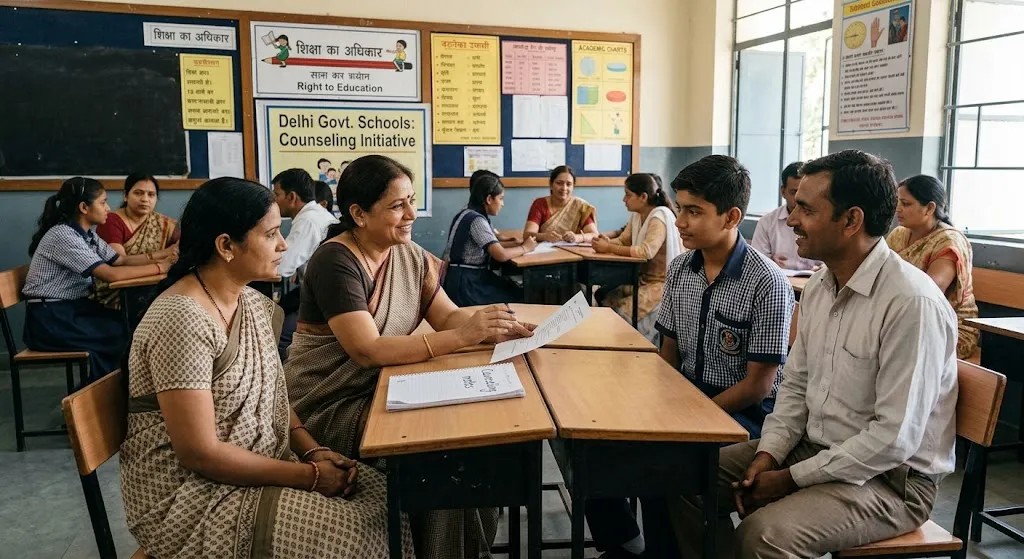
Educational experts state that the abrupt shift from the "no-detention" policy of primary schooling to strict, formal examinations in Class 9 frequently overwhelms underprepared students. Under the new directive, institutional heads must compile comprehensive registries of these repeaters. School administrators are required to personally invite these children and their parents to campus for structured, non-judgmental counselling sessions designed to restore academic confidence.
The NIOS Pathway: A Second Chance Without Losing an Academic Year
For families or students who feel alienated by traditional, rigid classrooms or who are eager to obtain a School Leaving Certificate (SLC), the DoE has formalized a seamless transition route into the open schooling network.
The circular dictates that if a family is hesitant to repeat the grade in a conventional environment, administrators must guide them toward immediate registration in Class 10 under the National Institute of Open Schooling. This project acts as a strategic bridge rather than a terminal exit. It allows students to study at their own pace, select subjects suited to their functional strengths, and completely bypass traditionally high-barrier subjects.
Critical Subject Relief: School principals have been specifically instructed to notify anxious parents that rigorous subjects like Mathematics are not compulsory under the NIOS model. Students can substitute them with lighter, vocational, or interest-driven alternatives.
Re-Entry and Mainstream Integration Assured
A recurring concern among parents has been that adopting an open schooling path might permanently banish children from the traditional system. To counter this, the government has explicitly clarified that any student who clears their Class 10 certifications via the NIOS route will remain fully eligible for direct readmission into Class 11 within their original parent government school.
While the Government Schools Teachers’ Association has raised minor procedural concerns—urging the state to ensure that these re-entering students receive completely equal access to competitive Streams like Science and Commerce—the NIOS administration has formally reiterated that its secondary certificates carry equal weight, parity, and legal recognition across all Indian educational boards.
Official Sources Section
The implementation framework is driven strictly by institutional mandates:
The Directorate of Education (DoE), Delhi: Issued the central directive instructing all regional school heads to establish supportive, non-judgmental environments for repeaters.
The NIOS Project Administrative Circular: Detailed the academic provisions, subject exemptions, and chronological bridge options to protect students from losing a school year.
Quote Section
"According to officials from the Directorate of Education, the ultimate goal of this intervention is to ensure that all children complete, at least, their secondary school education and do not drop out of the system due to a temporary loss of motivation or a lack of institutional guidance."
Why It Matters
For citizens and parents in Delhi, this policy shifts the school system away from punitive detentions and toward constructive retention. By removing the immediate shame of repeating a grade multiple times, offering flexible non-mathematical subject options, and preserving a legal pathway back into regular public classrooms for Class 11, the initiative directly eases domestic financial anxieties, reduces adolescent emotional stress, and protects vulnerable demographics from falling entirely out of the formal economy.
Key Facts at a Glance
Target Group: Students registered in Delhi government schools who have failed Class 9 twice or thrice consecutively.
Core Action: Mandated face-to-face, non-judgmental academic and psychological counselling for both students and their guardians.
Alternative Route: Direct transition to Class 10 via the National Institute of Open Schooling (NIOS), preserving academic timelines.
Curriculum Flexibility: Hard subjects, including Mathematics, are made optional to lower the testing barrier.
Mainstream Bridge: Guaranteed eligibility for students to return to their parent public schools for regular Class 11 enrollment upon passing.
Frequently Asked Questions (FAQ)
1. Can a student who failed Class 9 go directly to Class 10 through NIOS?
Yes. The NIOS pathway allows students who have failed Class 9 multiple times to register directly for Class 10 examinations, enabling them to continue their educational journey without losing an additional year.
2. Is Mathematics compulsory if a student chooses the NIOS route?
No. The Directorate of Education has explicitly noted that difficult subjects like Mathematics are not mandatory under the NIOS project framework. Students can choose lighter or alternative subjects based on their personal aptitudes.
3. Will my child be allowed back into a regular government school later?
Yes. The fresh guidelines clearly state that any student who successfully clears their Class 10 credentials through the NIOS alternative remains fully eligible for admission into Class 11 at their original parent government school.
4. What happens during the school counselling sessions?
The sessions are designed to be entirely supportive and non-judgmental. School heads will evaluate the specific reasons behind the student's academic struggles, offer motivational guidance, outline flexible study options, and reassure parents of ongoing institutional backing.
Sources: Official Directives and Institutional Circulars via the Delhi Directorate of Education, Curriculum Guidelines from the National Institute of Open Schooling