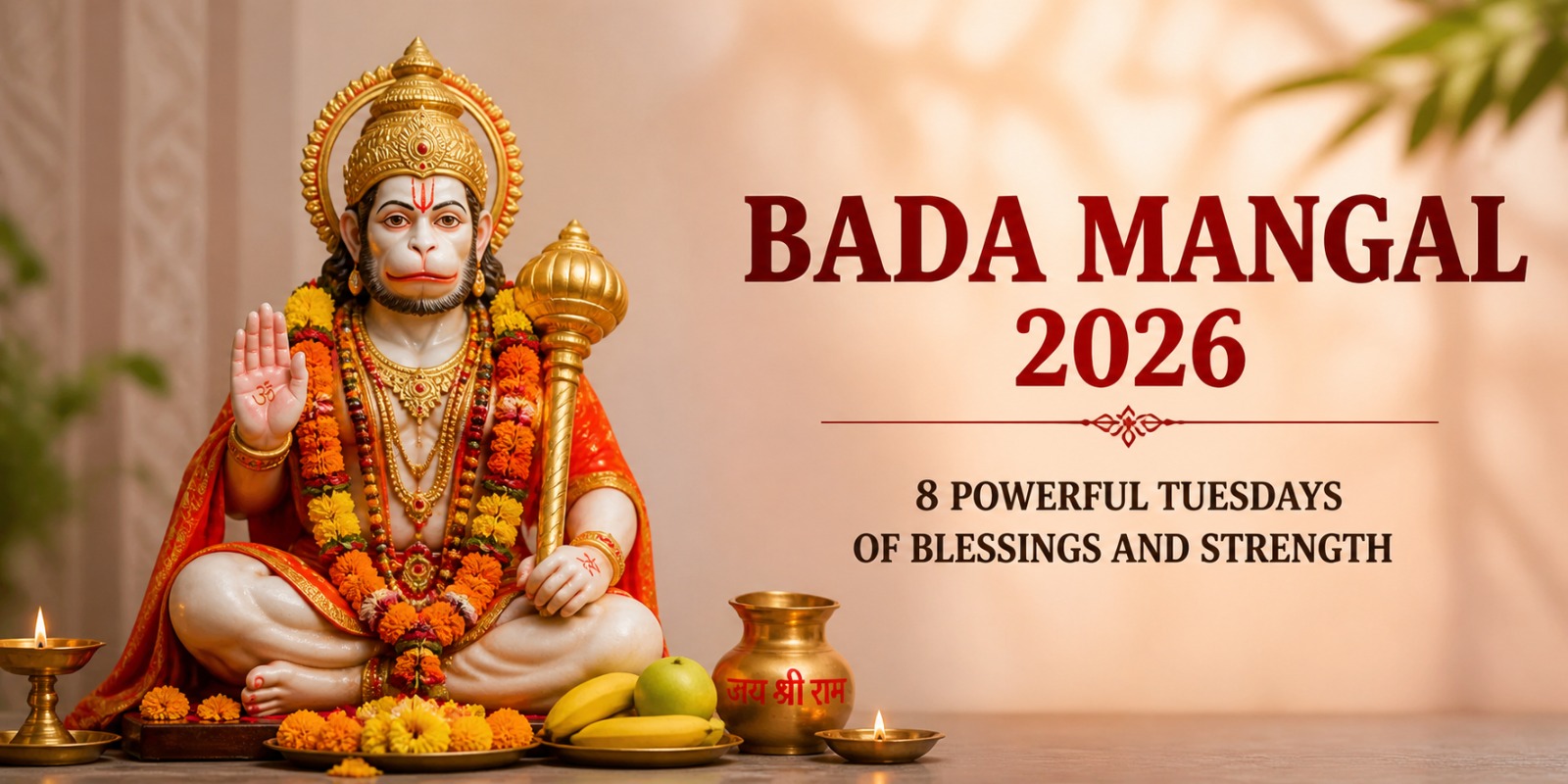
New Delhi will mark the final Tuesday of the historic eight-week Bada Mangal cycle with a unique 21-times Hanuman Chalisa collective recitation and live bhajan jamming session at Kamani Auditorium. The modern event aims to engage younger generations, using communal music to combat urban stress.
NEW DELHI — In a distinctive fusion of traditional Vedic ritual and contemporary youth culture, the National Capital is preparing to celebrate the final Bada Mangal of 2026 with a large-scale collective chanting and "bhajan jamming" assembly. The cultural event, scheduled for the evening of June 23, 2026, at the Kamani Auditorium in Mandi House, marks the culmination of a historically rare eight-week spiritual cycle dedicated to Lord Hanuman.
Collective Chanting and Interactive Musical Formats
Organized by the NKB Divine Meditation Foundation, the concluding celebration is anchored around a continuous 21-times collective recitation of the Hanuman Chalisa. While Bada Mangal historically observed primarily across Uttar Pradesh and the Delhi-NCR belt traditionally focuses on stationary temple darshans and community kitchens (bhandaras), this year's closing event introduces a modern, participative musical framework.
The integration of "bhajan jamming" incorporates high-fidelity acoustics, rhythmic orchestration, and interactive vocal choruses. According to event coordinators, the structured setup aims to shift public worship from a passive listening format into a shared experiential energetic space. The initiative reacts directly to a broader domestic trend where classic devotional compositions are being re-arranged musically to appeal to modern urban populations.
Calendar Anomalies and the Historic Eight-Week Cycle
The upcoming June 23 assembly carries deep significance for regional observers due to a rare astronomical misalignment in the Hindu lunar calendar. Standard iterations of the holy month of Jyeshtha typically produce only four or five Bada Mangal Tuesdays. However, the 2026 calendar incorporates an interlocking Adhik Maas (an extra lunar intercalary correction month), stretching the Jyeshtha timeframe and yielding an unusual total of eight Bada Mangal occurrences.
Historically, the root of Bada Mangal—colloquially termed Budhwa Mangal—stems from ancient literature. Sacred traditions hold that Jyeshtha Tuesdays mark the precise historical timeline when Lord Hanuman initially met Lord Ram in the wilderness. A secondary epic narrative from the Mahabharata states that on this specific seasonal day, Hanuman took the physical form of an aging, fragile monkey to humble the physical pride of Bhima, thus cementing the "Budhwa" (elderly) title.
Addressing Mental Fatigue Across Younger Demographics
Beyond its purely theological framework, the foundation managing the Mandi House assembly is positioning collective chanting as an accessible remedy for modern psychological stresses. The programming is deliberately designed to connect with Gen Z and millennial corporate workforces who routinely confront chronic anxiety, isolation, and digital burnout inside the metropolitan Capital.
By transforming standard temple rituals into an open, welcoming musical community forum, organizers hope to demonstrate that ancient practices can be highly practical tools for emotional balance and group solidarity. To maximize public access during the sweltering summer heat, Delhi’s administrative transportation hubs have confirmed smooth infrastructure connectivity, with the Mandi House metro station serving as the primary transit point for inbound crowds.
Official Sources Section
The logistical schedules, venue configurations, structural dates, and historical frameworks utilized across this report have been verified through official event press listings distributed by the NKB Divine Meditation Foundation alongside pan-Indian calendar metrics cataloged within The Economic Times Astrology Archive.
Quote Section
"The thought behind this initiative is simple yet profound: to create a spiritual space where people of all age groups can come together and experience the transformative power of collective chanting," stated Rahul Verma, founder of the NKB Divine Meditation Foundation. "We have placed a special emphasis on engaging Gen Z and younger audiences, presenting devotion not as a ritual of the past, but as a living, vibrant experience that nourishes the mind and soul."
Why It Matters
For regular citizens and local community members, the evolution of old festivals into modern, interactive public gatherings creates an open door for civic participation. By shifting focus away from rigid, mandatory rituals toward inclusive, artistic expressions, these modernized festivals preserve local heritage while building strong social safety nets and a sense of shared belonging across diverse generations.
Key Facts at a Glance
Event Location: Kamani Auditorium, Mandi House, New Delhi.
Core Activity: 21-times continuous Hanuman Chalisa recitation paired with live bhajan jamming.
Calendar Highlight: Concludes a historic 8-week extended Bada Mangal cycle caused by the Adhik Maas lunar correction.
Primary Target Audience: Designed explicitly to foster cross-generational unity among urban youth and elder devotees.
FAQ Section
Why is Bada Mangal celebrated on such a large scale in North India?
Bada Mangal honors the historic time Lord Hanuman first met Lord Ram, as well as his subduing of Bhima's pride. It is traditionally observed across Lucknow and Delhi through massive charity setups, free food kitchens (bhandaras), and community water stations (pyraus) to support citizens in the peak summer heat.
What makes the 2026 Bada Mangal cycle different from past years?
Most years only have four or five Bada Mangal Tuesdays. Because 2026 features an Adhik Maas (an extra month added to align the lunar and solar calendars), the holy month of Jyeshtha has been extended to include eight distinct Tuesdays.
How can the general public attend the Mandi House bhajan jamming event?
The event will run live from 6:00 PM to 9:00 PM on Tuesday, June 23, at the Kamani Auditorium. It is fully open to public attendees, with the nearest transit point being the Mandi House Metro Station on the Blue and Violet lines.
Source: Hindustan Times City Junction Records, Vedic Panchang Astronomical Logs 2026.