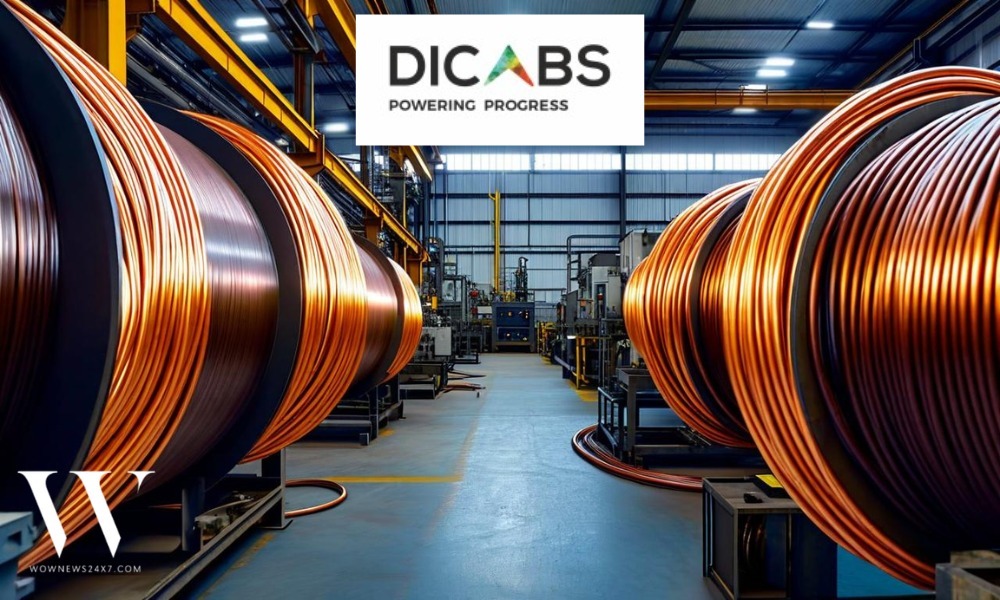
Diamond Power Infrastructure Limited's Board of Directors has approved raising up to ₹20 billion via a Qualified Institutions Placement (QIP). This decision doubles a previous fund-raising limit of ₹10 billion, with the capital set to optimize working capital and accelerate the production of high-voltage transmission cables and conductors.
VADODARA — The Board of Directors of Diamond Power Infrastructure Limited (NSE: DIACABS) has formally approved a proposal to raise capital through the issuance of securities up to an aggregate limit of ₹20 billion ($240 million). According to a regulatory disclosure filed under SEBI Listing Regulations on June 18, 2026, the fundraise will be executed via a Qualified Institutions Placement (QIP). This milestone board decision effectively doubles the company’s previously authorized capital ceiling to fund large-scale grid electrification contracts.
Strategic Shift to Meet Growing Infrastructure Backlogs
The capital enhancement resolution was finalized during an executive session convened at the company's corporate headquarters in Gujarat. Under Chapter VI of the SEBI (Issue of Capital and Disclosure Requirements) Regulations, 2018, the management secured approval to issue equity shares, convertible debentures, or eligible senior non-convertible securities to Qualified Institutional Buyers (QIBs).
This institutional choice completely replaces a previous fundraising threshold capped at ₹10 billion. The corporate treasury aims to capitalize on an extensive pipeline of grid modernization contracts. Over the past several quarters, the specialty equipment manufacturer has secured multiple heavy supply commitments, including a ₹1.01 billion cable contract from Adani Electricity Mumbai and a significant conductor line allocation for the Khavda renewable energy project in Gujarat.
Surging Financial Trajectory Backs Expansion Strategy
The board's aggressive decision to unlock fresh institutional capital lines is supported by strong financial performance recorded across recent audit terms. For the financial year ended March 31, 2026, Diamond Power Infrastructure reported a major net profit expansion, driven by optimized cost efficiencies and a broader domestic product mix.
Concurrently, the manufacturing entity has ramped up its technical infrastructure, commissioning its eighth high-voltage continuous vulcanization (CCV) cable production line at its central Vadodara complex. Financial analysts note that the incoming institutional capital will play a critical role in easing working capital intensity. The funds will help purchase essential raw polymer and metals while protecting overall profit margins from the short-term volatility of international aluminum and copper pricing indexes.
Market Parameters and Equity Allocation Safeguards
For retail market participants, mutual fund trust managers, and stock exchange short-term traders, the expanded placement limit shifts short-term valuation variables. Prior to this regulatory filing, the corporation held an estimated market capitalization of ₹10,653 crore on domestic exchange boards.
To ensure transparent compliance throughout the multi-stage funding cycle, corporate compliance officers implemented a strict trading window freeze for all designated insider networks on June 15, 2026. This window is mandated by SEBI guidelines to remain closed until 48 hours post-board outcome publication to preserve structural parity across public retail markets.
Furthermore, independent disclosure filings confirmed that the key promoter entity, Monarch Infraparks Private Limited, has maintained its core holdings completely clear of any external encumbrances, liens, or third-party debt pledges.
Official Sources Section
The underlying metrics, regulatory parameters, and timeline matrices detailed in this market coverage are compiled from formal regulatory disclosures submitted by the company's management. Original copies of the board outcome report are cataloged publicly on the National Stock Exchange of India (NSE) and BSE Limited. Historic corporate updates and performance tracking parameters remain accessible on the Diamond Power Infrastructure Investor Portal.
Quote Section
"According to officials from Diamond Power Infrastructure Limited’s compliance division, the expanded capital limit of ₹20 billion provides the corporate treasury with long-term flexibility to capture accelerating market demand. The regulatory team stated that expanding institutional capital lines ensures the enterprise can confidently fund high-voltage grid upgrades and execute multi-billion rupee EPC contracts without relying on expensive, high-interest commercial bank loans."
Why It Matters
The outcome of this QIP initiative highlights how crucial rapid capital generation is for manufacturing companies caught in a prolonged domestic infrastructure boom. By raising up to ₹20 billion entirely from institutional desks, Diamond Power secures the immediate cash injection required to execute massive infrastructure orders. This strategy allows the firm to scale its capacity ahead of slower tier-2 rivals while keeping its debt-to-equity ratios safe.
Key Facts at a Glance
Approved Funding Ceiling: Diamond Power’s board has authorized an updated fundraising limit of up to ₹20 billion.
Instrument Architecture: The capital will be raised through a Qualified Institutions Placement (QIP) under SEBI guidelines.
Historical Precedent: The fresh mandate doubles a previous funding authorization capped at ₹10 billion.
Infrastructure Target: Proceeds will clear working capital blocks to accelerate large-scale industrial cable and conductor supply deliveries.
FAQ Section
What is a Qualified Institutions Placement (QIP) and why do companies use it?
A QIP is a regulated capital-raising pathway that permits publicly listed Indian corporations to issue equity shares or convertible notes directly to pre-approved institutional buyers. This method avoids the lengthy review timelines typical of public rights issues.
Will this capital-raising move cause immediate equity dilution for small retail shareholders?
Yes. Issuing fresh equity shares through a QIP increases the total outstanding share volume, which can lead to a localized dilution of earnings per share (EPS) for existing retail investors.
When will the exact floor price for the upcoming QIP issue be determined?
The baseline floor price will be calculated mathematically using a SEBI-mandated formula based on the historical closing averages of the stock prior to the official opening date of the QIP.
Source: Statutory board resolution archives, regulatory filings, and index disclosure bulletins submitted to BSE India and the National Stock Exchange (NSE) by Diamond Power Infrastructure Limited.